A deployment card is the small note that travels inside a care package or shows up on its own, and it gets read far more often than anyone expects. These 12 quotes about military service for a deployment card are short enough to fit on a standard 5×7 card, written to be hand-lettered, and aimed at real relationships: a spouse, a parent, a grown child, a friend, an old buddy, a first sergeant.
None of them are borrowed from a famous speech or a novel, so there is no name to misattribute on a card a service member might tape inside a footlocker and keep for years. Pick the one that fits the person, write it neatly inside the card, then add one specific detail only you would know. Updated for 2026, and still the message people get stuck on is the same one: what do I actually say?
Table of Contents
- 1Quotes About Military Service for a Deployment Card at a Glance
- 2How to Choose Quotes About Military Service for a Deployment Card
- 31. Quiet Strength
- 42. Proudly Standing Beside You
- 53. Home Is Waiting
- 64. The Courage to Carry On
- 75. Service That Inspires
- 86. Grateful for Your Sacrifice
- 97. Safe Return, Always
- 108. Stronger Because You Serve
- 119. We See Your Service
- 1210. A Message of Honor
- 1311. You Are Not Alone
- 1412. Until You Are Home Again
- 15Frequently Asked Questions
- 16What is the best military service quote for a deployment card from a spouse?
- 17Which deployment card quote is most appropriate for a parent or grandparent?
- 18Should I include the service member’s branch, rank, or deployment location?
- 19How many words should I write inside a deployment card?
- 20Can I personalize these military service quotes before printing them?
- 21Final Card-Ready Choice
Quotes About Military Service for a Deployment Card at a Glance
Start with the relationship and the moment, not with the wording. The table below points each of the 12 quotes to the tone it does well and the card it fits best.
| Number and Theme | Core Message | Best Tone | Most Suitable Card Moment |
|---|---|---|---|
| 1. Quiet Strength | Service often looks like doing the hard thing without an audience | Restrained, sincere | For someone who dislikes big emotion in writing |
| 2. Proudly Standing Beside You | Our pride and faith travel with you | Warm, family-focused | Signed by parents, siblings, or the whole family |
| 3. Home Is Waiting | Distance makes home mean more | Tender, wistful | Leaving the family home for the first time |
| 4. The Courage to Carry On | Courage is continuing when the task gets difficult | Encouraging, steady | A card for someone facing a hard stretch |
| 5. Service That Inspires | Quiet courage and ordinary responsibility move us | Proud, respectful | A workplace or public tribute card |
| 6. Grateful for Your Sacrifice | We see the cost, even the parts we cannot see | Heartfelt, grateful | For a parent or grandparent writing to a child |
| 7. Safe Return, Always | You carry our hopes; we carry you | Loving, close | A partner or a very close family member |
| 8. Stronger Because You Serve | Discipline and purpose travel home with you | Affirming, forward-looking | Reenlistment, rotation end, coming home |
| 9. We See Your Service | Behind the rank is a person who answered | Formal, respectful | A unit, community, or veteran appreciation card |
| 10. A Message of Honor | Service means responsibility, leadership, honor | Formal, official | Addressed to a service member or a unit |
| 11. You Are Not Alone | Gratitude and memory close the distance | Versatile, warm | Almost any sender, any tone |
| 12. Until You Are Home Again | Steady road, clear purpose, grateful homecoming | Closing, ceremonial | The last line you write before they go |
How to Choose Quotes About Military Service for a Deployment Card
Match the message to the relationship first: a spouse gets tenderness, a parent gets pride, a friend gets something light, and a supervisor gets something formal. Next, check the space. A standard 5×7 folded card holds roughly 20 printed words comfortably in handwriting, so anything longer belongs on a separate letter. Then decide the tone you can actually pull off without feeling like a stranger wrote it. Sentimental, encouraging, or proud, pick the one that sounds like you on an ordinary Tuesday, not like a greeting card aisle. Finally, leave room for one personal line. A name, a nickname, a habit of theirs, or a date that means something to the two of you will carry more weight than any quote you choose.
1. Quiet Strength
Service does not always call for a victory speech; sometimes it looks like quietly doing the next hard thing with steady strength.
This one lands with people who flinch at ceremony. Plenty of service members would rather receive a card that sounds like an actual friend than a paragraph about destiny and eagles. It also works going the other direction, from a parent who is not comfortable declaring how proud they are out loud.
Written underneath, in smaller letters: You fixed that fence the whole summer without asking anyone for help. We noticed. Dad
2. Proudly Standing Beside You
While you serve with courage, we stand beside you with pride, love, and unwavering faith in your strength.
This is the family-signature card. It reads like something a mother, a father, or a whole sibling group would agree on, which is exactly why it works when more than one person is signing. The phrase about standing beside rather than in front of you keeps the tone equal.
Pair it with a signature line that names the signers: Signed by Mom, Dad, and the whole crew in Cedar Rapids
3. Home Is Waiting
Every mile between us makes home more meaningful, and every safe return makes our gratitude greater.
Use this when a service member is leaving the family home for the first time, or when home has a specific address everyone misses. It suits a spouse, a parent, or an adult child still living at home when the leave ends, and it stays hopeful without pretending the separation is easy.
A handwritten add-on that makes it personal: Counting days the way we used to count them before the first day of school. The porch light stays on.
4. The Courage to Carry On
Your courage is not the absence of fear; it is the steady choice to carry on when the task becomes difficult.
This is the encouraging card, for a rotation that has gone sideways or a person who has had a rough stretch and does not want to be asked about it. The wording gives them something to agree with without asking them to admit anything first.
Personalizing by branch or job without turning it into a stereotype: Same message whether you are stateside or forward. You called it in March, and here we are.
5. Service That Inspires
Your service reminds us that courage can be quiet, responsibility can be ordinary, and strength can be shown through dedication.
This version is built for public rooms. An office card, a school assembly, a community group, or a card signed by a whole team will usually have too many names for anything intimate. It praises the habit of showing up rather than a specific act, so nothing on the card depends on details of the deployment.
On a group card, keep the quote in the center and let the signatures run down the margin: From everyone at the [shop name] office, with genuine thanks
6. Grateful for Your Sacrifice
We may not understand every sacrifice you make, but we know that each one comes from a place of duty, courage, and love for others.
Parents and grandparents reach for this one because it names something they genuinely struggle with, which is not understanding the work. The admission in the first clause is what keeps it honest instead of flattering.
Keep the closing restrained so the card does not tip into melodrama. Sign simply: With love, always. Mom and Dad
7. Safe Return, Always
You carry our hopes toward safer ground; we carry your place in our hearts until you return.
Save this for a partner or the family member who shares a bed and a life, not for a card that will pass around an office. It is the most direct of the twelve about wanting someone back safely, and it is short enough to sit alone on a page with white space around it.
A clean layout: quote on the left-hand page, then on the right, in the corner, I love you. Come home. A
8. Stronger Because You Serve
You serve with discipline and purpose, and you return with a strength that reaches far beyond the uniform.
This suits a rotation ending, a reenlistment, or a return home after a long absence. It celebrates growth in the person rather than the uniform, which matters for younger service members who have not yet done anything they want pointed at.
A closing line for the card: Whatever you are planning next, do it the same way you did this. We will be here for that part too.
9. We See Your Service
Beyond the title on your uniform is a person who answered the call, accepted the responsibility, and chose to serve something greater.
Write this one for a formal card: a unit sending a note to a departing member, a veterans organization, a community group, or a workplace honoring someone on the way out. It reads as recognition without being a rank-and-file pep talk, which is exactly what a public card needs.
Address it plainly rather than warmly: Presented to [name], with the thanks of the [group] community.
10. A Message of Honor
To serve is to accept responsibility when others need strength, to lead when direction matters, and to return with honor when the work is done.
This is the most formal of the twelve, so it works where warmth would feel out of place. It fits a card from a commanding officer, a veterans hall, or a civic group, and it also works when the writer wants to be respectful rather than affectionate.
A military-addressed version keeps the structure intact: the quote, then Best of luck to you and your team, from [rank and name if you have it].
11. You Are Not Alone
Distance may separate us, but gratitude, memory, and affection keep you close wherever your duty leads.
This is the safe default when a relationship is hard to place, a cousin, an old teammate, an in-law who genuinely cares. It carries warmth without assuming a specific bond, and it survives being signed by two people who did not agree on anything else.
A nickname or one shared memory makes it unmistakably yours: Still thinking about that weekend at the lake and your terrible cast. Come back.
12. Until You Are Home Again
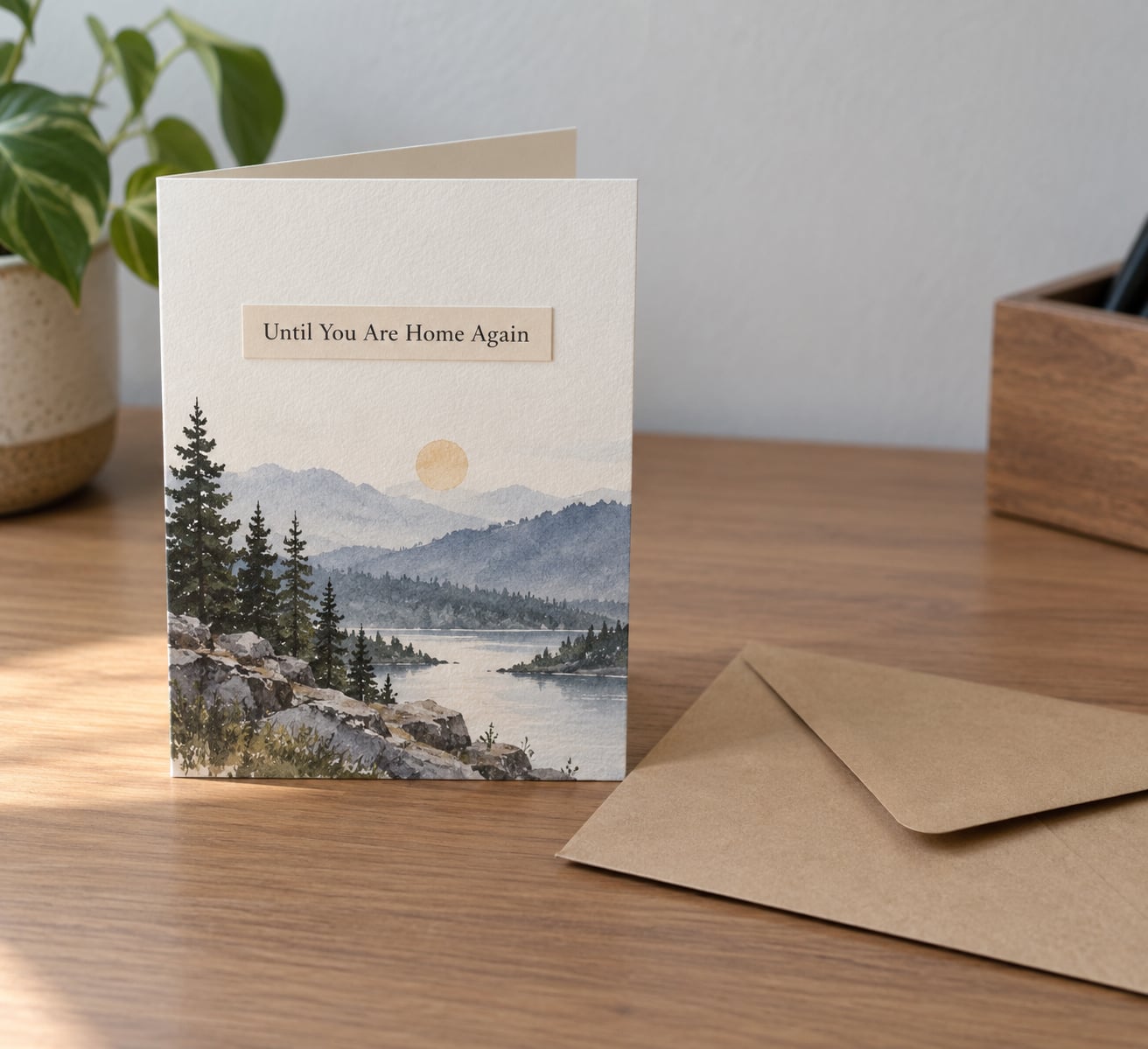
May your road be steady, your purpose remain clear, and your way home be filled with the gratitude of everyone who loves you.
Save this for the last message before someone leaves, when you want a ceremonial close that a reader can read out loud at a send-off without choking up halfway through. It is also the best of the twelve for a card signed by a large group, since it names everybody in the room at once.
A simple sign-off that closes it out: Until you are home. With all of us behind you.
Frequently Asked Questions
What is the best military service quote for a deployment card from a spouse?
Number 2 or number 7 usually works best from a spouse. Number 2 speaks to family pride and faith, which suits a card signed by several relatives, while number 7 is more intimate and reads like something between two people who share a life. Add one line only a spouse could write, such as a habit of theirs or a date you count down to.
Which deployment card quote is most appropriate for a parent or grandparent?
Number 3 and number 6 are the strongest choices. Number 3 centers on home and the address a family member is leaving, which suits anyone who left the family house for the first time. Number 6 admits that the family does not fully understand the work but is grateful for it, a sentiment many parents feel but hesitate to write down.
Should I include the service member’s branch, rank, or deployment location?
Branch and rank are fine to include in one short line because they are public and they make the card feel personal. A specific deployment location is a different matter, since locations are sometimes not confirmed in advance and service members are told to keep movements quiet. When in doubt, write branch only and let the recipient fill in the rest.
How many words should I write inside a deployment card?
Aim for about 20 words of quote plus two or three short handwritten lines. A standard 5×7 folded card holds roughly 20 printed words in comfortable handwriting, and anything longer starts to crowd the page or spill onto the envelope. If you want to say more, write a separate letter and let the card stay short enough to be read at a glance.
Can I personalize these military service quotes before printing them?
Personalize them by all means, and keep the quote itself intact so it stays recognizable. Add the recipient’s name, a nickname, a date that means something to you, or a line of your own handwriting underneath. What to avoid is swapping in invented famous-sounding attributions, since people put these on plaques and keepsakes and want them accurate later.
Final Card-Ready Choice
Choose the quote that best reflects the relationship you actually have with the person leaving, keep the printed wording short enough to fit inside a card without crowding it, and add one detail that no generic card could have included. Then write the whole thing by hand, even if your handwriting is bad. A slightly crooked line in a real pen is the part people keep. If you want a starting point, number 11 works for almost any sender, and number 2 works almost as often.