A good practice-room quote has one job: land in under three seconds every time you glance at it, and point at the thing that actually stalls you. Most music quote lists fail that test because they were written to be read once, not stared at five hundred times.
That is why the ten quotes below are organized by function rather than by author. Each one is paired with the exact moment it earns its place: the third hour of scales, the twenty minutes before a hard passage, the week your motivation quietly disappeared. Music teachers and students on r/MusicEd and r/musicians are blunt about this — the problem is rarely time, it is consistency, and vague uplift on the wall does not fix a consistency problem.
Every quotation here carries its speaker, and where the original source is hard to pin down, I say so rather than passing on a confident-looking attribution. People who read music quotes notice misattribution immediately, and a wall you have looked at for a year deserves better sourcing than a graphic you saved without checking.
Table of Contents
- 1Quotes About Music for a Practice Room at a Glance
- 21. A Beethoven Quote for Remembering Music’s Deeper Meaning
- 32. An Aristotle Quote for Building a Practice Habit
- 43. A Confucius Quote for Finding Joy in Musical Work
- 54. A Plato Quote for Listening Beneath the Notes
- 65. A Longfellow Quote for Music as a Shared Language
- 76. A Pablo Picasso Quote for Leaving Space for Expression
- 87. A Maria Callas Quote for Facing Demanding Material
- 98. A Duke Ellington Quote for Creating the Right Mood
- 109. A Michael Jordan Quote for Developing Through Repetition
- 1110. A Victor Hugo Quote for Staying Open to Inspiration
- 12Frequently Asked Questions
- 13What is the best quote to put on a music practice-room wall?
- 14How can I use music quotes to stay motivated when I practice?
- 15Which quote is best for musicians struggling with a difficult passage?
- 16Should a music quotation identify the composition it refers to?
- 17How do I turn an inspirational quote into a productive practice goal?
- 18Can music quotations replace technical drills or focused practice time?
Quotes About Music for a Practice Room at a Glance
The table below is the fast version: the line, who said it, what it is actually about, and which part of practice it speaks to. Pick from the last column, not from the first — that is the difference between a quote that helps and a quote that just looks good in a frame.
| Quotation | Credited speaker | Main idea | When it helps in practice |
|---|---|---|---|
| Music is a higher revelation than all wisdom and philosophy. | Ludwig van Beethoven | Meaning sits behind the notes | Repetitive scale and finger work |
| Music has the power of forming our character. | Aristotle | Repetition shapes the person doing it | The session you keep putting off |
| Music produces a kind of pleasure which human beings cannot do without. | Confucius | Music is a need, not a chore | Low-energy afternoons |
| Rhythm and harmony find their way into the inward places of the soul. | Plato | Playing reaches below technique | Slow tempo and sight-reading work |
| Music is the universal language of mankind. | Henry Wadsworth Longfellow | Music crosses the gap between people | Chamber and ensemble playing |
| Art is a lie that makes us understand truth. | Pablo Picasso | Fidelity is not the goal | A correct but lifeless take |
| Understand what you are saying and the tone will take care of itself. | Maria Callas | Words carry tone | Vocal and lyrical legato work |
| Music is the sound of feeling. | Duke Ellington | Mood decides the note | Phrasing, dynamics and articulation |
| I’ve missed more than 2,000 shots. I’ve failed over and over and over again in my life. And that is why I succeed. | Michael Jordan | Repetition outlives failure | The slow-progress plateau |
| Music expresses that which cannot be put into words and that which cannot remain silent. | Victor Hugo | Music carries what words cannot | Collecting ideas instead of waiting for them |
One sourcing caution before you print anything. Lines such as “Where words fail, music speaks” are pinned on Hans Christian Andersen constantly, but the story usually credited with it, “The Little Mermaid,” contains no such line, so treat it as unattributed. Ellington’s line in row eight is widely printed under his name without a traceable occasion. Print it, but print it as an Ellington line in wide circulation rather than as a dated, documented statement.
1. A Beethoven Quote for Remembering Music’s Deeper Meaning
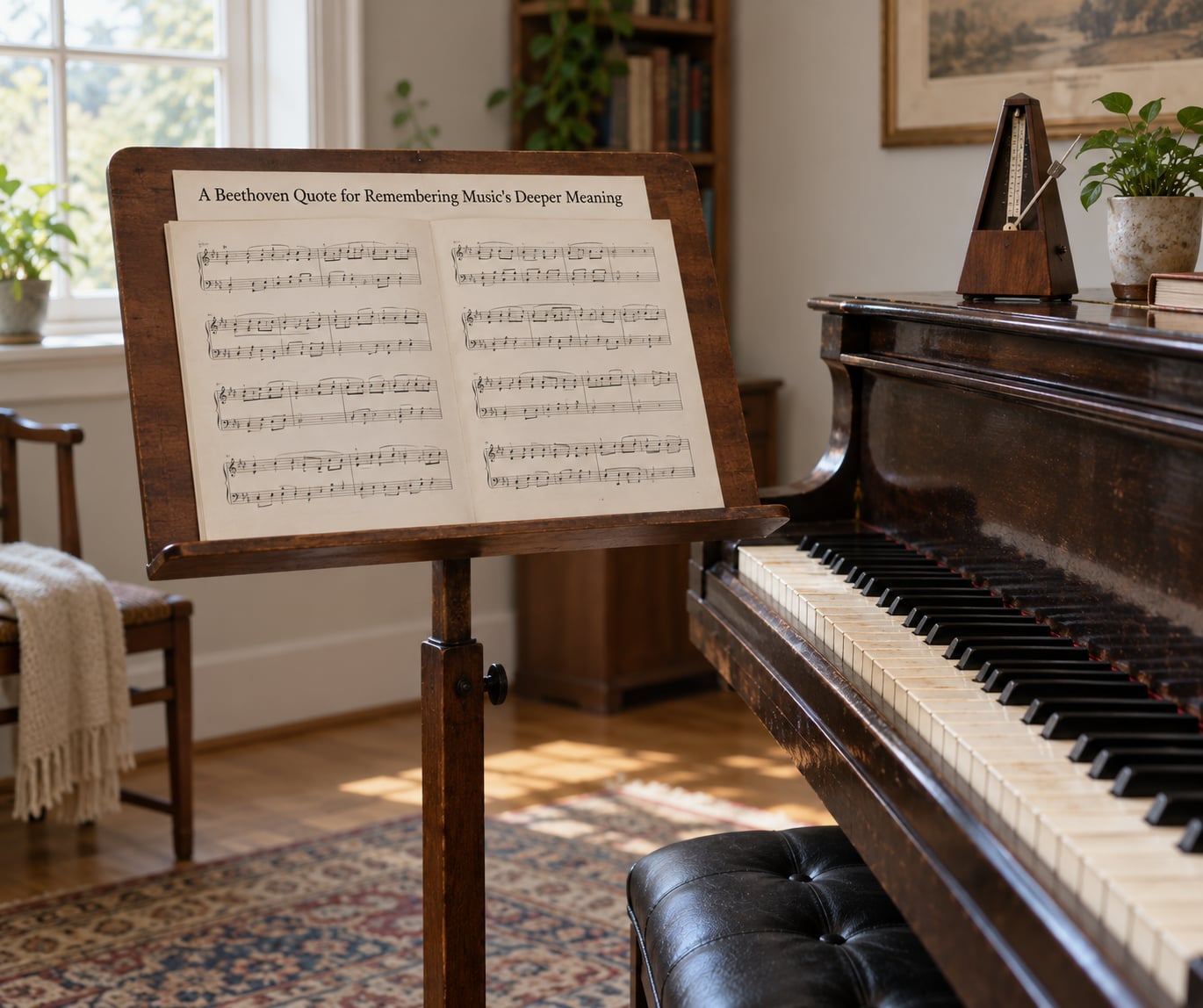
Music is a higher revelation than all wisdom and philosophy.
Beethoven’s line comes from conversations recorded by his student Ferdinand Ries and Czerny in the 1820s, which is about as close to his own words as a written source gets.
The reason it works during dull repetition is that it reframes what you are doing. Right hand thirds at 60 beats per minute, minute forty, do not feel like revelation. They feel like punishment you invented. A quotation like this one lets you hold two readings at once: the mechanical task and the thing the task is in service of.
Give it something to grip. Before you start the passage, pick one musical detail to listen for in your own playing — where the last note of a phrase releases, or whether the melody line stays on top through the sixteenth notes. Write it at the top of the page. Now the metronome is measuring that detail instead of measuring you.
2. An Aristotle Quote for Building a Practice Habit
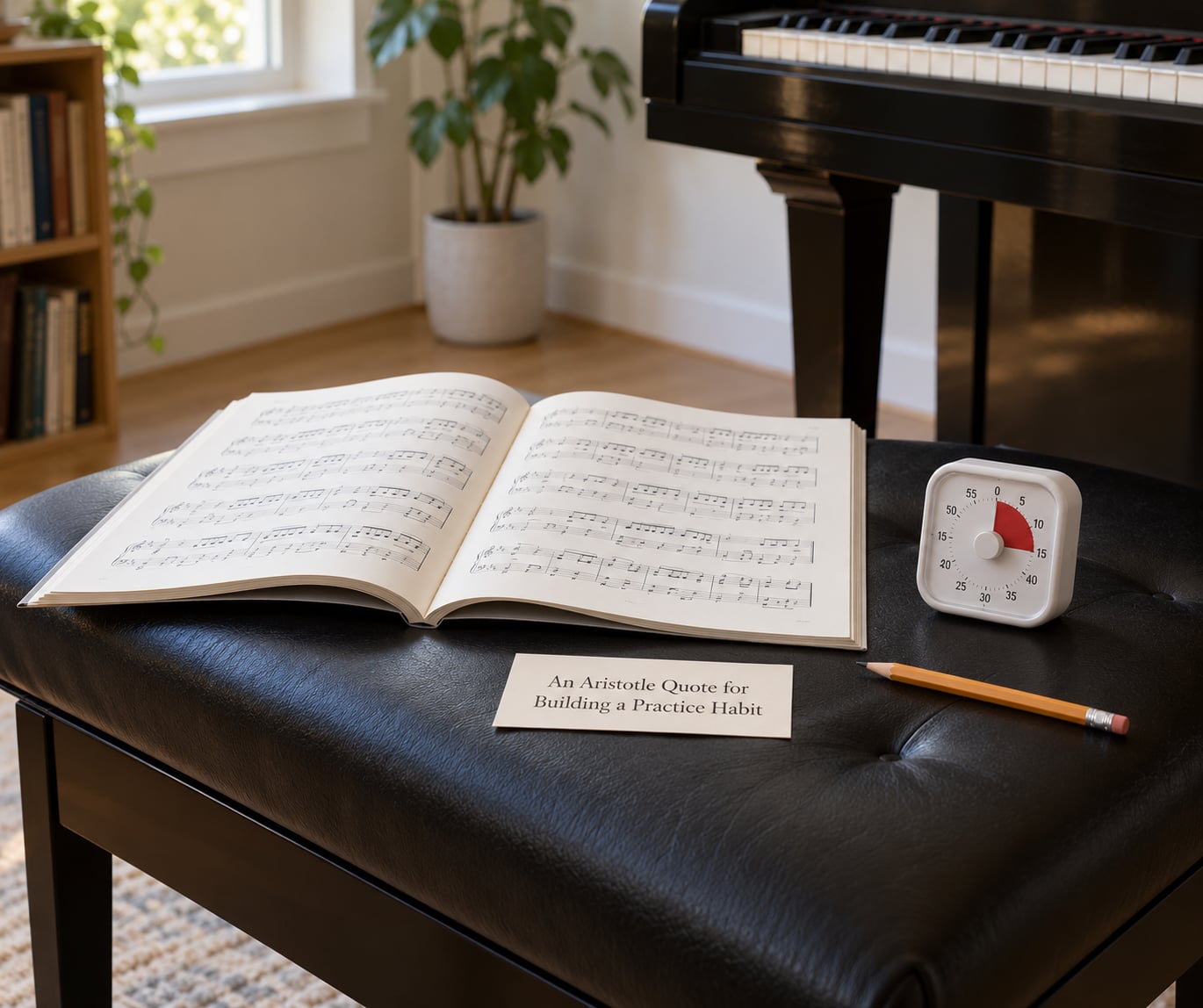
Music has the power of forming our character.
This one is from Aristotle’s Politics, Book VIII, in the discussion of how education shapes a person through habit rather than instruction. That distinction is the whole point for a practice room.
Nobody sits down intending to become more accurate at double thirds. The habit forms anyway, one unremarkable repetition at a time, and the character claim in that line is quietly accurate — what you do at 60 beats per minute for twenty minutes on a Tuesday is closer to who you are than what you tell yourself at 18.
Here is the twenty-minute version of a passage you avoid. Set a timer for 20 minutes, take the whole passage at half tempo, and stop the moment the timer goes even if it is still bad. Do it four days in a row. On Thursday you will not need the quote as much, which is a fine outcome.
3. A Confucius Quote for Finding Joy in Musical Work
Music produces a kind of pleasure which human beings cannot do without.
The line comes from The Book of Rites, in the chapter on music, where Confucius treats music as a human necessity rather than an ornament. Translated from the Chinese, it is a much warmer statement than most practice-room slogans.
Its value shows up on the days when practice feels punitive. If music is a pleasure people genuinely cannot do without, then a session where nothing is enjoyable is not discipline, it is a badly designed session. That is a reframe you can act on within a minute.
So name it. Write down the one thing in your practice that you would do even if nobody heard you: the étude you love, the slow session after dinner, the hour on the guitar with no recording gear in sight. Put that sentence on the wall instead of a slogan, and put it where you see it before you sit down, not after you have already decided the day is ruined.
4. A Plato Quote for Listening Beneath the Notes
Rhythm and harmony find their way into the inward places of the soul.
Plato says this in the Republic, describing education through music, and it is the line most often used to argue for playing under the notes rather than chasing them.
That distinction matters, because the two look identical from the outside. Reading from the page at sight-reading tempo is not listening; it is pattern-matching with your eyes. Playing from memory, ears open, following the harmonic motion, is listening. Same hour, completely different activity, and the difference shows up within weeks.
Try a five-minute version. Play eight bars twice: first pass, hum the line while you play and notice every place where your hum and your fingers disagree. Second pass, keep humming and slow down only where you disagreed. It is uncomfortable for about a week, then it starts sounding like music instead of arithmetic.
5. A Longfellow Quote for Music as a Shared Language
Music is the universal language of mankind.
Longfellow wrote it in The Poetic Fire in the middle of the nineteenth century, and it has outlived dozens of flashier lines because it is genuinely useful to anyone who rehearses with other people.
Duets and chamber groups fail on communication far more often than they fail on technique. Everyone plays their part perfectly and the group still sounds like four people rather than one. A line about shared language pushes you to listen outward — to blend, to match, to notice where the balance sits.
Write one shared goal with the person you rehearse with, and keep it specific enough to check: unison at the start of every phrase, or the third beat of every bar landing together, or matching the release at the end of the line. Then play the piece and see whether you both heard it. This is the fastest fix available for a group that is technically ready and still does not click.
6. A Pablo Picasso Quote for Leaving Space for Expression
Art is a lie that makes us understand truth.
This one is widely attributed to Picasso, though the specific occasion is not clearly documented, so it belongs on a wall as a shared line of thinking rather than as a dated statement. It says something genuinely useful about music, which almost no music quote does.
Playing a passage accurately is the floor, not the ceiling. A student can play a nocturne with not one wrong note and still leave the room with nothing, because accuracy was the only instruction given and the only instruction followed.
Take one passage you know by heart and play it three ways: exactly as written, then with a deliberate rubato in one phrase, then with the melody pushed forward and the accompaniment pulled back. Fifteen minutes total. Keep the version that made you wince slightly — that is usually the one with something in it. Write the time difference between them in your practice notes, not just the number of correct notes.
7. A Maria Callas Quote for Facing Demanding Material
Understand what you are saying and the tone will take care of itself.
This line appears in transcripts of Callas’s 1977 master class at the Juilliard School, which is a published record rather than an unsourced internet line. I would check it against the transcript before commissioning it on a large sign — it is a good example of how even a real speaker’s words get loosened in circulation.
The advice is disarmingly practical. If you know what the text means and where the sentence wants to go, tone stops being a separate technical problem to solve on top of the notes.
For the passage you have been avoiding, split it into tasks small enough to finish. Eight bars, one dynamic mark, one breath, one fingering. Do only the first task in the first session, and write down what is now possible that was not possible last week. The intimidation usually comes from the size of the imagined task, not from the difficulty of any single bar, and this is the quote to have on the wall for the weeks when that imagined task is at its loudest.
8. A Duke Ellington Quote for Creating the Right Mood
Music is the sound of feeling.
Ellington is credited with this line across decades of collections, though again the original occasion is hard to pin down. It has survived because it names the practical job that sits underneath articulation, dynamics and phrasing.
Every note has three jobs: pitch, length, and loudness. Beginners put almost all their attention on the first and treat the other two as leftovers. Mood lives entirely in the second and third, which is why the same passage can be technically flawless and emotionally flat.
Do this as a listen-play-adjust loop. Play four bars, then stop and describe the mood in one word. Play them again trying to make the word true, and change one thing only — weight on the first note, or how long you hold the release. Adjust, describe again. Three rounds takes about six minutes, and the word you keep landing on is usually the emotion the piece actually wants, which may not be the one you assumed when you started.
9. A Michael Jordan Quote for Developing Through Repetition
I’ve missed more than 2,000 shots. I’ve failed over and over and over again in my life. And that is why I succeed.
Jordan said this in interview and campaign material that circulated widely in the 1990s. Basketball is a strange fit for a music room until you notice that almost every skill in both fields is a miss rate.
Nobody talks about how much of practice is failing in public view. A passage you practise for twenty minutes and still cannot play is not wasted time, but it does not feel like progress while it is happening, and most people quit during exactly that stretch.
Keep a progress record that measures reps instead of outcomes. Note the tempo you held cleanly today and the date. Every ten days, look back five entries — on a technically imperfect instrument, the improvement is a slow curve, and a curve you have been inside of looks like nothing at all from the inside. Aim for a slightly better tempo, not a perfect run. The gap between the two is where most real musicians actually live.
10. A Victor Hugo Quote for Staying Open to Inspiration
Music expresses that which cannot be put into words and that which cannot remain silent.
Hugo wrote this in the Preface to Cromwell, arguing for the emotional force of music as drama, and it has been quoted by writers and musicians for well over a century.
It is the right line for the end of the wall, because it treats inspiration as something that keeps arriving whether or not you are ready. The trap with inspiration quotes is that they let you wait for a feeling instead of doing the work that produces one.
So collect instead of wait. Keep one notebook or audio file for musical fragments: a rhythm you heard somewhere, a bass line, a way a singer phrased a word. Two minutes of voice memo when it hits costs nothing, and reviewing ten of them at the start of a practice session is a better use of ten minutes than another scale run you have done four hundred times. Inspiration is common and memory is not, so the only real discipline is writing it down.
Frequently Asked Questions
What is the best quote to put on a music practice-room wall?
The best one is the shortest line that names the moment where your practice usually stalls. Long lines read well once and then fade. Look at where you actually give up: a hard passage, a low-energy evening, or the loss of a routine. Pick the quote written for that moment, hang it at eye level, and change it once the problem moves on.
How can I use music quotes to stay motivated when I practice?
Treat the wall as a cue, not as encouragement. Most people lose consistency rather than time, so the useful line names a concrete habit rather than praising talent or success. Read it before you sit down, not while you are stuck, and pair it with one instruction you can complete in twenty minutes so the session has an outcome independent of mood.
Which quote is best for musicians struggling with a difficult passage?
Start with Aristotle on music forming character, since it frames difficulty as the material of a habit rather than as evidence about your ability. The Michael Jordan line works well once the passage has become familiar and the plateau sets in. Avoid anything about genius, natural talent or fame; players on music forums consistently report that framing as more discouraging than useful.
Should a music quotation identify the composition it refers to?
Yes when the reference helps you play and no when it merely flatters the reader. A line tied to a specific work invites you to open it and apply the idea, which is useful. A decorative attribution to an unrelated composition adds trivia without changing anything at the piano. The same rule applies to the speaker: name the person, and say so honestly when the original source cannot be traced.
How do I turn an inspirational quote into a productive practice goal?
Take the one word in the quote that names a quality, then convert it into a measurable instruction. Character becomes four short sessions at half tempo. Tone becomes marking the words with their intent before singing. Listening becomes humming the melody during the run. Write the instruction on the same card as the quotation so the line and the task stay together.
Can music quotations replace technical drills or focused practice time?
No. A quotation changes how you approach the twenty minutes; it does not do the twenty minutes. Treat the wall as a way to start and to recover from a bad session, and keep the actual work in scales, etudes and slow repertoire. If the quote is doing the motivational work, you still owe yourself the repetitions that change what your fingers can do.
If you do one thing with this, find the five minutes in your week when you most often stop practicing, and put up the quote written for that moment. Beethoven, Aristotle, Picasso, Ellington, Jordan, Hugo — they each cover a different stall, and the right one on the wall beats a better-printed wrong one every time.