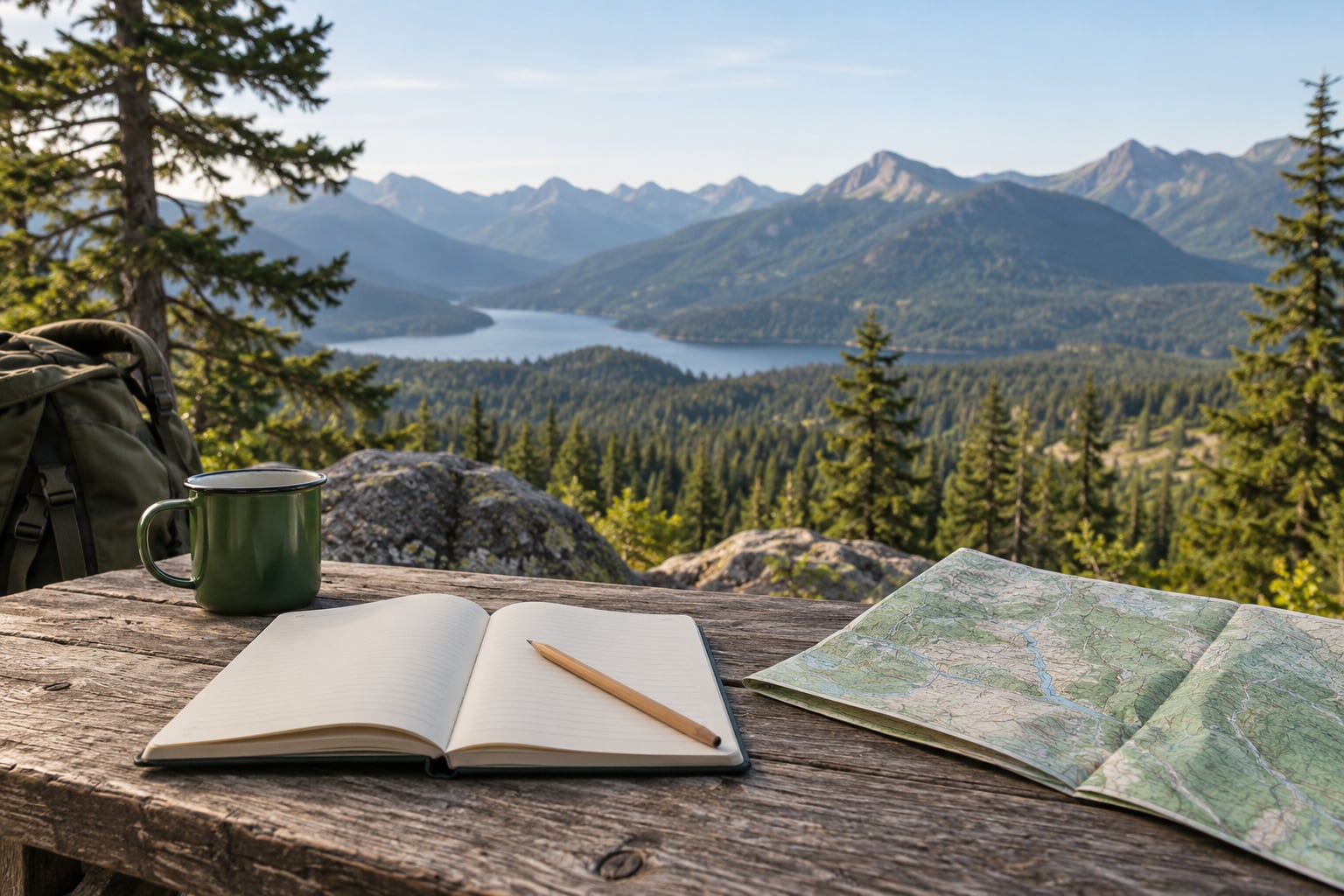
Quotes about nature for a hiking caption work best when the line matches the photo underneath it. A summit shot wants momentum, a pine trail at dusk wants quiet, and a lake before sunrise wants something that sounds unhurried. Here are twelve lines worth keeping in your phone, each with the kind of shot it suits and a ready-to-adapt caption using it.
A note before we start. Every quote credited to a named writer below carries the writer’s name, and where a line is genuinely disputed or original to this page, I say so plainly. Misattributed nature quotes are the most common complaint about quote lists, and there is no reason to add to it.
This page was last checked in October 2026. If you post often, the fastest use of it is to scroll the table, find your shot type, and work from the example caption rather than the quote alone.
Table of Contents
- 1Quotes About Nature for a Hiking Caption at a Glance
- 21. The Mountains Are Calling and I Must Go
- 3When to skip it
- 42. In Every Walk with Nature One Receives Far More Than He Seeks
- 5Making it sound like you
- 63. The Earth Has Music for Those Who Listen
- 7Pairing it with video
- 84. Nature Does Not Take It Back
- 9What this one signals to other hikers
- 105. Adopt the Pace of Nature: Her Secret Is Patience
- 11Why it works for winter hiking
- 126. The Clearest Way Into the Universe Is Through a Forest Wilderness
- 13Say why the light is there
- 147. There Is a Pleasure in the Pathless Woods
- 15Handling the group version
- 168. Look Deep into Nature, and Then You Will Understand Everything Better
- 17Where it flops
- 189. Nature Is the Art of the Great Improvisation
- 19Let the caption carry the story
- 2010. The Journey Is the Destination
- 21How short to make it
- 2211. Some Places Never Lose Their Quietness
- 23Keeping it level
- 2412. Keep Your Face Always Toward the Sunshine
- 25When to use something else
- 26Frequently Asked Questions
- 27What is a good short nature quote for a hiking caption?
- 28Do I need to credit the author of a nature quote?
- 29How many hashtags should I use on a hiking post?
- 30Should I write my own hiking caption instead of using a quote?
- 31How long should a hiking caption be?
- 32Where to Start With Your Next Hiking Post
Quotes About Nature for a Hiking Caption at a Glance
These are the twelve, with the photo each one is built for. Pick the row that looks like your trail, then read the full entry below it.
| Shot type | Quote mood | Quote |
|---|---|---|
| Summit or ridge | Driven, urgent | The mountains are calling and I must go |
| Woodland or fern trail | Attentive, noticing | In every walk with nature one receives far more than he seeks |
| Stream or windy ridge | Sensory, listening | The Earth has music for those who listen |
| Overlook after a climb | Respectful, restrained | Nature does not take it back |
| Long descent or rest stop | Unhurried, patient | Adopt the pace of nature: her secret is patience |
| Dense pines or night hike | Contemplative | The clearest way into the Universe is through a forest wilderness |
| Trail with no other people | Solitary, private | There is a pleasure in the pathless woods |
| Moss, rocks, wildflowers | Observant, close | Look deep into nature, and then you will understand everything better |
| Switchbacks or weather shift | Adaptable | Nature is the art of the great improvisation |
| Mid-trail photo | Process, not arrival | The journey is the destination |
| Remote lake at dawn | Still, empty | Some places never lose their quietness |
| Golden hour finish | Upbeat, forward | Keep your face always toward the sunshine |
1. The Mountains Are Calling and I Must Go
This is the one line almost everyone has already seen, and it still works because it is short and it has a verb in it. John Muir wrote it in his journal about climbing in the Sierra Nevada, which is useful context if someone asks you where it came from.
Use it when the photo shows effort or arrival: a summit marker, a switchback you just finished, a view you earned. It pairs well with a hard-earned shot rather than a flat trailhead picture.
The mountains are calling and I must go. — John Muir
A caption that uses it: Four hours up, twenty minutes of view, and every step worth it. ⛰️ #MountainHiking #TrailDay. Swap the number for whatever your own hike actually cost.
When to skip it
Do not use this on a flat, easy walk. The line promises struggle, and a photo of a paved greenway under it reads as a joke at your expense. Save it for the day you actually earned something.
2. In Every Walk with Nature One Receives Far More Than He Seeks
Muir wrote this after a 1867 walk through the Adirondacks with a walking stick his teacher had given him, which is why it sounds less like a slogan and more like a note to himself. The line suits any shot where the small things are the subject.
Reach for it on a fern trail, a boardwalk through pines, or a photo of a bird you sat still long enough to spot. It rewards slow captions, so keep the text plain.
In every walk with nature, one receives far more than he seeks. — John Muir
Adapted: Went out for two hours, came back with three things I did not know to look for. 🌲 #ForestWalk #TrailPhotography
Making it sound like you
The line rewards a specific detail, so name something small in the frame. A specific fungus on a log, a species of bird you can identify, the boardwalk where the rain started. Generic captions on woodland photos get scrolled past because they describe the whole internet.
3. The Earth Has Music for Those Who Listen
This line is usually credited to Saint Augustine, though the exact source is disputed and it appears in several older forms. Write it as an unattributed line if you want to be safe, or credit Augustine the way most quote sites do.
It belongs beside anything with a sound in it: water moving over rock, wind in grass, a ridge you had to lean into. Audio is invisible in a photo, so the caption supplies what the image cannot.
The Earth has music for those who listen. — commonly credited to Saint Augustine
Adapted: Could not hear it over the wind on the ridge. Took the photo anyway. 🎧 #WildernessSound #TrailMix
Pairing it with video
If your post is a reel with actual audio, this is the line to use on the cover and let the clip carry the rest. Put it on a still frame with no sound and it reads like a caption for a post that was not there.
4. Nature Does Not Take It Back
This line is original to this page, so there is nothing to misattribute and nothing to verify. I wrote it for the post where you took the good photo and then stepped on something fragile two frames later.
It suits a summit overlook shot, a campsite photo, or anything where you are showing off a place you also want to keep intact. It pairs honestly with a Leave No Trace mention instead of a call to adventure.
Nature does not take it back. — original line
Adapted: Took the picture, took nothing else. Packed out the rest. 🥾 #LeaveNoTrace #PackItInPackItOut
What this one signals to other hikers
Posting the view and the ethics together reads well to the people who care about both, and it saves you the second post where you have to explain where you parked. Keep it in your back pocket for the campsite photo at the end of a two-day trip.
5. Adopt the Pace of Nature: Her Secret Is Patience
Usually credited to Ralph Waldo Emerson, and printed in enough collections that you will see it without a name as often as with one. The sentiment is slow on purpose, so it does not suit a frantic energy post.
Use it on a long descent, a rest stop with a thermos, a flat mile in the middle of a big route. Slow hikers get a lot of use out of this one because it says something true about their pace.
Adopt the pace of nature: her secret is patience. — commonly credited to Ralph Waldo Emerson
Adapted: Eleven miles, no hurry, two breaks. Turns out the flat parts are where the good stuff is. ⏱️ #SlowHiking #LongTrail
Why it works for winter hiking
Short daylight, cold hands, slow footing. It is exactly the mood of a February ridge, and captioning a winter hike with summit energy usually falls flat. This line gives you a register that matches the conditions without complaining about them.
6. The Clearest Way Into the Universe Is Through a Forest Wilderness
John Muir wrote this one, and it is the best of his lines for a night hike or a thick stand of pines with the light dropping out of it. The stars do half the work in the photo; the caption finishes the thought.
It also works for a misty morning in old-growth forest, where nothing is visible and everything is. Keep the caption short so the image stays mysterious.
The clearest way into the Universe is through a forest wilderness. — John Muir
Adapted: Headlamps off for ten minutes. This is what we came up here for. 🌌 #NightHike #DarkSky
Say why the light is there
The caption works harder when the photo has a real reason to be dark. Name the moon phase, the new moon window, or the trail’s lights-out rule. That detail separates a night hike post from a daylight photo with the exposure dropped.
7. There Is a Pleasure in the Pathless Woods
Wordsworth wrote it in a poem from the early 1780s, and it is the closest thing on this list to a caption that sounds like a person rather than a brand. Take the short version for the photo and let the long one live in your journal.
Use it when the trail is empty and you want to say so without sounding smug. An unmaintained spur, a fire road nobody drives, a lake with one boat on it.
There is a pleasure in the pathless woods. — William Wordsworth
Adapted: Took the spur nobody signs. Best decision of the weekend. 🌲 #OffTrail #PathlessWoods
Handling the group version
On its own this reads as solitude. Add a companion, a dog or a full pack to the frame and change the wording, or the caption will contradict the photo. The same goes for a shot where someone clearly walked the trail before you.
8. Look Deep into Nature, and Then You Will Understand Everything Better
This one is widely attributed to Einstein, and that attribution is not well documented. If it matters to you, leave the name off. The line reads fine as an unattributed thought, which is how most hikers will use it anyway.
Match it to close work: moss on a boulder, a fern unfurling, wildflowers at boot level, or a hiker standing still and looking at something off frame. Macro shots need captions that slow people down.
Look deep into nature, and then you will understand everything better. — widely attributed to Albert Einstein
Adapted: Ten minutes on the ground, looking. Answered more of my questions than the whole drive home. 🍃 #MacroNature #TrailDetails
Where it flops
Wide shots and drone footage lose this one badly. There is nothing close to look at in the frame, so the caption ends up promising detail the viewer cannot see. Keep it for hand-height photos of moss, bark, ice and stone.
9. Nature Is the Art of the Great Improvisation
People pass this one off to Emerson and Thoreau with confidence. It is original to this page, which means you can use it without sending anyone looking for a citation that does not exist.
It fits the improvised parts of any hike: the weather that turned, the trail that washed out, the switchback you added because the bridge was gone. Improvisation captions get saves because they tell a story in four words.
Nature is the art of the great improvisation. — original line
Adapted: Bridge out at mile four. Added four miles. Wrote this caption from the detour. 🥾 #TrailDetour #ImprovisedRoute
Let the caption carry the story
This is the one on the list that behaves like a mini post rather than a tagline. Follow it with the problem, the workaround and how the day ended, and the middle line stops being decoration and becomes the reason people read to the end.
10. The Journey Is the Destination
Emerson is the usual attribution, and it is fair enough for a caption even if the exact wording drifts between sources. Keep the full phrasing in a card or a journal and use a shortened version under the photo.
This is the mid-trail caption, the one you post from the halfway point when nothing has been achieved yet. It also works on a photo of your boots, your pack, or a signpost that says nothing exciting.
It is not the destination, but the journey. — commonly credited to Ralph Waldo Emerson
Adapted: Mile 6 of 11. Nowhere near the top and not thinking about it. 🎒 #MidTrail #KeepWalking
How short to make it
The full Emerson phrasing runs long under a photo. For a feed post, four or five words is plenty, and there is room for a real detail underneath. Keep the longer wording for a card, a print, or the top of a journal page.
11. Some Places Never Lose Their Quietness
Original to this page. There is no author to credit and no source to check, which makes it the safest line here if you are posting from a place you would rather not have a crowd following to.
Quiet photos usually fail because the caption shouts. This one stays level. Pair it with a still frame, an empty shoreline, an early campsite with the fire already out.
Some places never lose their quietness. — original line
Adapted: Nobody else on the lake. Turned the phone over and sat there instead. 🤫 #QuietLake #StillWaters
Keeping it level
Quiet photos fail when the caption oversells them. Nothing here says wow or breathtaking or hidden gem, which is the point, and it works best on an unfiltered frame with no golden-hour treatment.
12. Keep Your Face Always Toward the Sunshine
Often credited to W. B. Yeats, though the sourcing is thin. Like the Einstein line, it holds up without a name, and a lot of hikers will caption it their own way anyway.
Close the set with something bright. It suits a golden-hour finish, a ridge walk that turned around a corner into full sun, or a post about pushing through weather you would rather forget.
Keep your face always toward the sunshine. — commonly credited to W. B. Yeats
Adapted: Cloud broke at the last switchback. Worth every wet mile before it. ☀️ #GoldenHour #TrailHike
When to use something else
Skip it on a flat overcast walk and on photos where nobody appears to have enjoyed themselves. The line assumes good humour about hard conditions, so it only lands when the story behind the photo earns it.
Frequently Asked Questions
What is a good short nature quote for a hiking caption?
A good short nature quote is one line, under ten words, that describes something visible in your photo rather than your mood. Match the line to the shot: forest lines for trees, summit lines for elevation, patience lines for slow hikes. Write it in your own words if a borrowed one sounds wrong on your post.
Do I need to credit the author of a nature quote?
Yes, when the quote is attributed to a real writer, and it costs you eight characters. Credit Muir, Thoreau, Emerson or Wordsworth by name in the caption. If you cannot confirm the source, leave the name off rather than guessing. Quote sites get called out constantly for invented attributions, and readers check.
How many hashtags should I use on a hiking post?
Three to five specific hashtags usually work better than a wall of thirty broad ones. General tags get heavy competition, so pair one or two wide tags with tags tied to your actual shot, like a trail name or a season. There is no rule in the platform; the useful habit is changing the set each post.
Should I write my own hiking caption instead of using a quote?
Write your own whenever you can. Photographers on Reddit keep saying the same thing, that recycled captions read as performative and get less engagement than a plain description of what happened. Use a quote as a starting line, then add one specific detail only you know, like the mile or the weather.
How long should a hiking caption be?
Keep it to roughly one to three lines for a feed post, since the first line is what shows before the fold. Stories and reels work with a single line. If you want to tell the full story, put the long version in a carousel slide or the first comment, and keep the caption itself short.
Where to Start With Your Next Hiking Post
Find your shot type in the table, take the matching quote, and rewrite at least half of it before you post. A caption that names your own mile marker or weather will always beat a borrowed line, and if the quote is someone else’s, the name goes with it.