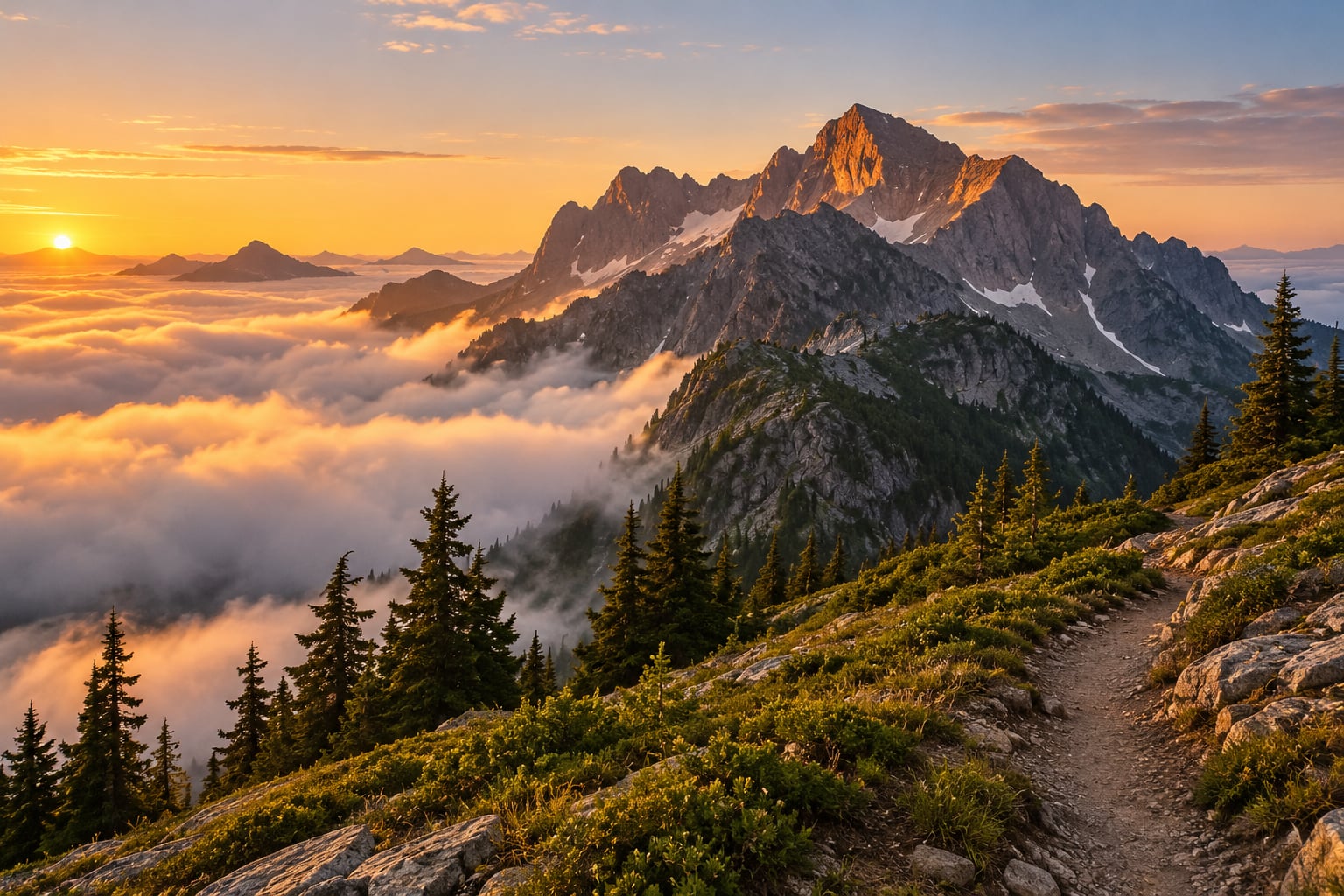
The mountain lines people reach for most often are John Muir’s “The mountains are calling and I must go,” Edmund Hillary’s “It is not the mountain we conquer, but ourselves,” and Ed Viesturs’s “Getting to the top is optional. Getting down is mandatory.” All three work as an adventure caption, provided each one matches the photo underneath it.
That last part is where most posts fall flat. A literary passage dropped under a photo of a sunny car park reads like a mismatch, and the comments fill up with people asking who said it. So the fifteen quotes about mountains for an adventure caption below come grouped by mood and by the type of photo they fit, and each one comes with a caption example you can adapt in a few seconds.
Table of Contents
- 1Quotes About Mountains for an Adventure Caption at a Glance
- 21. The Mountain Calls Us Higher
- 32. Above the Clouds, Beyond the Ordinary
- 43. Every Mountain Is an Invitation
- 54. Find Your Strength in the Climb
- 65. The View Is Worth Every Hard Step
- 76. Let the Wild Places Change You
- 87. Mountains Teach Us to Rise
- 98. Peace Lives Where the Roads End
- 109. Chasing New Heights
- 1110. It Begins with One Step
- 1211. Where the Earth Reaches the Sky
- 1312. Breathe Deep, Take the Scenic Route
- 1413. No Shortcut to the Summit
- 1514. A Mountain Is a Promise to Explore
- 1615. Leave Only Footsteps, Take Only Stories
- 17How to Personalize Quotes About Mountains for an Adventure Caption
- 18Frequently Asked Questions
- 19What is the best short caption for a mountain photo?
- 20Is The mountains are calling too overused to post?
- 21What makes a good mountain view caption?
- 22Who said the famous mountain quotes, and are the attributions accurate?
- 23Who is the most famous mountaineer?
- 24Should I add hashtags to a mountain caption?
- 25Conclusion
Quotes About Mountains for an Adventure Caption at a Glance
| Quote | Mood | Best photo | Use it for |
|---|---|---|---|
| The mountains are calling and I must go | Bold | Summit selfie, trailhead at dawn | Big statement post, cover line |
| Above the clouds, nothing but sky | Expansive | Above an inversion layer at sunrise | High-elevation hiking post |
| Every mountain is an invitation | Welcoming | Easy trail, group of beginners | First hike, inviting followers |
| Strength is built in the last ten switchbacks | Determined | Steep grade, tired legs | Fitness and personal growth |
| The view is worth every hard step | Rewarding | Viewpoint, road trip overlook | Classic scenic post |
| Let the wild places change you | Wild | Forest trail, remote campsite | Backpacking and solitude |
| Mountains teach us to rise | Resilient | Sunrise climb, bad-weather day | Gritty achievement post |
| Peace lives where the roads end | Quiet | Remote cabin, lake, empty overlook | Slow travel, digital detox |
| New heights to chase | Energetic | Climbing day, quick post | Under eight words |
| It begins with one step | Motivational | Packed backpack, boot laces | Start of a trip |
| Where the earth reaches up to meet the sky | Poetic | Wide landscape, ridge panorama | Photography account |
| Breathe deep, take the scenic route | Relaxed | Road trip, pull-off | Casual weekend wander |
| No shortcut to the summit | Earned | Summit cairn, tired selfie | Hard-earned win |
| A mountain you have not climbed yet | Forward-looking | Bucket-list peak, map photo | Planning a trip, invite |
| Leave only footsteps, take only stories | Stewardship | Untouched campsite, packed gear | Leave No Trace, reflection |
Read the table straight down and you can already see how the moods cluster: lines one through six lean loud, seven through twelve lean reflective, and the last three lean purposeful. That clustering is the whole trick, because a caption only works when its mood and your photo agree.
1. The Mountain Calls Us Higher
The mountains are calling and I must go. — John Muir
Muir wrote it in 1873, after a long afternoon in the Sierra Nevada, and it is still the first line people think of when a mountain post needs a headline. It is short, it has a verb in it, and it explains the photo without describing the photo.
What it does not do is sound original. Hikers on r/Mountaineering have been swapping alternatives for years, and if your feed is mostly climbing posts, the Muir line gets scrolled past. Use it when the post is a milestone or a cover line, and step to item four when the same image needs to sound fresher.
Caption example: Last one before the trail turns to scree. Muir wrote it better, but today it was mine to answer.
2. Above the Clouds, Beyond the Ordinary
Above the clouds, nothing but sky and the sound of your own breathing.
There is a specific moment on a high trail when you break above an inversion layer and the world goes quiet and white below you. Most captions describe the view; this one describes the sound, which is the part people remember on the drive home.
Pair it with a photo shot early, before the cloud deck burns off. A blue-sky midday shot undercuts it completely.
Caption example: 6,400 feet of altitude and I could hear my own boots. Gained a new perspective, and a blister, for free.
3. Every Mountain Is an Invitation
Every mountain is an invitation, and every trailhead is the answer. — after Lao Tzu
This is the line to use when the people in your photos have never hiked properly before. It sets the tone as welcoming rather than intimidating, which matters when you are inviting your audience to come along.
The Lao Tzu framing comes from the proverb that he who climbs a mountain begins at the bottom. It travels well because it does not claim the mountain was conquered by anyone.
Caption example: First real hike for three of them and nobody complained once. Turns out the mountain was the easy part of the trip.
4. Find Your Strength in the Climb
Strength is not found at the summit. It is built in the last ten switchbacks.
Everybody photographs the top and nobody photographs the two hundred vertical feet where the legs stopped working. This line gives you permission to post the boring, honest middle instead, which is far more interesting to look at.
It also sidesteps the corny growth-poster register. For a more literary option, George Mallory’s line from his 1924 Everest expedition holds up: It’s a hard climb up to the gods, and the only way to do it is to keep the faith.
Caption example: The top was easy. These ten switchbacks are the ones I’ll remember.
5. The View Is Worth Every Hard Step
The view is worth every hard step you took to earn it.
This is the reward caption, and it suits the widest range of photos on this list: a ridge walk, a slow road up a mountain pass, or a viewpoint reached after two hours of uphill. It reads as satisfied rather than triumphant, which ages better in a feed.
For a quieter variant, Anne Morrow Lindbergh’s line from her 1938 travel book works well: I am a part of all that I have met. It suits a lake or a valley shot where the point is the feeling rather than the altitude.
Caption example: Two hours up, twenty minutes of view. I’d do the climb again tomorrow and complain the whole way.
6. Let the Wild Places Change You
Let the wild places change you. Going is the point.
This one is for the photo with no mountain in it: a mossy forest trail, a camp tucked under trees, boots drying by a fire. It gives a post about the surrounding environment the same weight as a post about a summit, which is fair, since that is usually the part that stays with you.
John Muir’s forestry line is the better-known companion here: The clearest way into the Universe is through a forest wilderness.
Caption example: Three days above the treeline and I’d still pack that one camera for the woods. Wild places work on you slowly.
7. Mountains Teach Us to Rise
Mountains teach us to rise, one switchback at a time.
Built for the hard days: rain at altitude, a summit pushed back twice, a sunrise start that began in the dark. It keeps the resilience message without slipping into the motivational-poster register that gets accounts unfollowed.
Henry Miller put the same idea more cleanly: One’s destination is never a place, but a new way of seeing things. That one carries further on a text-only post.
Caption example: Minus eight at the trailhead, back to the car before dark. The mountain sets the pace, you just answer it.
8. Peace Lives Where the Roads End
Peace lives where the roads end.
Some mountain posts are not about the climb at all. They are about the silence, the empty car park, the cabin with no signal. This is the caption for that mood, and it pairs best with wide, quiet frames that have very little in them.
Henry David Thoreau’s opening line from Walden holds the same mood with more detail: I went to the woods because I wished to live deliberately.
Caption example: Road ends here, signal dies here. Best two days of the month.
9. Chasing New Heights
New heights to chase.
Four words, and it works when the post is already doing the talking. This is the one to use for a climbing day, a new route, or a quick post between two longer ones.
Ed Viesturs, one of the names climbers on r/Mountaineering quote more than almost any other, put the dry counterweight to it: Getting to the top is optional. Getting down is mandatory. It photographs well against a tired, honest summit shot.
Caption example: New route, same mountain. Day two and I’m still finding things to be scared of.
10. It Begins with One Step
It begins with one step from the trailhead.
Start-of-trip posts deserve their own line, and this is the one. The photo that suits it is the unglamorous one: a loaded pack in the car, boots being laced, the trailhead sign with the day counting down behind you.
For something with an older root, Psalm 121 opens with I will lift up mine eyes unto the hills, which travels well as a caption and needs no explanation of who wrote it.
Caption example: Packed for four days, carrying two of them. Here we go, one step at a time.
11. Where the Earth Reaches the Sky
Where the earth reaches up to meet the sky.
Photography accounts live on this one. It is the caption for a frame with real scale in it, something with ridgelines receding into haze, where the picture is doing the describing.
William Blake’s couplet does something similar in miniature: To see a World in a Grain of Sand, and a Heaven in a Wild Flower. William Shakespeare’s line, Our peace shall stand as firm as rocky mountains, is also genuinely his, from Henry IV.
Caption example: Ridgeline after ridgeline, and then weather. Took me four tries to get this one.
12. Breathe Deep, Take the Scenic Route
Breathe deep. Take the scenic route.
Road trip captions have their own rhythm, and this line fits it without dragging in summits you never reached. It suits a pulled-over overlook, a winding pass, and the kind of weekend where the plan was deliberately thin.
Ralph Waldo Emerson’s poem Mountain Interval is the literary match: I have in me so much nearer home, to scare myself with my own desertion. Save it for a longer caption when you have the space to break a line.
Caption example: Detour added an hour and cost me nothing. Would happily add another.
13. No Shortcut to the Summit
No shortcut to the summit. You earn the view with your legs.
An accomplishment post wants a line that admits the effort. This one does the job in nine words and doesn’t claim anything about conquering, defeating, or reaching the top of your life.
Edmund Hillary’s version is the one most people expect, and it is genuinely his: It is not the mountain we conquer, but ourselves. It earns its place on a summit-day post, not on a mid-hike one.
Caption example: Seven hours, two wrong turns, one very steep final mile. Worth all of it, and I’d still ask for the photo.
14. A Mountain Is a Promise to Explore
A mountain you have not climbed yet is a promise you have not kept.
This is the caption for the trip you have not taken yet, so it works for bucket-list posts, planning shots, and the last entry in a series where you invite people to come with you.
W. B. Yeats wrote in his Sonnet: I will go there, and a thousand years be on the road. It is a good closer for a series announcement.
Caption example: Number six on the list. Three states away, one long weekend, no firm plan yet. Who’s coming?
15. Leave Only Footsteps, Take Only Stories
Leave only footsteps, take only stories.
The stewardship line is the one that ages best, and it usually lands best on a photo of a spot nobody should know about, campsite packed, fire ring cold. It reads as respect rather than as a lecture.
Jane Austen’s line from Persuasion, spoken by Captain Wentworth, does the same job with a literary accent: What are men to rocks and mountains?
Caption example: Camp packed, fire cold, no trace left but the view. Kicked out before anyone else showed up.
How to Personalize Quotes About Mountains for an Adventure Caption
A quote straight off a list will read like a quote straight off a list, because everyone else copied it from the same list. Picking between quotes about mountains for an adventure caption comes down to five small changes that make the line sound like yours.
Change the setting. Replace the generic with the actual place: the trail name, the pass, the park, the elevation you hiked to. One proper noun does more than a paragraph of adjectives.
Change the activity. The mountain did not care whether you hiked, scrambled, skied, or sat in a car park with a thermos. Say which one it was.
Change the mood, not the meaning. Keep the feeling of the line and swap the weather. A hard climb reads completely differently in fog than in sun, and the same quote can carry both.
Change the audience. Writing for hikers gets you the technical crowd. Writing for friends gets you the group-trip tone, and it usually travels better with younger followers.
Change the punctuation. A full stop makes it a statement. An ellipsis makes it a thought. A question makes it a prompt, which pulls comments without asking for them.
Keep the length tier honest too. Scenic photos want under eight words, achievement photos want a sentence, and anything longer than about twenty words gets truncated on most phone screens before the second line finishes.
One formatting note worth knowing: Instagram truncates around 125 characters before the ellipsis, so put the payoff line first. Longer captions carry well on Facebook and in a written post, so the same line can breathe there.
Frequently Asked Questions
What is the best short caption for a mountain photo?
The strongest short mountain captions are four to seven words with a verb in them, such as New heights to chase or Peace lives where the roads end. Short lines suit scenic photos, where the image already carries the story. Keep them under eight words so nothing gets cut off on a phone screen.
Is The mountains are calling too overused to post?
It is well known, which is the problem. It still works as a cover line or a milestone post, because readers recognise it instantly. On a feed where most of your followers also hike, pick something fresher instead. Items four, nine and twelve in this list were written as direct alternatives.
What makes a good mountain view caption?
A good view caption names one thing the photo cannot show, such as the sound, the weather or the effort it took to get there. Describing the scenery in the caption repeats what the image already says. Add a place name or a specific feeling and the post reads as a memory rather than a caption.
Who said the famous mountain quotes, and are the attributions accurate?
John Muir’s line is from his 1873 letter, Edmund Hillary’s is from his account of the 1952 Everest expedition, and Ed Viesturs’s belongs to the climber himself. Be cautious with lines that float around unattributed, including the one often credited to Jack Kerouac. If you cannot confirm the source, leave the name off.
Who is the most famous mountaineer?
Edmund Hillary is usually named first, since he and Tenzing Norgay made the first confirmed ascent of Everest in 1953. Reinhold Messner changed the sport by climbing peaks without oxygen. George Mallory remains the most discussed, since the question of whether he reached Everest in 1924 is still open.
Should I add hashtags to a mountain caption?
A short bundle at the end of the caption works better than thirty tags in the first comment, because Instagram reads them as part of the post. Five to ten specific tags usually outperform broad ones. Mix a place tag, an activity tag and a mood tag rather than repeating the same travel tag five times.
Conclusion
Fifteen lines, and they divide into three moods: bold, reflective, and purposeful. Bold lines suit summits and trailheads, reflective lines suit forests, lakes, and empty car parks, and purposeful lines suit the planning posts and the trip you have not taken yet.
Pick the quote about mountains for an adventure caption whose mood matches your photo, then change one detail until it sounds like your trip rather than a list. Start with the two that take the least editing, number nine for a quick post and number eight for a quiet one.