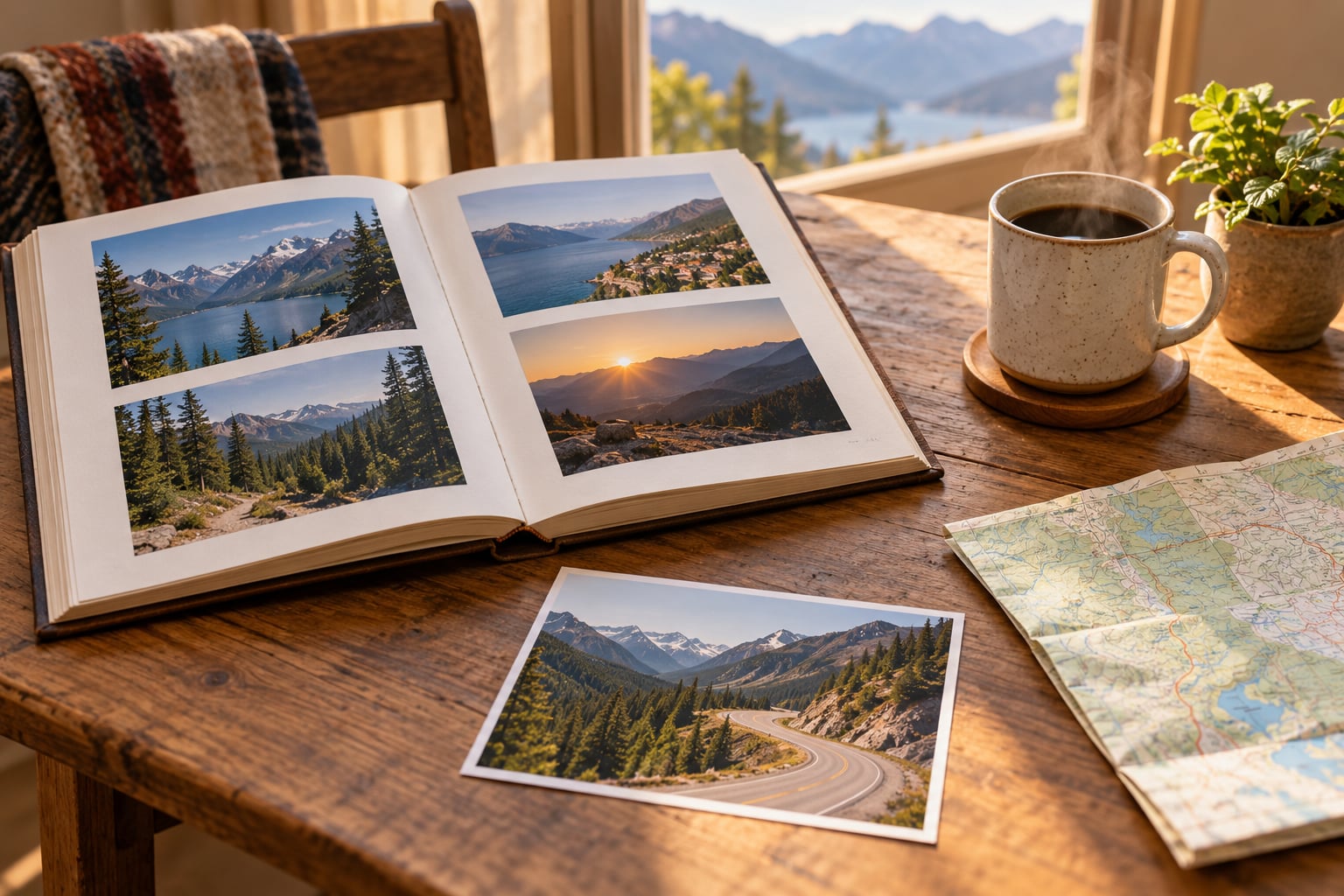
A road trip quote for a photo album is a short line that sits beside a printed photo and says what the picture cannot: how the drive felt, why you turned down that road, who was in the car. The quotes below are grouped by the album page they belong on, so you can match a line to one spread instead of scrolling a wall of options.
Two things make a quotation worth printing. It has to fit the space you have, which is usually a caption slot rather than a paragraph, and its attribution has to be honest, because a printed page lasts longer than a screen. I mark the lines whose authorship is shaky rather than passing a guess along as fact.
Start with the photo you like best and read down the list until one lands next to it. The wording matters less than the fit.
Table of Contents
- 1Quotes About Road Trips for a Photo Album at a Glance
- 21. “The journey is the destination” for an opening photo
- 3Road trip quote attribution and a caption for the opening spread
- 42. “Not all those who wander are lost” for a scenic detour
- 53. “To travel is to live” for a wide panorama
- 64. “The road is calling” for a motorcycle or convertible
- 75. “A journey of a thousand miles begins with a single step” for departure day
- 86. “Life is a journey, not a destination” for a milestone trip
- 97. “Somewhere, something incredible is waiting to be known” for anticipation
- 108. “We wander for distraction, but we travel for truth” for a reflective spread
- 119. “Take nothing but pictures, leave nothing but footprints” for nature memories
- 1210. “Home is the road I’m on” for the final-page closing photo
- 13Frequently Asked Questions
- 14How do I choose the right road-trip quote for a photo album?
- 15How should I format a quotation on a photo-album page?
- 16Can I use these road-trip quotes on social media?
- 17How do I verify who wrote a popular travel quotation?
- 18Should a photo-album caption be a quotation or my own memory?
- 19How long should a road-trip photo caption be?
- 20Conclusion
Quotes About Road Trips for a Photo Album at a Glance
| Quote | Best album page | Mood it captures |
|---|---|---|
| The journey is the destination | Opening spread, departure shot | Anticipation, nerves, going anyway |
| Not all those who wander are lost | Turnoff, overlook, unplanned stop | Curiosity, permission to detour |
| To travel is to live | Wide panorama page | Wonder, discovery, quiet awe |
| The road is calling | Motorcycle or convertible action shot | Energy, freedom, motion |
| A journey of a thousand miles begins with a single step | Suitcase, keys, first mile | Resolve, day one, milestone start |
| Life is a journey, not a destination | Birthday, graduation, anniversary | Reflection, people over places |
| Somewhere, something incredible is waiting to be known | Maps at sunrise, horizon ahead | Hoping, planning, the pull forward |
| We wander for distraction, but we travel for truth | Rainy window, forest, mountain road | Stillness, what the trip revealed |
| Take nothing but pictures, leave nothing but footprints | Trail, wildlife, conservation page | Stewardship, respect for wild places |
| Home is the road I’m on | Final page, last photo | Belonging, return, companionship |
One column is worth slowing down on. The last page of most albums is the one nobody thinks about while driving, and it is the page people flip to first years later.
1. “The journey is the destination” for an opening photo
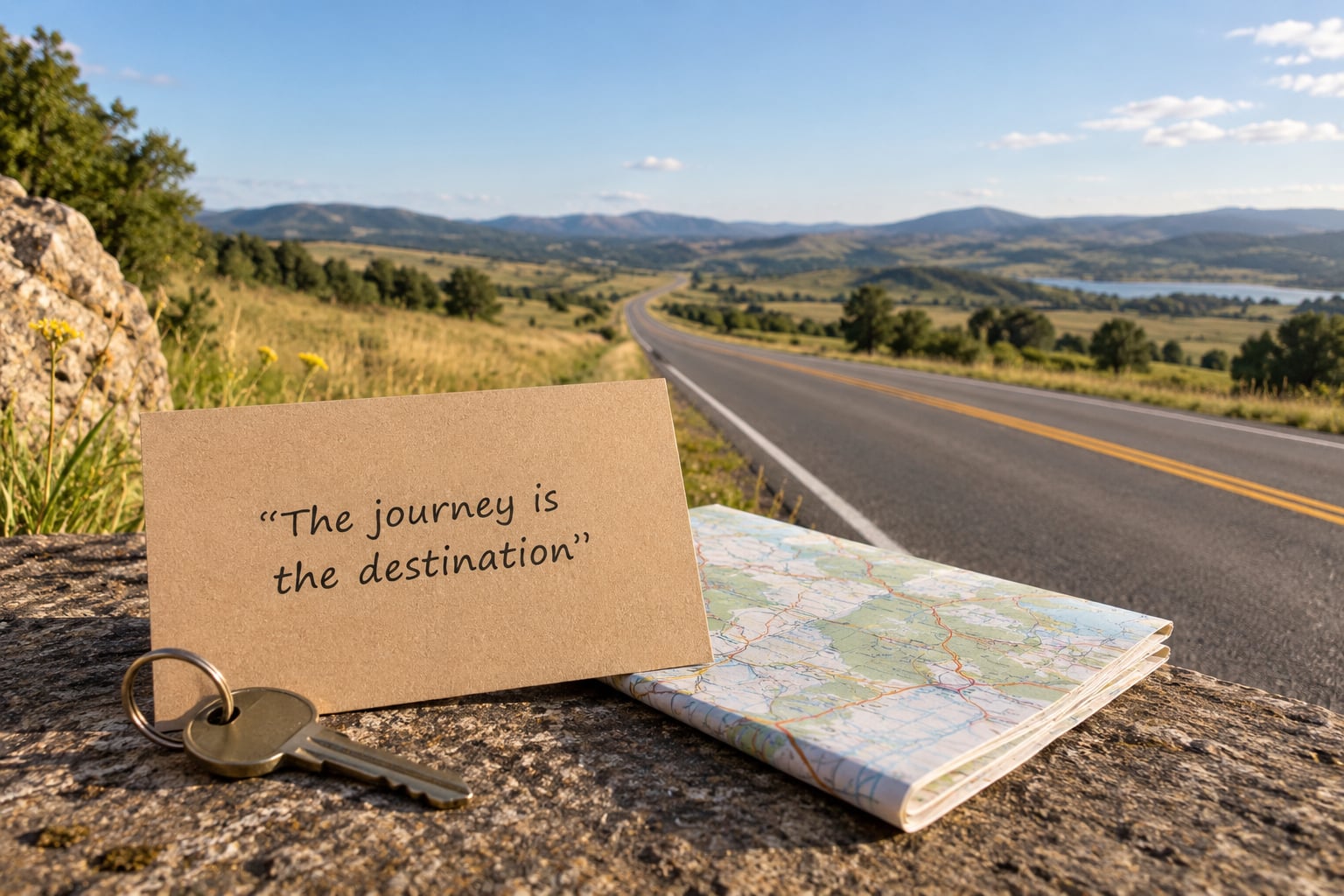
This is the line most people reach for when they cannot decide what to write on the first spread, and it works because it tells the reader the whole point of the book before they turn a page. Pair it with a photo of the car loaded, the driveway at dawn, or the first long straight stretch where everyone falls quiet.
Road trip quote attribution and a caption for the opening spread
The saying circulates constantly and is often credited to Ralph Waldo Emerson, but no published Emerson text contains it. If you print it, print it as unattributed. Attribution on a keepsake matters more than a name sounds good, because the next person who handles that album will repeat whatever you wrote down.
A caption that sits well under it: We pulled out at 6:10 with a full tank, two paper cups of coffee and no plan past lunch. That line names a time and a detail, which is what makes an album readable to someone who was not there.
2. “Not all those who wander are lost” for a scenic detour
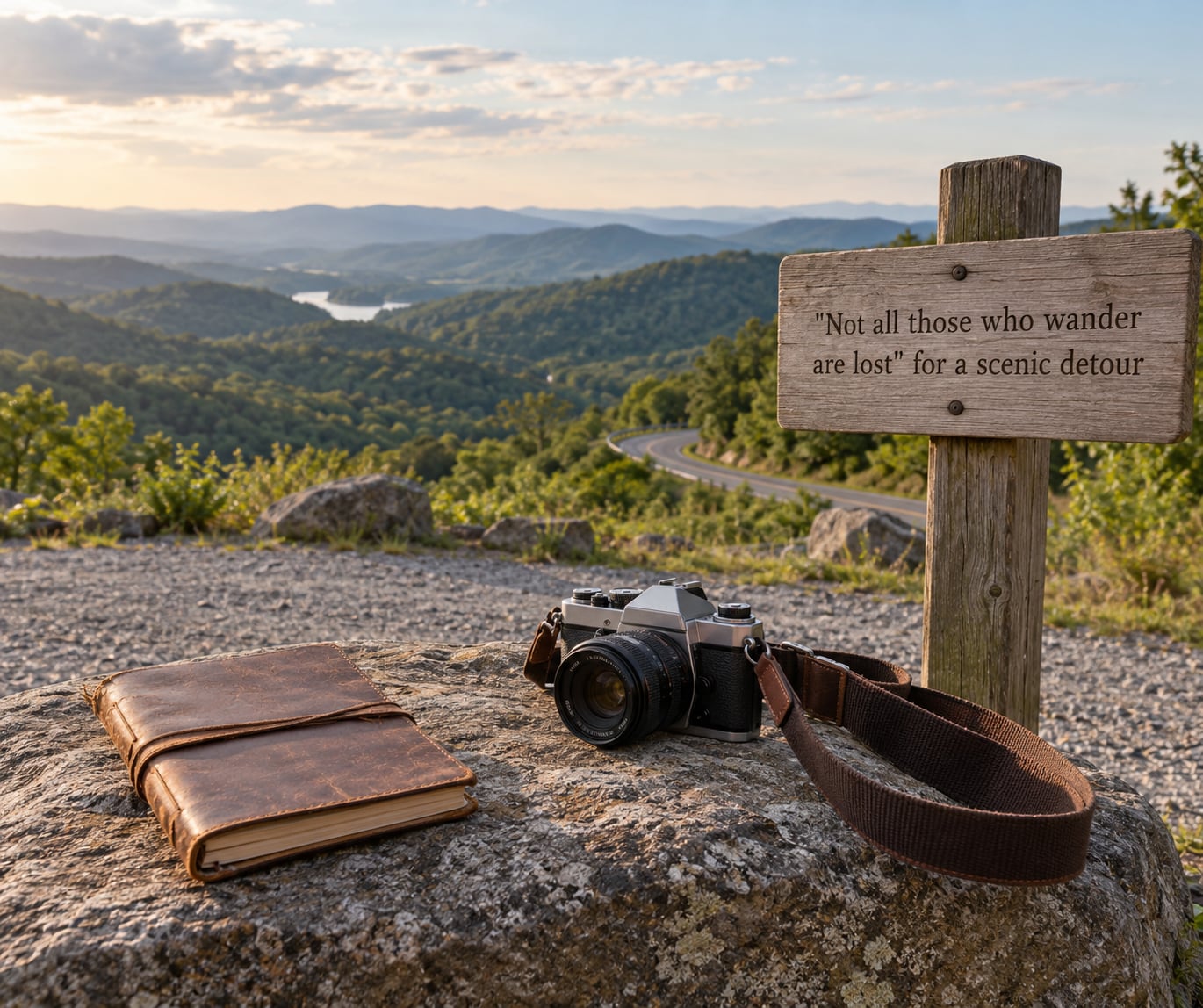
Every road trip album has a page with a road on it that was not in the plan. This quotation fits that page, because it gives you a reason to keep the photo of the turn you took for no logical reason other than that the light looked good.
The line is usually credited to J. R. R. Tolkien, and the credit comes from a letter rather than from the published books. It did not appear in The Hobbit or The Lord of the Rings. Written on an album page it reads perfectly well as a caption, just not as a quotation from a novel.
Try this under the photo: Forty minutes off the highway for a lake we had never heard of, and no argument about it.
3. “To travel is to live” for a wide panorama
Hans Christian Andersen used this line about his own habit of moving through the world, and it carries a different weight from the usual open-road slogans. It is about what changes in the person who goes, not about the scenery passing the window.
That makes it a strong match for the big panorama page, the one where a ridge drops away and the photo is doing most of the talking on its own. Keep your own caption to a single sentence so you do not compete with the view.
Twelve miles of nothing, then this. We pulled over and said nothing for a while.
4. “The road is calling” for a motorcycle or convertible
For a photo of a rider at a stop sign, a convertible with the roof down, or two bikes leaning against a guardrail, this phrase does the job a longer quotation would ruin. Short lines suit short images, and action photos punish paragraphs.
Be aware that the exact wording travels without a dependable author. Versions appear credited to writers, singers and campaign copy, and none of those origins hold up. Present it as a traditional expression, which is both accurate and more interesting on the page than a shaky name.
Top down, windows open, the kind of morning that makes the wrong turns feel chosen.
5. “A journey of a thousand miles begins with a single step” for departure day
This is the translation most English readers meet, and it belongs to Tao Te Ching, chapter 64, in the tradition associated with Laozi. Translators disagree on the wording, so if you print it, keep the familiar rendering and describe it as a rendering rather than a line read straight off a page.
Use it on the page with the suitcase, the keys on the counter, or the fuel receipt from the first morning. It works best when the trip is starting rather than finished, since it is about the moment you commit.
For a family album: Suitcase packed the night before, map folded wrong, everyone pretending they were not excited. For a solo album: One bag, one road, and the first hour of deciding whether to keep going.
6. “Life is a journey, not a destination” for a milestone trip
This is probably the most printed unattributed quotation in the travel category. It circulates with several names attached, Emerson among them, and none of the claims are documented. For a keepsake, print it without an author line and let your date and location do the crediting.
It earns its place on anniversary, graduation and milestone birthday albums, because those trips are about who was in the car rather than where you parked. Put it on the page that holds the group photo, not the one holding the motorway.
Forty-one years, three states, and the same two people arguing about the route.
7. “Somewhere, something incredible is waiting to be known” for anticipation
Sourcing here is genuinely murky, so treat the line with care. It is very often credited to the writer Maria Popova, who has circulated it widely, and it also appears under the name of Carl Sagan. Neither credit comes with a documented first source, and the honest description is a popular unattributed line with two famous names attached to it.
Its mood is forward-looking, which makes it right for a photo of maps spread on a picnic table, a sunrise the morning of arrival, or a road disappearing into haze. It also sits well on an album page you write before you know how the trip turned out.
We did not know what was at the end of it. We only knew we had not seen it yet.
8. “We wander for distraction, but we travel for truth” for a reflective spread
This line is regularly credited to Ralph Waldo Emerson. He was a writer who thought about exactly this distinction, and the attribution has circulated for decades without a confirmed published source, so treat it as Emerson-associated rather than certain.
It belongs on the quiet page: a mountain road with weather coming in, a forest turn, or the shot taken from inside the car through a rain-flecked window. Those photos are already contemplative, and the quotation gives them something to say.
We drove four hours in silence and came back quieter than we left.
9. “Take nothing but pictures, leave nothing but footprints” for nature memories
This one circulates as a nature-travel tradition with an unclear origin. It shows up attributed to John Muir, and similar lines appear in popular retellings of speeches associated with Chief Seattle. The exact wording is not documented to either of them.
It works beautifully on a wildlife, trailhead or public-land page, and it pairs well with a line of your own about behaving well on that ground. Photograph from the trail edge, carry out what you carried in, and keep off seed beds and fragile ground.
Elk at first light, forty yards upwind, and we stayed in the car where we were supposed to be.
10. “Home is the road I’m on” for the final-page closing photo
An unattributed sentiment that closes albums well, because it turns a list of places into a story about people. It suits a last page with two sets of headlights, a campsite at the end of the drive, or the same road photographed on the way back.
Print it as a line with no author beside it. Then let the caption underneath say what actually happened, since the closing page is where a reader decides whether the whole trip was worth it.
Last fuel stop, then home by ten, still arguing about the good parts.
Frequently Asked Questions
How do I choose the right road-trip quote for a photo album?
Look at the photo before you look at the list. Pick the one image that carries the mood of the spread, decide how much room the page has, then choose a quote that fits that room and sits beside that picture. A line that matches the page always looks better than a line that matches the trip in general, and it is far easier to trim a long quote down to a short one than to find words for a blank space.
How should I format a quotation on a photo-album page?
Set the quote first and the attribution underneath it in a smaller size, on a separate line rather than squeezed to the end of the sentence. Keep the quote under about fifteen words for a caption slot and under thirty for a half page. Print the author in italics, and if the source is uncertain, write attributed or unattributed instead of guessing at a name.
Can I use these road-trip quotes on social media?
Short public-domain lines and unattributed sayings are fine to reuse, but check anything written after 1930 or by a living writer before you post it. Attribution matters more on a shared post than people expect, since screenshots travel. Credit the author every time rather than only the first time you use a line, and skip the credit only for genuinely anonymous traditional sayings.
How do I verify who wrote a popular travel quotation?
Search the exact wording in quotation marks and check whether any published book, letter or speech contains it. If the only results are quote lists and social posts, the attribution is unproven. Wikipedia article pages on a writer or work are a useful second check. Failing that, write the line without a name; an unattributed quote is a smaller risk than a wrong one printed permanently.
Should a photo-album caption be a quotation or my own memory?
Use both, but give them different jobs. The quotation carries the mood of the page and the memory supplies the specifics, like the time of day, the weather, who complained about the last two miles. Albums where every caption is a borrowed line feel flat by page ten. A good spread has a quotation at the top and one specific sentence underneath it.
How long should a road-trip photo caption be?
Match the length to the space. One word works for a small album page or a sticker. Up to ten words suits a caption slot next to a standard photo. Under twenty-five words fits a half page with room for the image. Longer lines need a full spread. If your caption runs past three lines on the page, it was written for the screen rather than for paper.
Conclusion
Choose the photo that best carries the feeling of the trip, match it with a quotation whose attribution you can stand behind, and write one short sentence underneath with a real detail from the day. Print the line that people will recognise and the memory that only you have. That combination is what makes these quotes about road trips for a photo album worth the paper they are printed on.