A powerful veteran quote does one job: it gives a room full of grieving people a single sentence they can all agree on. The lines below were written for this article, so there is no famous name to misattribute and no source to get wrong. Read one aloud, print it on a remembrance slide, or adapt it into a family tribute.
If you are gathering quotes about veterans for a memorial program, a printed booklet, an order of service or a display for the reception table, you are in the right place. Every quotation below comes with its tone and its best placement, because a line that works on the cover often falls flat when read aloud at the close.
Table of Contents
- 1Quotes About Veterans for a Memorial Program at a Glance
- 21. A Veteran Is Remembered Through the Life Lived in Service
- 3How to use these quotes about veterans for a memorial program
- 42. Honor Is Carried Forward by Those Who Remember
- 53. Service Speaks Through Quiet Acts of Courage
- 64. Freedom Is Held Together by the Courage of Others
- 75. Every Veteran Leaves Behind a Story of Strength
- 86. A Tribute Can Be Small and Still Carry a Lasting Meaning
- 97. Remembrance Brings the Absent Presence Closer
- 108. Sacrifice Is Held with Respect, Not Defined by War
- 119. The Nation’s Peace Is Built on Service and Sacrifice
- 1210. May the Memory of a Veteran Remain a Source of Honor
- 13Frequently Asked Questions
- 14What is a respectful veteran quote for a memorial program?
- 15How long should a quote be when read aloud at a memorial?
- 16Should memorial program quotations be attributed to a veteran or speaker?
- 17What can I write in a veteran memorial program when I do not know a formal quotation?
- 18How do I include veterans from different branches, backgrounds and experiences?
- 19Can I use these veteran quotations on printed programs and memorial slides?
- 20Conclusion: Choose One Line That Feels True to the Veteran
Quotes About Veterans for a Memorial Program at a Glance
All ten selections are original lines written for this article. The table shows where each one lands best in a printed program or in the order of service.
| Number | Quote (shortened for reference) | Tone | Best placement |
|---|---|---|---|
| 1 | Remembered for the life shaped by service | Dignified, reflective | Biography or remembrance segment |
| 2 | Honor is carried forward by those who remember | Warm, forward-looking | Candlelight ceremony or closing |
| 3 | Service speaks through quiet acts of courage | Solemn, restrained | Opening invocation or reflection |
| 4 | Freedom is held together by courage | Civic, unifying | National or community theme |
| 5 | Behind every veteran is a story of strength | Personal, gentle | Family tribute segment |
| 6 | A small tribute still carries lasting meaning | Gentle, participatory | Candle lighting or flower placement |
| 7 | Remembrance brings the absent presence closer | Tender, reflective | Poetry reading or moment of silence |
| 8 | Sacrifice held with respect, not defined by war | Honest, balanced | Educational or remembrance page |
| 9 | The nation’s peace is built on service | Reflective, civic | Larger civic reflection |
| 10 | May the memory of a veteran remain a source of honor | Hopeful, concluding | Benediction or final candle |
1. A Veteran Is Remembered Through the Life Lived in Service
A veteran is remembered not only for years served, but for the life shaped by service, sacrifice and devotion to something larger.
This is the most neutral line in the set. It avoids naming a conflict, a rank or a branch, which means it sits comfortably next to a photograph on the biography page of the program.
Use it during the remembrance segment, after the life story has been told and before the formal honors. It also works well when the veteran’s service included something the family has never spoken about publicly.
How to use these quotes about veterans for a memorial program
Most programs are not overloaded with words. Families who have never written an order of service tend to over-fill it, and the reading ends up carrying the emotion instead of the family.
Reserve one principal quotation for the host, the chaplain or the speaker. Everything else stays secondary. Keep any line you read aloud under twenty words, and let a full pause of a beat or two sit before and after it. That silence does more work than another sentence would.
Introduce original language honestly rather than attaching a name to it. A simple “these words were written for him” costs you nothing and avoids the single most common regret families report: seeing a famous quote misattributed in a permanent printed keepsake.
Match the length of the line to the space you actually have on the page:
| Quote length | Where it fits | Example from this list |
|---|---|---|
| 3 to 5 words | Program cover, yard sign, bookmark | Service before self |
| 8 to 12 words | Inside cover or a reflection page | A name spoken softly |
| 15 to 20 words | Full page with white space around it | May the memory of a veteran remain a source of honor |
| Full sentence, 20 words or more | Read aloud only, not printed small | Freedom is held together by courage |
2. Honor Is Carried Forward by Those Who Remember
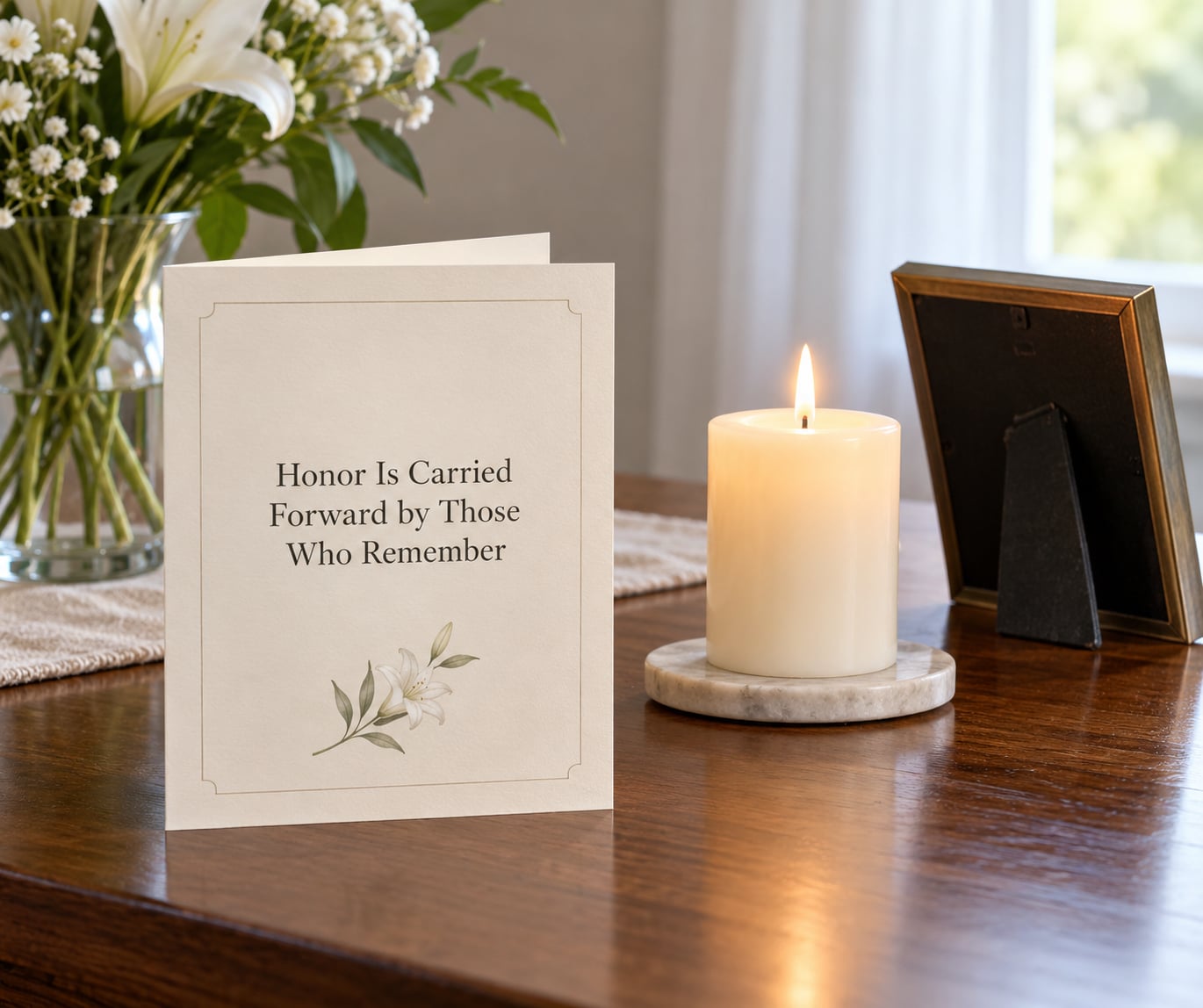
Honor does not end with the final farewell; it is carried forward by every life that pauses to remember courage with gratitude.
This line has a forward lean to it, which makes it useful right when a room tends to sag. It points at the living instead of at the loss.
I have seen it work best at the candlelight ceremony, read quietly while the room is dark, and on a projected remembrance slide during the reception. It also holds up as the closing reflection if the service ends quietly rather than with a benediction.
3. Service Speaks Through Quiet Acts of Courage
Service is often remembered in silence, but its courage speaks through every choice made to stand ready for others.
The strength of this line is its restraint. It does not describe heroism in the abstract, so it does not put words in anyone’s mouth.
Use it for an opening invocation, for a military reflection led by a fellow service member, or as a transition between the family remarks and the formal honors. Read it by someone with a steady voice and a slow pace, and let it be the last thing said before the pause.
4. Freedom Is Held Together by the Courage of Others
Freedom is held together by courage, the courage of those who serve, protect and ask little in return.
This is the civic line of the group. It speaks about what service makes possible without naming a party, a president or a war, which matters in a room where families disagree about most of that.
It suits a Veterans Day program, a community memorial, or a service held at a veterans’ organization post. For a small family eulogy it may feel too broad, so I would save it for a gathering where strangers are present.
5. Every Veteran Leaves Behind a Story of Strength
Behind every veteran is a story of strength, loss, pride, change and the faithful love of those who waited at home.
That last clause is why this line earns its place. It turns the spotlight toward the spouse and family, who often feel invisible at the service that is nominally about the service member.
Use it as a bridge between the service history and a reflection on the family. It pairs naturally with a photograph of a homecoming, a wedding, or a garden, and it works well when read by a child or a grandchild.
6. A Tribute Can Be Small and Still Carry a Lasting Meaning
A tribute may be a name spoken softly, a candle lit in silence or a promise to remember; even the smallest gesture can carry lasting meaning.
This is the participation line. It names the three things guests at a memorial service actually do, which gives the audience something to do instead of only something to feel.
Read it just before the candle lighting or the flower placement. It also works well on a remembrance table card, where attendees can pick one up on their way out and read it again at home.
7. Remembrance Brings the Absent Presence Closer

In remembrance, absence becomes a quiet presence beside us, felt in the stories shared, the names spoken and the love that continues.
This is the most personal line in the set and the one people adapt most often. It tends to land harder in a small room than in a large hall.
Use it for a family tribute, for a poetry reading, or for the moment of silence itself. If you pair it with a specific memory rather than a general statement, it becomes the part of the program that people mention years later.
8. Sacrifice Is Held with Respect, Not Defined by War
We honor sacrifice by remembering the person behind the uniform, celebrating a life of courage and holding difficult memories with respect.
Some veterans and veterans’ families are tired of tributes that celebrate combat for its own sake. This line names that weariness without dismissing the service.
It suits a remembrance or educational page in the program, and it works when the veteran’s own views about war were complicated. Handle it with care, though. If the family never talked about service in those terms, adding it may feel like an argument you are having on their behalf.
9. The Nation’s Peace Is Built on Service and Sacrifice
Peace rests upon the service and sacrifice of veterans, whose willingness to protect others gives communities the freedom to gather in peace.
There is a small, deliberate turn in that line. It brings the service home to the community rather than leaving it in a distant place.
Reserve it for a civic reflection, a Veterans Day ceremony, or a memorial service where the community is the subject. It is too general for an intimate family eulogy, where the person was loved for reasons that had nothing to do with a nation.
10. May the Memory of a Veteran Remain a Source of Honor
May the memory of a veteran remain a source of honor, a reminder of courage and a blessing carried forward by those who remember.
It opens like a benediction and closes with warmth, which is exactly the shape a final line needs. Unlike most of the others here, it is phrased as a wish rather than a statement, so it asks the room to carry something out with them.
Use it as the last words read aloud, at the closing candle lighting, or as the final line on the back page of the program. If you print only one line from this whole list, this is the one most people would choose.
Frequently Asked Questions
What is a respectful veteran quote for a memorial program?
A respectful veteran quote is short, dignified and free of politics or celebration language. It should describe service, sacrifice, memory or gratitude without telling the family how to feel. The most reliable lines name the person rather than the war, and they leave room for the family’s own words around them. Original wording you wrote yourself is always safe to print.
How long should a quote be when read aloud at a memorial?
Keep any quotation read aloud under twenty words, which is roughly ten seconds of speaking. A two to three minute reading at a memorial service is the usual norm, and a single line leaves more space for silence and for the family remarks that follow it. Print longer sentences on a full page, never in small type beside a photograph.
Should memorial program quotations be attributed to a veteran or speaker?
Only attribute a line to a named person when you can verify the source, and give the speech, book or year if you have it. Never attach a famous name to a line you rewrote or adapted, because a printed program is a permanent keepsake and misattribution is the error families regret most. Original lines can be presented plainly as written for the service.
What can I write in a veteran memorial program when I do not know a formal quotation?
Write three or four plain sentences about the person instead of hunting for a famous line. A favorite meal, a habit on Sunday mornings, a nickname only the family used, and the job he took after he came home will say more to guests than any borrowed quotation. Then pair that short paragraph with one of the original lines in this list.
How do I include veterans from different branches, backgrounds and experiences?
Use language that applies to every service member rather than branch-specific wording, and mention the branch only when you are certain of it. Avoid partisan or political framing, since a service with honors usually includes families who disagree. Where the veteran’s own experiences were complicated, the honest line about holding difficult memories with respect is usually the most inclusive choice.
Can I use these veteran quotations on printed programs and memorial slides?
Yes. Every quotation in this list was written for this article, so you can use it on printed programs, remembrance slides, memorial cards, bookmarks and yard signs without crediting anyone. Keep the wording exactly as printed when you copy it, and check the final proof at large print size so older guests can read it comfortably from the back of the room.
Conclusion: Choose One Line That Feels True to the Veteran
Start with the person, not the template. Pick the quotation whose tone matches who he or she was, place it where it will be read rather than where it merely fits on the page, and put one specific memory next to it. A single detail about a Sunday morning or a nickname does more for the people in the room than any borrowed line.
Keep the attribution honest, print at a readable size, and leave room for silence. Those three things are the difference between a memorial program people keep and one they file away.