A vow renewal is a ceremony where married couples say their promises out loud again, usually on a milestone anniversary, without a new license or legal ceremony. Quotes about marriage for a renewal of vows work best when they carry a named author and a real source, because a line that can be traced feels truer in front of family than an unattributed saying someone found on a pin board.
Every selection below comes from a specific book, poem, scripture or speech, and each one includes the moment in a renewal ceremony where it lands hardest. Check the original publication before you print anything.
Table of Contents
- 1Quotes About Marriage for a Renewal of Vows at a Glance
- 21. A Love That Grows Stronger Through the Years
- 3Choosing a Partner for Life
- 42. I Choose You Again
- 53. Marriage as a Partnership of Friends
- 64. Gratitude for the Life You Have Built
- 75. Staying Together Through Life’s Changes
- 86. Love Rooted in Trust
- 97. Laughing Together and Building a Shared Life
- 108. A Marriage of Two Families
- 119. Forgiving and Beginning Again
- 1210. Growing Better Together
- 1311. Love That Endures Every Season
- 1412. A Promise Made for the Years Ahead
- 15Frequently Asked Questions
- 16What is the best quote for a renewal of vows ceremony?
- 17Can you read marriage quotes at a church renewal ceremony?
- 18How do I verify who wrote a marriage quote?
- 19What if no quote about marriage for a renewal of vows feels personal?
- 20Should renewal-of-vows readings be funny, romantic or sentimental?
- 21Conclusion
Quotes About Marriage for a Renewal of Vows at a Glance
These twelve lines cover the ground most couples need: gratitude, recommitment, enduring love, partnership, forgiveness and shared growth. Match the tone column to the mood of your ceremony before you read further.
| Quote | Source | Theme | Tone | Best moment in the ceremony |
|---|---|---|---|---|
| Grow old along with me! The best is yet to be. | Robert Browning, Rabbi Ben Ezra | Enduring love | Poetic | Closing line before rings |
| Whatever our souls are made of, his and mine are the same. | Emily Bronte, Wuthering Heights | Partnership | Steady | Vow exchange |
| I love you without knowing how, or when, or from where. | Pablo Neruda, Sonnet XVII | Choosing again | Tender | Opening reflection |
| Let me not to the marriage of true minds admit impediments. | William Shakespeare, Sonnet 116 | Unbending love | Formal | Read to the guests |
| Give thanks to the LORD, for he is good; for his steadfast love endures forever. | Psalm 106:1 (ESV) | Gratitude | Reverent | Faith-based ceremony |
| Two are better than one, because they have a good return for their labor. | Ecclesiastes 4:9 (ESV) | Weathering change | Plainspoken | Mid-ceremony reading |
| You have made us for yourself, O Lord, and our heart is restless until it rests in you. | Augustine, Confessions, Book I | Trust | Reflective | Faith-based ceremony |
| What do we live for, if it is not to make sport for our neighbours, and laugh at them in our turn? | George Eliot, Middlemarch | Shared joy | Light | Toast or reception |
| A man shall leave his father and his mother and hold fast to his wife. | Genesis 2:24 (ESV) | Two families | Solemn | Blended-family renewal |
| The best way to avenge yourself is not to become like the person who did you wrong. | Marcus Aurelius, Meditations 6.6 | Forgiveness | Firm | Honest, inclusive vows |
| Love is patient, love is kind. | 1 Corinthians 13:4 (ESV) | Growing together | Warm | Second reading |
| For the path of the righteous is like the light of dawn, shining ever brighter till the full day. | Proverbs 4:18 (ESV) | Every season | Hopeful | Final portion |
1. A Love That Grows Stronger Through the Years
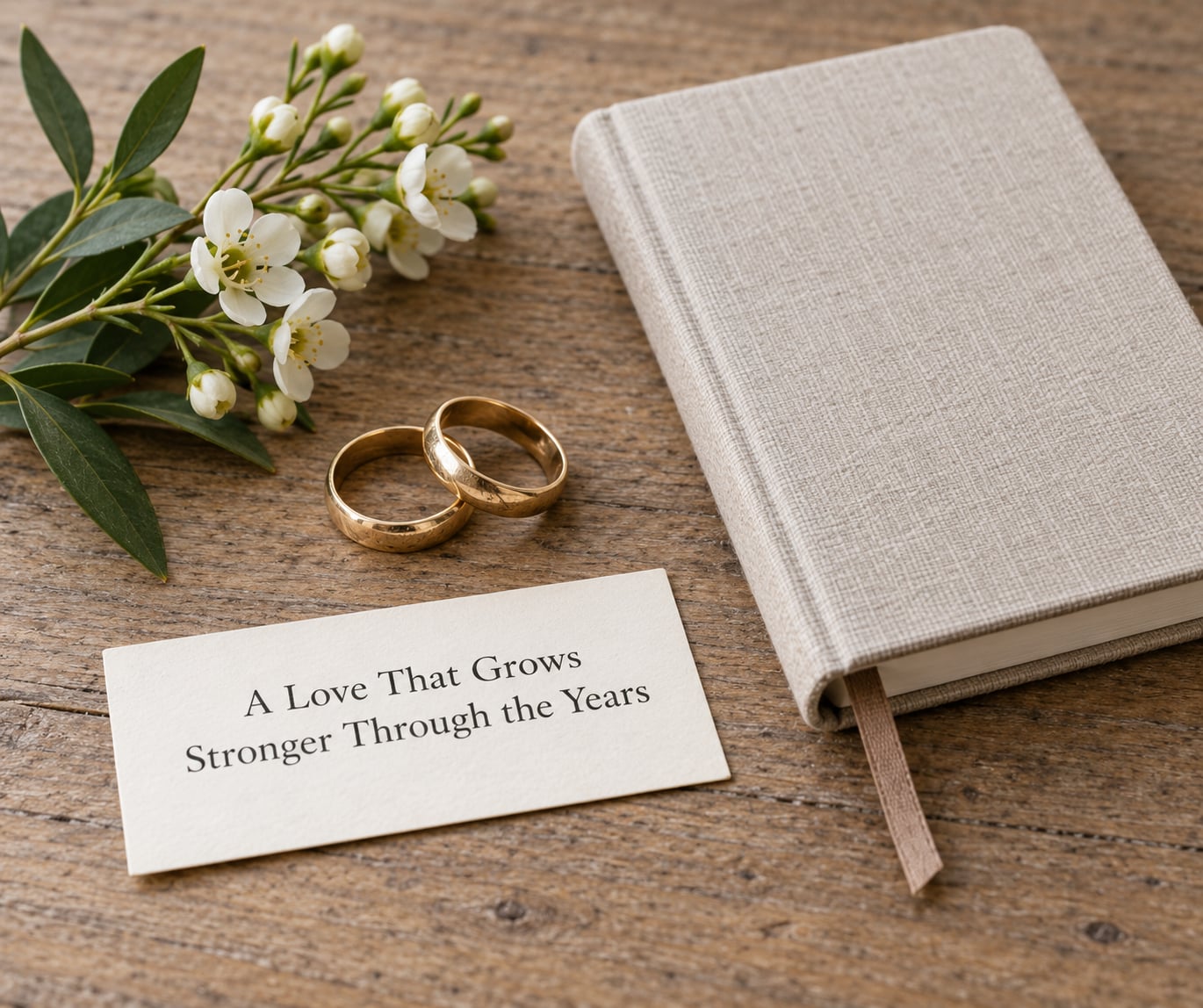
Grow old along with me! The best is yet to be.
Robert Browning wrote those words in the dramatic monologue Rabbi Ben Ezra, published in 1864. The speaker is an old man looking back on a life and refusing to treat age as a verdict, which is exactly the note most couples want twenty-five years into a marriage.
It suits a ceremony marking continued commitment because it points forward instead of backward. Read it as a reflective introduction, then name one specific thing you are looking forward to rather than summarising the years in general.
A personal version might be: “We said those words on a Tuesday in spring, and twenty-three years later the best is still ahead. I am looking forward to the ordinary Tuesday of our fifties.” That specific detail does more work than the poem ever could.
Choosing a Partner for Life
Whatever our souls are made of, his and mine are the same.
Emily Bronte put that line in the mouth of Cathy Earnshaw in Wuthering Heights, published in 1847. It describes a bond that existed before either person understood what they were choosing, and renewal vows turn that idea into something deliberate rather than accidental.
Read it during the vow exchange or as an intimate reading for family only. The exact focus keyword, quotes about marriage for a renewal of vows, is worth saying in your own words: you did not fall into this, you keep landing in it on purpose.
One example: “Whatever we were made of, we were made for each other. I am not choosing you again because I have to. I am choosing you because the alternative has never once interested me.”
2. I Choose You Again
I love you without knowing how, or when, or from where.
Pablo Neruda wrote the original in 1924, and the English versions usually appear as Sonnet XVII. It is the shortest and most easily verified selection here, and that brevity is exactly why it carries weight out loud.
Sixteen words take about seven seconds to say. Put a pause after it and let the room settle before you continue, then move straight into your own sentences so the poem is a doorway rather than the whole speech.
A personal-vow example that echoes it without copying: “I have never been able to explain how this happened, only that it happened early and it kept happening. I choose you in whatever language we have left.”
3. Marriage as a Partnership of Friends
Let me not to the marriage of true minds admit impediments.
William Shakespeare opens his 116th sonnet, published in 1609, with that line and follows it with the claim that this kind of love bends with the sun and never alters when the moon moves. It is the most quoted verse in English wedding readings for a reason: it describes marriage as a fixed choice rather than a mood.
This angle keeps a ceremony grounded. Marriage as partnership of friends lands harder than sentimental language because everyone at the reception has actually seen the two of you do the washing up on a Tuesday.
Use it during a toast or a blessing from a friend, then let the specifics do the emotional work. Something like: “Twenty years of meals, airports, bad decisions and one shared playlist. We picked the thing that keeps the ordinary days from being ordinary.”
4. Gratitude for the Life You Have Built
Give thanks to the LORD, for he is good; for his steadfast love endures forever.
Psalm 106 opens the psalms traditionally used at weddings and renewals, and the ESV translation carries this exact wording. It differs from a wedding toast because it names a gratitude that exists now, not gratitude for a future that has not been tested.
Pair it with one specific blessing rather than a list of everything. Say which year you were in when you needed it most, and why the person beside you showed up then.
An example: “You held the job, the diagnosis and the long hospital corridor in the same decade. I noticed. I am grateful in a way I did not know how to be at twenty-three.”
5. Staying Together Through Life’s Changes
Two are better than one, because they have a good return for their labor: for if either of them falls down, one can help the other up.
Ecclesiastes 4:9 in the ESV continues with a line about pity on anyone who falls without help, which makes it unusually honest for a ceremony. Acknowledging that marriages include falls is what makes the recommitment mean something.
Acknowledging difficulty should not turn the ceremony into therapy. Keep it to one sentence and keep it forward-leaning, then move to what you will do differently this decade.
A workable promise: “I will not promise a year without a hard patch. I promise to be the person who reaches out first when one comes, and to ask for help before we sink.”
6. Love Rooted in Trust
You have made us for yourself, O Lord, and our heart is restless until it rests in you.
Augustine wrote that confession in the early chapters of Confessions, compiled around 397. Couples who came to their first marriage the same way often find it speaks for the quiet scaffolding a marriage sits on rather than the loud parts.
For a recommitment ceremony the useful thread is trust. Say who holds what: the money, the difficult family member, the decision neither of you can make alone.
Language to introduce it: “A man once wrote that the heart is restless until it is held somewhere. Twenty-five years in, I trust the holding more each year, and I trust you with the parts I cannot carry.”
Before this goes on a printed card, check the translation and edition you are quoting from rather than trusting a search result. Serendipity Press’s So Here We Are (2019) is the popular source many of these lines circulate through, and it credits originals.
7. Laughing Together and Building a Shared Life
What do we live for, if it is not to make sport for our neighbours, and laugh at them in our turn?
George Eliot wrote that in Middlemarch, published in 1871 and 1872 as a five-book novel. It is often misattributed to Jane Austen, so if you use it, credit Eliot. A lighter quotation like this one balances the seriousness of the vow exchange.
Placing a funny line right before the vows stops the ceremony drifting into solemnity for twenty minutes. It also gives the reception an obvious place to pick up.
Use it to introduce a short story: “He proposed with a joke that made my entire family lose composure. He proposed again this year with the same joke, twenty-nine years on. Some things you simply do not improve.”
8. A Marriage of Two Families
Therefore a man shall leave his father and his mother and hold fast to his wife, and they shall become one flesh.
That is Genesis 2:24 in the ESV. It works especially well when relatives and friends fill the seats, because the people hearing it are the ones the sentence is technically about.
For second marriages and blended families it does something useful: it names the joining without dismissing what came before. Keep the reading short and let the people matter more than the text.
A personal example: “We brought two households and four sets of keys to this. My daughter and your son argue about whose turn it is to load the dishwasher, and I would not trade that for anything.”
9. Forgiving and Beginning Again
The best way to avenge yourself is not to become like the person who did you wrong.
Marcus Aurelius wrote that in Book VI of Meditations, compiled around 180. Translated versions vary in wording, so pick one edition and stay with it if you are reading aloud.
Framed well, forgiveness in a renewal is hopeful rather than heavy. It says a recommitment can begin a new chapter without pretending the earlier chapters were painless.
Couples who prefer honest and inclusive renewal vows can say: “There are things I would have done differently, and there are things you would have done differently. I forgive you for them, and I ask you to forgive me, and then I want to stop keeping score.”
10. Growing Better Together
Love is patient, love is kind.
1 Corinthians 13:4 in the ESV is the best-known verse in the passage, and the surrounding verses describe love as keeping records of no injuries. That detail is worth knowing if you are asked to read more of the chapter.
Connect it to shared goals rather than feelings. A marriage improves in measurable places: a difficult relative handled better, a dream funded, a child raised by two people who stayed calm.
A concrete vow sentence: “I am not the person you married, and thank God for that. I want to be easier to be married to in the next ten years than I was in the last one.”
11. Love That Endures Every Season
For the path of the righteous is like the light of dawn, shining ever brighter till the full day.
Proverbs 4:18 in the ESV turns walking into a gradual brightening, which suits a couple marking a long marriage better than any line about a wedding morning. The rhythm works when read slowly, one clause per breath.
Save it for the final portion of the ceremony, after the gratitude and the laughter. At that point the room has been softened and a forward-looking line lands as encouragement rather than instruction.
Practise it out loud with a timer. Fifteen seconds of silence after it does more for the meaning than adding two more sentences before it.
12. A Promise Made for the Years Ahead
How do I love thee? Let me count the ways.
Elizabeth Barrett Browning published Sonnets from the Portuguese in 1850, written after Robert Browning courted her while she was recovering from a childhood injury. The opening line is the most requested reading at ceremonies worldwide, and it still earns its place.
It works as a closing note before you exchange rings because it promises enumeration rather than abstraction. Counting is a small act of attention, and attention is what the promise is really about.
Then follow it with something direct and original, not more literature: “I counted, and here is the count in one sentence. I choose the ordinary days with you, starting now, out loud, in front of everyone you can see.”
Frequently Asked Questions
What is the best quote for a renewal of vows ceremony?
For most ceremonies the best quote is Robert Browning’s line Grow old along with me! The best is yet to be from Rabbi Ben Ezra, because it points forward rather than reminiscing. Pair it with one specific memory from your own marriage so the poem sets up your words instead of replacing them. Read it slowly near the close, just before you exchange rings.
Can you read marriage quotes at a church renewal ceremony?
Yes, and most officiants expect it. Only the religious readings carry restrictions at many churches, since a text outside your tradition can feel out of place. Ask your officiant early and send them the lines in advance so nothing is a surprise on the day. Secular quotes from literature are almost always fine in a church setting.
How do I verify who wrote a marriage quote?
Search the distinctive phrase in quotation marks and look for a named work with a publication date. If you cannot find the quote inside the book or poem it is claimed to come from, treat the attribution as unreliable and pick another line. Several popular wedding quotes circulate under the wrong author’s name, and printing one on a vow card is hard to walk back.
What if no quote about marriage for a renewal of vows feels personal?
That is a good sign, not a problem. Quotes are scaffolding for your own words, not the speech itself, and couples who skip them rarely regret it. Try writing the memory first and finding a line that matches its mood afterwards. If nothing fits, your vows are already personal enough on their own.
Should renewal-of-vows readings be funny, romantic or sentimental?
A mixture works best. Serious material lands harder when a lighter line breaks it up, so alternate rather than stacking sentiment. Keep the funny reading early in the ceremony or at the reception, and save the most emotional passage for the part right before the vow exchange. Guests remember the tone changes more than any single quote.
Conclusion
Start with one quote whose central idea matches your actual marriage rather than the one that sounds nicest on a card, then build your own words around it. Add a single shared memory, confirm the source before printing anything, and choose a line that supports the vows instead of competing with them.