
A rejection letter is a short piece of writing that arrives carrying more weight than its words deserve. It says you were not selected this time, and it rarely says why. What you do with the next twenty-four hours is where quotes about rejection letters and trying again earn their keep: they let you hear the same news from someone who took a hundred of those letters and kept working.
Below are ten quotes I come back to, each with a plain reading of what the rejection usually is, plus one action to take before you send anything else out. A rejection letter, by the way, is the formal written no from a job application, a college admission decision, a grant or scholarship committee, a publisher, or a client turning down a pitch.
Table of Contents
- 1Quotes About Rejection Letters and Trying Again at a Glance
- 21. A Rejection Is a Redirection, Not a Final Verdict
- 32. The Closed Door Can Lead to a Better Path
- 43. Keep Going After the No
- 54. Failure Is Feedback, Not Your Identity
- 65. The Next Attempt Starts with a Clearer Plan
- 76. You Are Allowed to Begin Again
- 87. Success Can Arrive Through a Different Route
- 98. Courage Is Trying Once More
- 109. A Rejection Does Not Erase Your Preparation
- 1110. Turn the Rejection into a New Beginning
- 12Using quotes about rejection letters and trying again in your first 24 hours
- 13Frequently Asked Questions
- 14What is the best quote about rejection?
- 15What is a good quote about trying again?
- 16What is a powerful comeback quote?
- 17What is a famous quote about trying and failing?
- 18What to say when getting rejected?
- 19Should I reply to a rejection email?
- 20Conclusion
Quotes About Rejection Letters and Trying Again at a Glance
| Quote theme | Situation it fits | Best use |
|---|---|---|
| Rejection as redirection | Job application, internship, fellowship | Reframing before you reread the email |
| Closed doors and better paths | College admission, grant decision | Widening your shortlist |
| Keep going after the no | Third and fourth rejection in a week | Getting back to work the same day |
| Failure as feedback | Manuscript returned, pitch declined | Pulling one useful note out of the letter |
| A clearer second plan | Anything needing a rewrite | Choosing one fix before resubmitting |
| Permission to begin again | Long break from applying or writing | The first hour of a fresh start |
| A different route to success | Dream job, single choice, one school | Opening up comparable options |
| Courage to try once more | Repeated rejection, auditions | Responding to an invitation you nearly declined |
| Preparation still holds | Any rejection after heavy prep | Keeping your portfolio and skills intact |
| New beginning | Everything above | The first-24-hours checklist |
If you want the short version before you read the whole thing, start with the redirection line and the checklist at the end. Everything between them is for a different kind of day.
1. A Rejection Is a Redirection, Not a Final Verdict
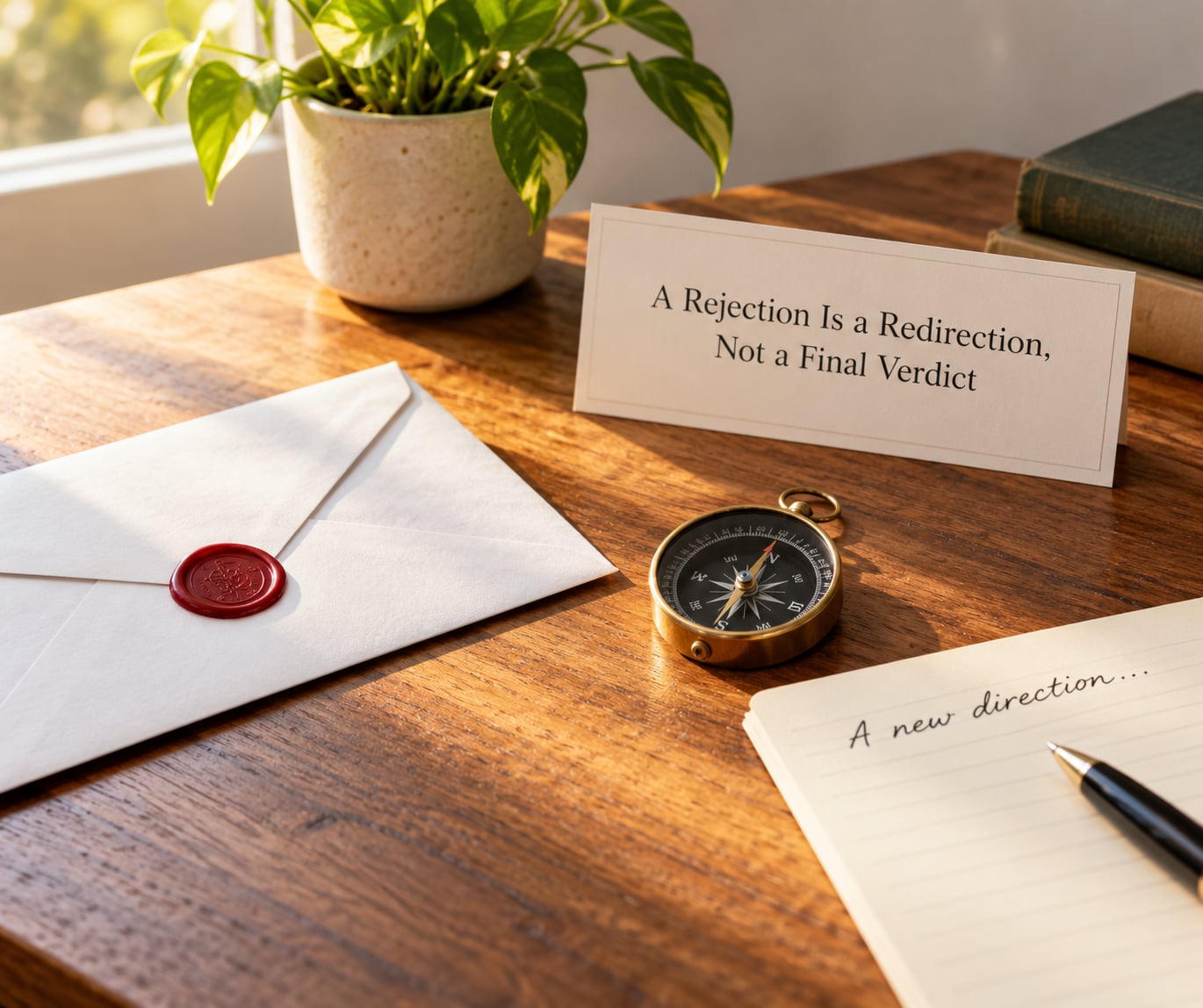
“Failure is not the opposite of success; it is part of success. The real danger is not to fail; it is to succeed but to fail in ways you don’t like.” — Bo Bennett
This is the one I use most, because it changes the grammar of the situation. Bennett takes failing out of the moral category and puts it in the practical one, which is exactly where a rejection letter belongs. The decision is a statement about fit at one organisation on one day, not a verdict on a person. Committees weigh a vacancy, a budget line, a roster gap. Often the call is made before anyone reads your work closely.
People who have been turned down repeatedly say the sting is real even when they know this intellectually. It still lands as a personal measure. The quote works as a separator: it puts the decision on one side of the table and your worth on the other.
Try this with the last application you sent. Write down the role, the organisation, and the one requirement you were weakest against. That gap is a work problem, and work problems have plans attached to them.
2. The Closed Door Can Lead to a Better Path
“Two roads diverged in a wood, and I took the one less traveled by, And that has made all the difference.” — Robert Frost
Frost wrote about choices, not rejections, but the line maps cleanly onto an admission decision. You applied to one programme with one imagined future attached to it. The no does not shrink that future; it just removes one door from a building with several.
Applicants describe this particular loss as the sharpest kind. It is not the programme itself, it is the story you had built around it. The honest recovery is to notice the story, then build the next one around somewhere that actually said yes to you.
Concrete version: list three comparable programmes or roles you would genuinely take, and check whether any of them close applications soon. Move the ambition from the fantasy option to a real deadline.
3. Keep Going After the No
“Success is not final, failure is not fatal: it is the courage to continue that counts.” — Winston Churchill
Churchill is not offering comfort, exactly. He is saying the only part of the process you control is the continuation, which is a tougher thing than encouragement. That matters in a week when four applications got declined in three days.
The pattern that does the damage is cumulative rejection, not single rejection. One no is a bruise. Six nos in a fortnight is burnout, and burnout does not respond to slogans.
Turn the quote into an action instead of a mood. Set a low bar for today: submit one application that is good enough, close the email tab, and go do something unrelated. Momentum is built out of small completed steps, not big feelings about the pile.
4. Failure Is Feedback, Not Your Identity
“It is our choices, Harry, that show what we truly are, far more than our abilities.” — J.K. Rowling
A rejection letter is one reader’s judgement on one document. It is a data point, not a character assessment. Writers collecting rejection slips tend to learn this the hard way, by putting a hundred of them in a drawer and noticing that the criticism repeats only two or three times.
Pull one lesson, not ten. Ask of the letter: was it about fit, timing, budget, or quality? Those four answers call for four very different responses, and only one of them is about your ability.
Then write the lesson on the envelope of the next application you send. That is how a stack of rejections turns into a system instead of an archive of shame.
5. The Next Attempt Starts with a Clearer Plan
“You can’t connect the dots looking forward; you can only connect them looking backwards.” — Steve Jobs
At the moment of a rejection, the dots make no sense. The pattern only shows up later, which is awkward when you have to decide tonight whether to try again.
The workaround is to build the dot deliberately. Before you resubmit anything, change one measurable thing: the length of the personal statement, the length of the pitch, the number of portfolio pieces, the specific results you lead with.
Vague improvement does nothing. “Try again harder” produces the same document. A named change, applied once, tells you whether the second attempt was actually different.
6. You Are Allowed to Begin Again

“It’s never too late to be what you might have been.” — George Eliot
Read this one when the gap is long. People return to applying, writing, or auditioning after years away and feel they have to begin at the level they left. You do not. The skill you built did not expire while you were busy elsewhere.
Restarting also means forgiving the version of yourself who stopped. That self made a reasonable decision with the information available. No amount of quotation repairs that, but it does stop the story from becoming “I am someone who quits.”
A fresh start needs a date, not a mood. Open a new document tonight and put a heading on it, even if the body stays empty for a week.
7. Success Can Arrive Through a Different Route
“Success is liking yourself, liking what you do, and liking how you do it.” — Maya Angelou
Angelou’s definition pulls the goal away from a single outcome. On a rejection day that is useful, because the story running in your head is narrow: this one role, this one programme, pass or fail.
A decline from one organisation tells you about that organisation’s needs on that day. It says very little about comparable rooms where the same skills are wanted, usually with less competition.
Write down the two or three comparable options and their actual timelines this week. If one of them closes while you are still mourning the first, that decision was made for you anyway.
8. Courage Is Trying Once More
“It always seems impossible until it’s done.” — Nelson Mandela
Mandela spent decades in prison and twenty-seven years in office, so the quote carries more patience than most rejection-day readers want. Read it less as reassurance and more as a description of the gap between starting and finishing.
The gap is where people quit. Applying is uncomfortable before you hear anything, then uncomfortable after, and the two uncomfortable stretches are separated by weeks of silence.
Put the next attempt in the calendar before you finish feeling bad about the last one. Sending the entry, the draft, or the pitch while you are still disappointed takes less willpower than waiting until you feel ready.
9. A Rejection Does Not Erase Your Preparation
“Nothing is absolutely impossible.” — Henry Ford
Everything you built to send that application survives the decline. The portfolio, the certification, the version numbers you fixed last month, the contacts who answered your questions. None of it was refunded.
This is the practical answer to the thought that a no means the work was worthless. In most fields the preparation transfers directly to the next application, and it is often the reason the next one gets further.
Keep the artefact. Save the version you submitted, note the date, and put it in a folder rather than a drawer. When you send the next one, you are not starting over, you are sending revision four.
10. Turn the Rejection into a New Beginning
Using quotes about rejection letters and trying again in your first 24 hours
“I have not failed. I’ve just found 10,000 ways that won’t work.” — Thomas Edison
Edison’s line is the most repeated rejection quote in existence, and it works because it converts a tally into research. The number is the point. Ten thousand attempts is not a story about defeat, it is a story about volume.
The version most people need is smaller and more specific. After a rejection email, do these four things, in order, and stop there for the day.
- Do not reply straight away. Rage replies to rejection emails are common and almost never useful. A short thank-you line is fine if you want the door open later; anything more is worth a day’s wait.
- Classify the letter. Clear no, request for revision, or no answer at all. These three call for different responses, and most of the frustration comes from treating a clear no like feedback.
- Write down the one change. One sentence about what you would do differently. Save it with the submitted version.
- Schedule the next attempt. A date in the calendar, not an intention. Applying again tomorrow is the whole point of the quote.
If the silence case is yours, the honest read is that a decision was never made about you. Ask how many applications went out with no reply at all in the last month. Silence tends to outnumber the letters that actually arrive.
Frequently Asked Questions
What is the best quote about rejection?
The one most people return to is Bo Bennett’s line that failure is not the opposite of success, and that the real danger is to succeed but fail in ways you do not like. It works because it separates one decision from your whole worth in a sentence. A rejection letter reflects one organisation’s needs on one day, not your ability. Use it the morning after, before you reread the email a fifth time.
What is a good quote about trying again?
Winston Churchill’s line that success is not final and failure is not fatal, and that the courage to continue is what counts, is the most useful one for action. It does not promise a good outcome, which makes it honest on a bad week. Pair it with one small task: submit one application that is good enough rather than waiting to feel ready.
What is a powerful comeback quote?
Thomas Edison’s line about not failing but finding ten thousand ways that won’t work reframes a tally as research. For a powerful short comeback, George Eliot’s it’s never too late to be what you might have been works after a long break. Both are quotable in one line and neither overstates what a rejection letter can tell you.
What is a famous quote about trying and failing?
Churchill and Edison are the two most cited. Churchill covers persistence after a setback, and Edison covers repetition and volume. For writers and musicians, J.K. Rowling’s line about choices showing what we truly are, more than abilities, separates the work from the person, which is the part rejection tends to blur.
What to say when getting rejected?
Say almost nothing at first. Write one sentence about what you would change, save it with the submitted application, and let the decision stand for a day. If friends ask, describing the outcome as one organisation’s fit at one moment usually lands better than a verdict on your future. When several rejections arrive at once, pick one reply to make and leave the rest alone.
Should I reply to a rejection email?
Usually no, and definitely not the same day. A brief thank-you is harmless and keeps a door open for a future application. Anything longer invites a response you do not control. If the letter asked for a revision, reply properly instead, thank them for the specific feedback, and send the revised version on schedule.
Conclusion
Pick one quote and keep it where you will see it, then let it do a specific job rather than a motivational one. Read the letter honestly, name the one thing you would change, and send the next attempt on a date you have already written down. That sequence works far better than waiting for the sting to fade before you try again.