The best quotes about fitness for a home gym wall are short, plain, and readable in a single glance while you are mid-set. Fifteen of them are below, each with a wall location and a styling idea so you can pick one line, hang it properly, and get on with training.
Most of the wall art I have seen in garages and spare bedrooms falls into one of two camps. Either it is a famous athlete line printed in thin grey letters across a huge canvas, which you cannot read from the weight rack, or it is a joke that made you laugh once and then bugged you every morning. The lines that survive on a real wall are the ones you wrote or chose yourself, because you can read them without thinking.
Two things shape every suggestion in this list. First, readability beats decoration: if you cannot read it from where you train, it is wallpaper. Second, one wall should carry one main message, so your eye lands somewhere useful instead of everywhere at once.
Table of Contents
- 1Quotes About Fitness for a Home Gym Wall at a Glance</
- 21. Strong Days Begin With Simple Starts
- 32. Consistency Outlasts Intensity
- 43. Make Movement Part of Your Day
- 54. Progress Counts Even When the Scale Stays Still
- 65. Rest Is Part of the Work
- 76. Discipline Is Choosing What You Need Today
- 87. Finish Before You Feel Finished
- 98. Your Home Gym Is a Place to Begin
- 109. One Rep Today Builds Tomorrow’s Habit
- 1110. Focus on the Next Good Rep
- 1211. Small Goals Create Big Momentum
- 1312. Earn Your Quiet Confidence
- 1413. Move With Purpose, Not Haste
- 1514. The Best Plan Is the One You Repeat
- 1615. Keep Showing Up for Yourself
- 17How to Use These Messages Without Turning the Gym Into a Billboard
- 18Choosing quotes about fitness for a home gym wall you can actually read
- 19Frequently Asked Questions
- 20Are these quotes safe to attribute to famous fitness experts?
- 21What is the best size for fitness quotes on a home gym wall?
- 22Where should I put a motivational quote in a small workout room?
- 23How many motivational quotes should I display in a home gym?
- 24How often should I change the quote on my workout wall?
- 25Can a fitness wall quote motivate someone who dislikes exercise?
Quotes About Fitness for a Home Gym Wall at a Glance</
All fifteen maxims are original lines written for this list, so there is no attribution problem and no risk of hanging a misquoted line in front of your family.
| Maxim | Mindset | Best wall location | Suits this reader or moment |
|---|---|---|---|
| Strong days begin with simple starts | Getting started | Above the dumbbell rack | Beginners and low-energy mornings |
| Consistency outlasts intensity | Steady effort | Beside a wall calendar | Anyone training more than once a week |
| Make movement part of your day | Frequent activity | Near a shelf or clock | Busy schedules and split sessions |
| Progress counts even when the scale stays still | Non-scale progress | Above the workout log | Strength and mobility work |
| Rest is part of the work | Recovery | Stretching corner or bench | Deliberate deload and rest days |
| Discipline is choosing what you need today | Self-direction | Entrance wall | Readers who resent hard-sell motivation |
| Finish before you feel finished | Goal focus | Band station | Final reps of a set |
| Your home gym is a place to begin | Inclusivity | Above the mat corner | Limited kit, shared spaces |
| One rep today builds tomorrow’s habit | Low-energy days | Small markable card | Days you only want to do one set |
| Focus on the next good rep | Form and attention | Eye level facing a mirror | Technique check during lifts |
| Small goals create big momentum | Concrete targets | Near the door | Building a new routine |
| Earn your quiet confidence | Internal validation | Opposite the equipment | Readers tired of comparison |
| Move with purpose, not haste | Deliberate form | Low, near the mat | Everyday safe practice |
| The best plan is the one you repeat | Sustainability | Above a habit grid | Programmes that keep breaking |
| Keep showing up for yourself | Long-term adherence | The wall you face first | Everyone, beginners included |
1. Strong Days Begin With Simple Starts
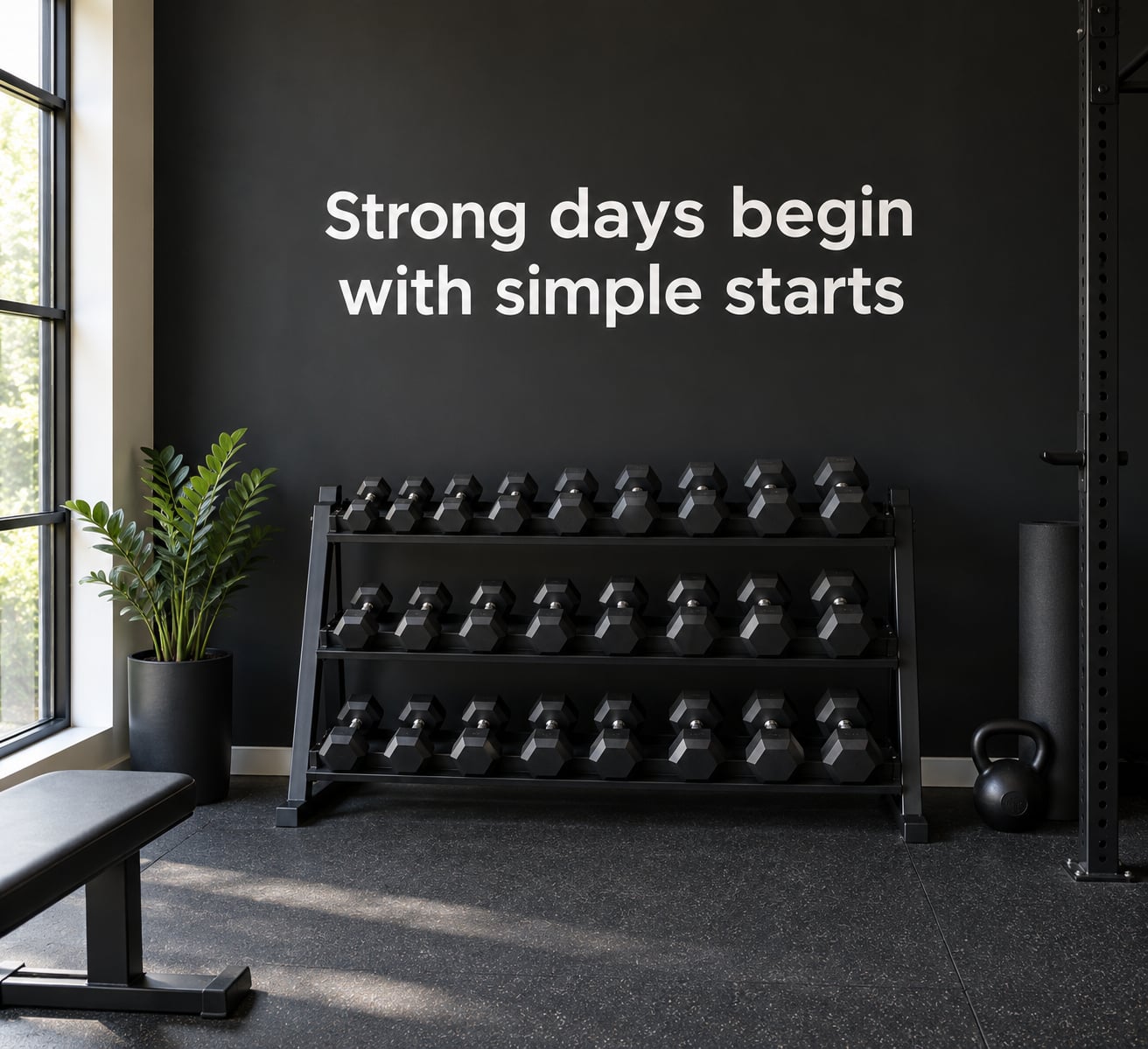
“Strong days begin with simple starts” works because the objection it answers is almost always logistical, not physical. People skip a session because getting changed and finding shoes feels like a bigger decision than it is.
Put it where you start rather than where you finish, which is normally above the dumbbell rack or the equipment you touch first. I like pairing it with a smaller line underneath, such as “TEN MINUTES IS ENOUGH TO BEGIN,” because it gives the reader an exit that does not feel like failure.
Sanity check the lettering from the floor position, not from a chair at your desk. If you cannot read the small line from where you stand, drop it and keep only the maxim.
2. Consistency Outlasts Intensity
“Consistency outlasts intensity” is the most useful thing on this list for people who keep restarting programmes. Steady moderate sessions, repeated for months, tend to beat heroic two-week bursts that end in a sore elbow and a cancelled membership.
Placement matters more than usual here, because the line only works where you are already in the habit of looking. A wall calendar or a whiteboard with boxes is the natural partner, and members of home gym forums on Reddit describe checking off a box as the moment the wall stopped being decoration and started being a prompt.
Style it plainly. One sans-serif typeface, generous spacing, and a checkmark shape or seven small squares beneath the words gives you something to interact with instead of just read.
3. Make Movement Part of Your Day
“Make movement part of your day” is written for people whose week is full. It does not ask for a session, so it survives a travel week, a broken sleep, or a house where the only free space is a hallway.
That makes it a good fit for a small secondary spot, such as the wall by a shoe rack or the shelf above where you keep a skipping rope. Pair it with a time cue, for instance “TWO MINUTES BEFORE THE SHOWER”, so the line describes a moment rather than an ambition.
Home gym owners posting in r/GetMotivated often describe these small, unglamorous reminders as the ones that survive a bad week, because they do not require changing clothes or planning a session.
4. Progress Counts Even When the Scale Stays Still
“Progress counts even when the scale stays still” is the antidote to the most demoralising gym moment, which is a week of good sessions with a number that refuses to move. Progress in a home gym often shows up in technique, endurance, mobility, or simply turning up on the days you planned to.
Hang it above wherever you keep notes, a training log, a whiteboard, a calendar, or a shoebox of receipts you will swear you will sort. The pairing does the work: the sentence sits directly over the evidence.
Keep the promise modest on the wall itself. It is a general encouragement, not a claim about anyone’s body, and words that stay honest tend to age better on a wall than words that promise a number.
5. Rest Is Part of the Work
“Rest is part of the work” gives a rest day a status that beginners rarely grant it. Sitting out a planned session usually feels like quitting, and a line on the wall can reframe it as part of the plan rather than a lapse in it.
Give it the least demanding wall in the room, near a stretching area, a recovery bench, or a corner with a mat. Not above the heaviest equipment, where it can undercut the effort you are making two minutes later.
To be clear about the limits: rest days are ordinary training practice, not medical advice. If you are managing an injury, an ongoing condition, or pain that does not settle, the person to ask is a doctor or a qualified physiotherapist, not a wall.
6. Discipline Is Choosing What You Need Today
“Discipline is choosing what you need today” reframes discipline as a decision rather than a punishment. On a heavy day it can mean showing up; on a tired day it can mean choosing an easy session, or deliberately resting, without deciding you have failed.
That makes it a strong entrance wall line, since you read it on the way in rather than in the middle of a set. It works in any style, and I would try it first as a minimalist single line inside a plain unbranded chalkboard frame, so the wording carries the weight and the frame stays quiet.
Readers who dislike motivational shouting tend to respond well to this one. It asks for a choice rather than promising a result, which is a much smaller promise to keep.
7. Finish Before You Feel Finished
“Finish before you feel finished” is a goal-oriented line for the last reps of a set, when stopping early is a choice rather than a limit. It works best when it has an obvious visual partner, like a marked line on the floor or a fixed position on the bar.
Print it large and hang it above a resistance-band station or a pull-up bar, somewhere it stays readable while you are moving. Big type here is functional, not decorative.
One important distinction: this line is about finishing planned, sensible work, not about ignoring your body. Sharp pain, dizziness, or anything that feels wrong ends the set. Persistent problems belong with a doctor or physiotherapist, and no slogan is worth training through them.
8. Your Home Gym Is a Place to Begin
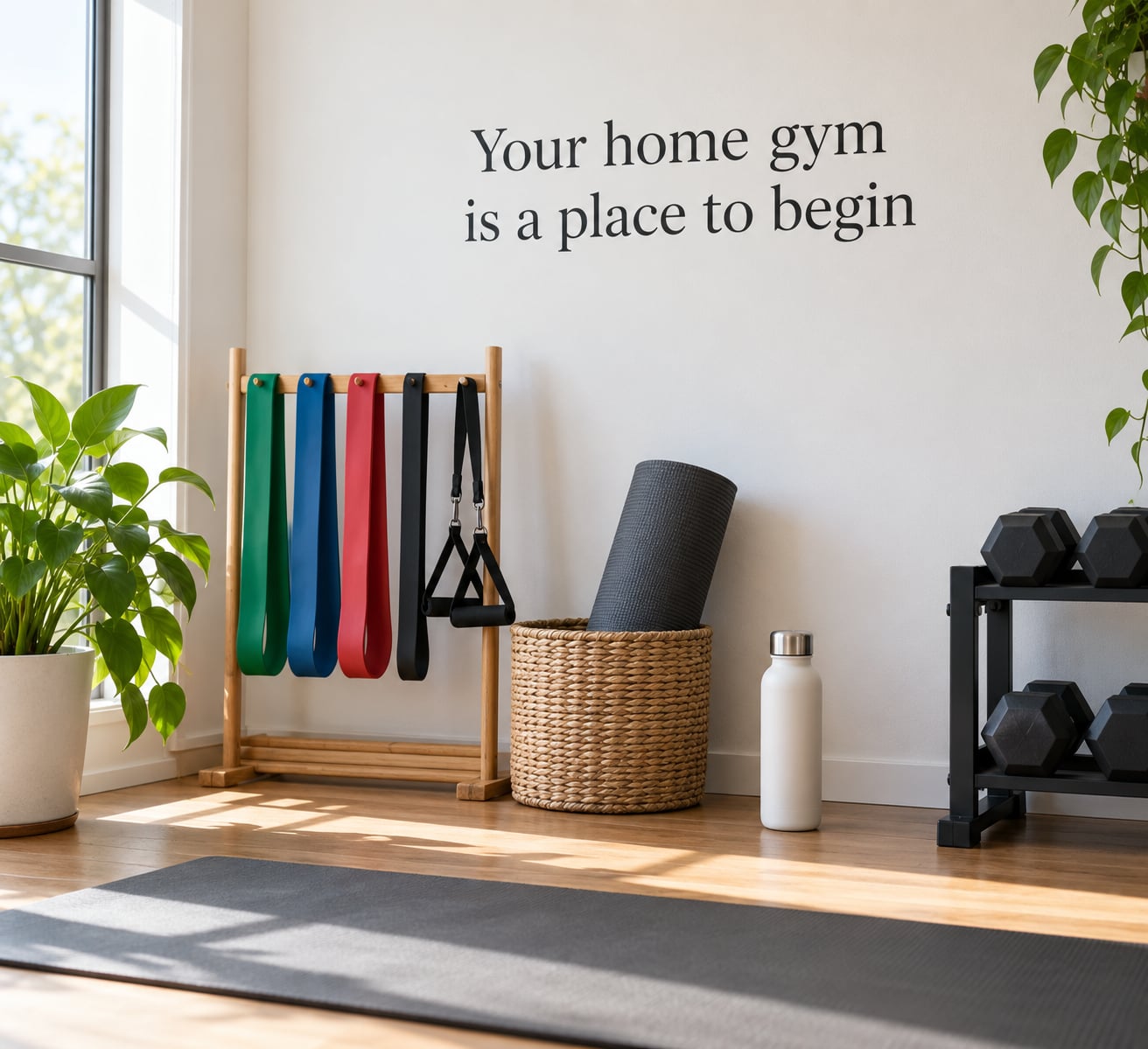
“Your home gym is a place to begin” is the most inclusive line in the collection. It works for someone with a mat, two bands, and a water bottle, which describes a lot of home gyms that exist outside store advertising.
It also does something practical for beginners. Rooms with visible equipment can feel like places where people who already belong are working, and a line that lowers the bar removes the sense that you are being measured against anyone.
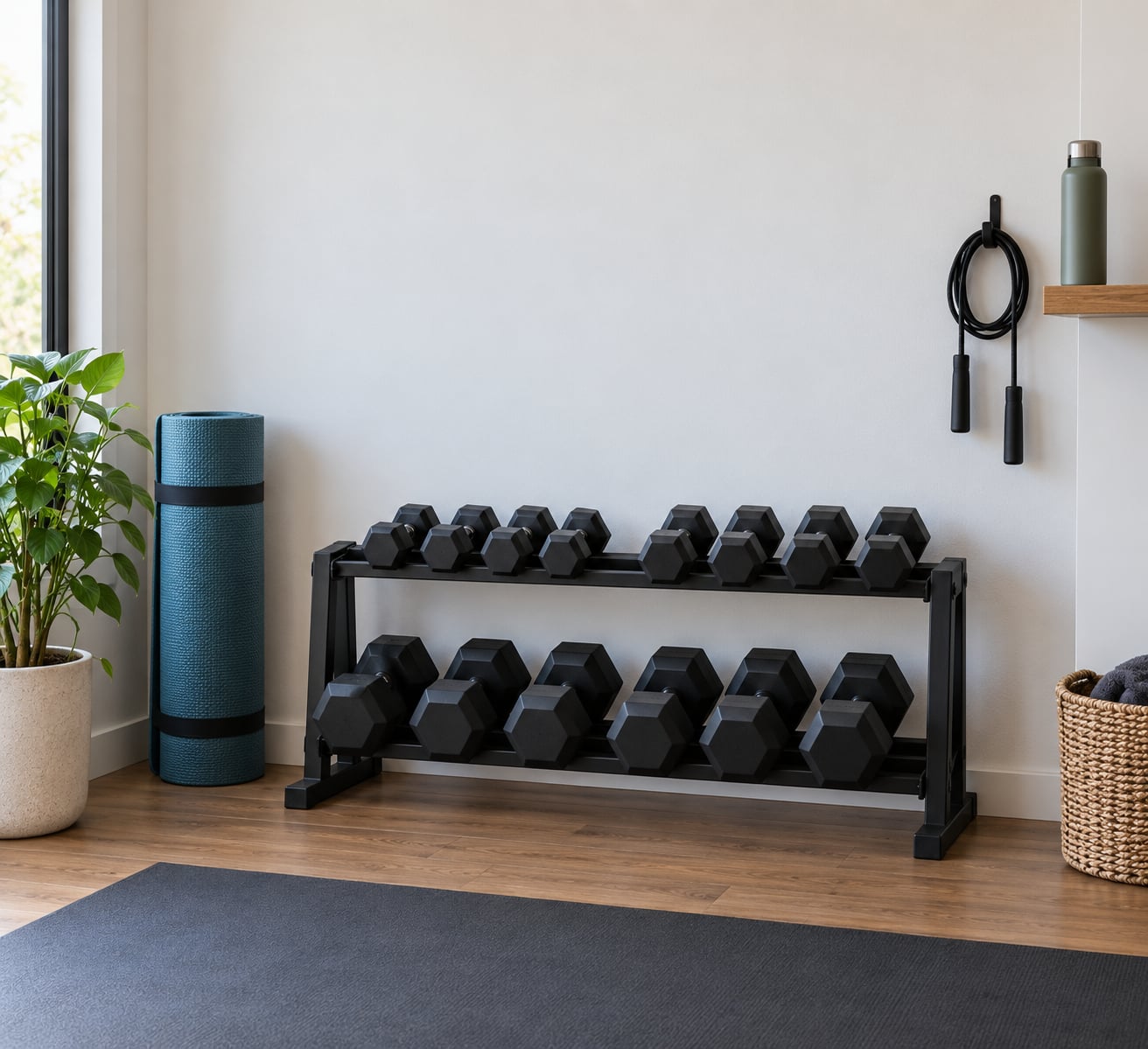
Pair the words with the actual tools you own. Bands hung on hooks, a mat rolled against the wall, and a bottle on a shelf say more than a photograph of a commercial gym ever will, because the message matches the room.
9. One Rep Today Builds Tomorrow’s Habit
“One rep today builds tomorrow’s habit” is built for the low-energy day, when the honest realistic option is one set instead of none. It lowers the target and keeps the chain intact, which is the part that matters for adherence.
This is a line to frame small rather than large. A quote card sized like a postcard, hung near the mat or the coffee maker, tells you it is a nudge rather than a command. Leave a blank line or a small square underneath so you can mark the day yourself.
Forum readers often point out that personal mantras stick around longer than borrowed ones. If you write your own version in the space beneath it, this wall gets better with use.
10. Focus on the Next Good Rep
“Focus on the next good rep” narrows attention to a single repetition instead of the whole set. That is easier to hold onto when the set is long or the weight is honest, because there is less left to think about.
Eye level on the wall you face during a lift is the right spot, which usually means the wall opposite the mirror. That way the line shows up in the same glance as your reflection, without you having to turn your head.
Read the word good as controlled, not maximal. The line is about form and range, which is also the safest reading of it. Anyone uncertain about technique for a particular lift should get it checked by a qualified trainer rather than copied off a wall.
11. Small Goals Create Big Momentum
“Small goals create big momentum” solves a specific problem: a vague intention has nothing to tick off. A target you can finish today gives you a finished thing, and finished things are what make tomorrow easier to start.
Turn the maxim concrete with a strip of lettering or a card beneath it, such as “2 MINUTES, 3 SETS, REPEAT TOMORROW.” That example suits a home gym built around short sessions, and it reads as a plan rather than a slogan.
Near the door is the strongest position, because it catches you on the way in, when deciding is still possible. Once you are mid-session, a goal written at the entrance is behind you and out of sight.
12. Earn Your Quiet Confidence
“Earn your quiet confidence” points at repeatable preparation instead of outside validation. It suits readers who are tired of public progress posts and would rather rely on what they did last Thursday than on a feed.
Mount it opposite the equipment, where you see it while resting between sets or changing plates. That reflective position is the reason this line works there rather than above the rack.
Keep the treatment restrained: one typeface, matte finish, no frame glare. A confident line printed in a loud decorative style undermines itself, which is a good rule for most wall maxims in this list.
13. Move With Purpose, Not Haste
“Move with purpose, not haste” favours deliberate form over speed, and it reads as a safety instruction rather than a pep talk. It is a good default line for a home gym, because the person most likely to rush is the one training alone without a spotter.
Place it low and near the mat, where it does not compete with the main message. If your room has one strong line, that line probably belongs somewhere more visible.
The wording is not a green light to push through warning signs. Pain, dizziness, or loss of control in a movement means stop, and if it keeps happening, ask a doctor or a qualified physiotherapist. Serious symptoms need professional care, not encouragement.
14. The Best Plan Is the One You Repeat
“The best plan is the one you repeat” argues for a routine you will actually keep rather than an ideal programme you abandon in March. It suits anyone who has started something ambitious and stopped.
A seven-day habit grid is a natural companion, one row per day with a small mark for each session you complete. Wall owners on home gym forums describe grids as less intimidating than a full calendar because the unit is a day, not a target.
One caveat worth stating plainly: repeating a plan is an argument for good equipment and sound technique, never a reason to keep using a broken rack, a frayed band, or a movement that hurts. Retire anything unsafe and speak to a qualified professional about form.
15. Keep Showing Up for Yourself
“Keep showing up for yourself” closes the list because it is the least demanding and the most durable. It suits beginners, long-timers, and anyone whose training week has been rearranged by work, travel, or family.
Framing options change the tone rather than the meaning. A thin sans-serif in matte black suits a plain room, a handwritten script suits a warmer space, and a chalkboard treatment suits a garage that already has other working surfaces on the wall.
If your room is small, make this one the visually dominant quote. The most useful thing these quotes about fitness for a home gym wall can do is be read once a day by someone training alone, which argues strongly for one big readable line rather than four small competing ones.
How to Use These Messages Without Turning the Gym Into a Billboard
The failure mode with gym wall art is not a bad quote. It is five good ones competing for attention, in mismatched frames, at a size you can only read from two feet away.
Choosing quotes about fitness for a home gym wall you can actually read
Use viewing distance as the sizing rule rather than the size of the wall. A common signage guideline is roughly one inch of letter height per ten feet of viewing distance, so letters about 6 to 8 inches tall suit a wall you read from across the room, and anything above 10 inches is for a wall read from across a garage.
Contrast matters more than typeface. Light lettering on a dark wall, or dark lettering on a light one, reads well even in a dim room with a single overhead fixture. Grey on grey, which appears constantly in print catalogues, disappears at workout distance.
Glare is the other problem. A framed print angled toward a window or a bright lamp becomes a mirror at exactly the moment you glance up, so test it in the position where the light actually falls.
Then narrow it down. One primary maxim per zone is plenty, and one changeable element, such as a weekly goal card or a small framed card you swap each Sunday, gives you variety without a second fixed message competing for the wall.
For renters, decals are the option people in forum threads recommend most often because they come off and take the paint with them. For a permanent wall, paint directly on the drywall is another route people report using, and it costs nothing beyond a steady hand. Whatever you choose, follow the manufacturer’s instructions for the surface and test a small patch first.
Frequently Asked Questions
Are these quotes safe to attribute to famous fitness experts?
No, and please do not attach a name to them. Every maxim in this list was written for this article, so attributing any of them to an athlete, coach, or philosopher would be a false citation. If you want an attributed line, use a primary source such as an interview, a book, or a post, and quote it exactly. A personal line you wrote yourself is often the better wall message anyway.
What is the best size for fitness quotes on a home gym wall?
Size to the distance you will read it from, not to the wall. A common signage guideline is about one inch of letter height for every ten feet of viewing distance. For a wall you read from across the room, letters around 6 to 8 inches tall work well. For a garage wall read from further back, go above 10 inches and keep the wording to a single short line.
Where should I put a motivational quote in a small workout room?
Put the main line on the wall you face while training, at roughly eye level, and clear of the equipment you use most so it is not hidden behind a rack. In a small room the entrance wall works well for a second, shorter message about getting started. Avoid the wall directly behind a mirror, where reflections and equipment make the text harder to read.
How many motivational quotes should I display in a home gym?
One per zone is the practical limit, and in a small room that means one or two in total. Wall owners on home gym forums generally report that several competing signs become clutter and stop being read within a few weeks. If you want variety, keep the permanent text to a single maxim and swap a small card each week instead of adding more fixed pieces.
How often should I change the quote on my workout wall?
Roughly every three months is a good rhythm, according to home gym owners posting in fitness forums who rotate their wall messages. Frequent enough that the line still gets read, infrequent enough that you are not changing it weekly. If you want something more current, use a small removable card and update that weekly while the main wall text stays put.
Can a fitness wall quote motivate someone who dislikes exercise?
Rarely on its own. Wall quotes work best as a small nudge on days you already plan to train, not as a replacement for finding an activity you genuinely enjoy. If exercise feels genuinely unpleasant rather than simply effortful, that is worth discussing with your doctor, since low mood and loss of interest in usual activities are worth raising with a clinician.
Start with one line: pick the maxim that describes the part of training you find hardest, hang it where you will actually read it, and size it for that distance. If you want more, add a small changeable card rather than a second fixed sign, and change the main line once a season.