
The Eisenhower line almost everybody wants is short: plans are worthless, but planning is everything. He said versions of it across fifty years of public life, and each version points at the same idea — the document is disposable, the thinking behind it is not.
Collecting quotes about Dwight Eisenhower and planning is trickier than it looks. The famous wording was popularized by another author, the exact phrasing changes depending on the year, and half the versions circulating online have no source at all. So I pulled the documented wordings, lined up what each one was said in, and attached a practical use to every one.
If you only need the answer, this is it: the most-cited Eisenhower planning quote is “Plans are worthless, but planning is everything,” popularized through Richard Nixon’s 1962 book Six Crises. His own fullest version, from a November 14, 1957 speech, is “In preparing for battle I have always found that plans are useless, but planning is indispensable.” Eisenhower himself credited an unnamed Army soldier with the idea.
Table of Contents
- 1Quotes About Dwight Eisenhower and Planning at a Glance
- 21. Planning Is Everything, Not Just the Final Plan
- 32. Preparing for the Worst While Acting Toward the Best
- 43. A Plan Is an Arrangement, Not an Intention
- 54. The Plan Must Fit the Objective
- 65. Flexibility Is Essential When Conditions Change
- 76. Study Past Operations Instead of Copying Them
- 87. Coordination Is as Important as Individual Effort
- 98. Timing Is a Strategic Resource
- 109. Decisive Leadership Still Requires Preparation
- 1110. Begin with a Clear Objective and a Review Date
- 12Frequently Asked Questions
- 13Did Dwight Eisenhower say “Plans are nothing, but planning is everything”?
- 14What does “Plans are worthless, but planning is everything” actually mean?
- 15Who actually originated the saying about plans and planning?
- 16What is a famous quote about the importance of planning?
- 17What is the main message of Eisenhower’s 1957 speech?
- 18Conclusion
Quotes About Dwight Eisenhower and Planning at a Glance
Here is the short version of all ten, with where each one comes from and a question to sit with. Wordings marked variant circulate without a firm primary source.
| Quotation | Planning lesson | Source or context | Ask yourself |
|---|---|---|---|
| Plans are worthless, but planning is everything | Preparation outlives the document | Popular form, popularized via Nixon’s Six Crises, 1962 | What did the planning teach me that the plan never did? |
| In preparing for battle I have always found that plans are useless, but planning is indispensable | Fullest stated version; two ideas, not one | Speech at the National Defense Executive Reserve Conference, November 14, 1957 | Which of my current plans are actually still true? |
| Peace-time plans are of no particular value, but peace-time planning is indispensable | Prepare in calm conditions for the ones you cannot predict | Eisenhower letter, 1950, recalling his early Army training | What am I rehearsing while things are still quiet? |
| Plans are useless, but planning is essential | Same idea, compressed for a slide | Circulating variant | Am I defending a document or serving the goal? |
| Plans are nothing; planning is everything | Sharpest cut, weakest sourcing | Widely circulated variant | Does this sound confident because it is true, or because it is punchy? |
| Plans are of little importance, but planning is essential | Softening the claim without changing it | Circulating variant | Where am I confusing activity with progress? |
| Before a battle, planning is everything | The line under pressure, not before it | Circulating variant | When is my deadline actually a battle? |
| Plans can make a prisoner of us all, but the act of planning is truly invaluable | Warning about commitment to a stale intention | Modern restatement, University of Connecticut undergraduate research page, 2024 | What intention of mine is quietly holding me hostage? |
| A 1871 statement by Moltke the Elder on the limits of plans | The idea predates Eisenhower by decades | Antecedent saying, 1871 | Whose old am I being? |
| A 1941 statement by Winston Churchill on preparation and surprise | Preparation survives the surprise it was built for | Antecedent saying, 1941 | Which surprise have I already half-seen coming? |
1. Planning Is Everything, Not Just the Final Plan

Every collection of quotes about Dwight Eisenhower and planning starts here, because this is the version that escaped into general culture. The line splits one word into two ideas, and the second idea is the whole argument.
“Plans are worthless, but planning is everything.”
A plan is a snapshot. It fixes an assumption about weather, staffing, budget, timing and about what other people will do, and every one of those assumptions can break. The planning that produced it did something more durable than the plan itself: it forced you to look at the problem, list what you had, name the risks and decide in advance what mattered most.
That knowledge survives the failure of the document. When the plan goes sideways, the person who planned well can still tell you which of three prepared options to take. Someone who skipped to the answer and never examined the problem just watches.
The wording people quote most is also the one with the weakest paper trail. Richard Nixon’s 1962 book Six Crises is where this version spreads widely. Eisenhower used it, but it travelled through other hands on the way to your feed.
Practical test: after a project falls apart, write down what the planning revealed — not what the schedule promised. If that second column is empty, the team had a plan but no planning.
2. Preparing for the Worst While Acting Toward the Best
The less-quoted 1950 line shows where his thinking started, and it is the one business readers skip past.
“Peace-time plans are of no particular value, but peace-time planning is indispensable.”
In that letter Eisenhower was recalling his early Army training, where officers studied maps of a place they might never fight in, like Alsace-Lorraine, walking through ground they had no intention of visiting. The exercise was worthless as a plan for any specific coming event. It was invaluable because it built a working knowledge of terrain, roads, supply and difficulty that arrived before the emergency did.
This is not pessimism dressed up as strategy. Expecting failure makes you cautious and slow. Preparing for plausible failure makes you faster, because the expensive part of a crisis is the part you did not think about in advance.
Concrete case: a marketing lead has a product launch on a fixed date and learns that one contractor is three weeks behind. A team that planned in calm conditions already knows which parts of the launch can slip without breaking it, and which cannot. The launch moves by three weeks instead of collapsing.
Ask what you would do differently if the setback landed tomorrow. Write that answer while conditions are calm. That is peace-time planning doing its job.
3. A Plan Is an Arrangement, Not an Intention
A well-formed plan is a careful arrangement: named people, dated actions, assigned resources and a stated order. Anything looser than that is a hope with a deadline attached, and Eisenhower’s own record offers the test.
He ran the largest coordinated Allied operation in history through people he had not personally chosen, across three service branches and several allied governments. If vague intention had been enough for D-Day, none of it would have worked. The invasion ran on arrangements — landing schedules, artillery preparation, transport allocation, deception efforts to convince Germany the main attack would land elsewhere.
Here is a fast way to test your own plan. Read it and point to the person who owns each task, the date each one is due, and what happens if it slips. If your finger lands on nobody or on nothing, you are working with an intention. That is a normal and useful early stage, but do not call it a plan.
The gap between the two is where most missed commitments come from. Not from bad ideas, but from arrangements nobody finished writing down.
4. The Plan Must Fit the Objective
People plan before they decide what they are planning for. The result is a busy schedule pointed at a fuzzy goal, and a schedule is not a strategy.
Before you list any tasks, write the outcome in one sentence with a date attached. Not “improve engagement” — “grow weekly active users from 4,000 to 6,000 by the end of the quarter.” The second version immediately tells you which tasks belong and which are decoration.
Then work backwards. If the outcome is a one-day community workshop, the arrangement is specific and finite: a date, a room or platform, a headcount, a budget, a signup page that opens four weeks out, a speaker confirmed six weeks out, reminders the week before. Every task traces to a requirement of the outcome. The ones that do not, get cut.
Most plans that fail were never badly executed. They were well-executed plans for the wrong objective, which is why a tight schedule on the wrong target feels like progress right up until it does not.
My own test: if two tasks in your plan would still be worth doing under a completely different objective, one of them probably belongs to a different plan.
5. Flexibility Is Essential When Conditions Change
There is a difference between abandoning your purpose and abandoning your route. Eisenhower’s remark only makes sense if you keep that distinction straight.
“In preparing for battle I have always found that plans are useless, but planning is indispensable.”
Before D-Day the Allied command prepared for a landing on a wide front in northwest France, on a specific date, with weather windows and tides that all had to line up. Eisenhower’s own contingency plan had a landing at Pas-de-Calais preserved as the alternative, and on June 6 the weather broke. The purpose — a foothold in France that forces the Germans to commit reserves — was untouched. The route changed entirely.
That is what preparation buys: the ability to switch without starting over. An unprepared team facing the same weather has no second option, so it improvises under pressure. An over-prepared team facing it has already costed option two and can price option three on the spot.
Where this goes wrong at work is attachment to the artifact. A status report that says the schedule slipped, when the real answer is that the schedule is now wrong, is a team defending a document instead of a goal. Revise the route, keep the objective visible.
6. Study Past Operations Instead of Copying Them
Eisenhower’s career gave him an unusual volume of after-action material, and he used it as a working method rather than a ceremonial one. Understanding why an operation succeeded or failed was how the next one improved.
Most teams do the opposite. A process gets built during a hard quarter, works under pressure, and then sits in the toolkit for years. Nobody reopens it because it still functions. Meanwhile the staffing, tools and regulations around it have changed three times.
Make it a habit instead. Once a quarter, pick one finished project and write four lines: what we expected, what actually happened, which assumption was wrong, what we will do differently. Four lines, half an hour, once per quarter is enough to keep your process honest.
The value shows up in the second project run on the same template. The first one built the checklist. The second one should be the version that has learned something, and it cannot learn anything unless somebody looks.
Eisenhower’s lesson is not that plans change. It is that understanding has to keep pace with them.
7. Coordination Is as Important as Individual Effort
Individual pieces of a plan can each be excellent and still fail to produce a result, because planning is mostly a problem of connection rather than quality.
An operations plan from the Second World War was not one good idea. It was a set of separate efforts — naval gunfire, airborne drops, airborne and seaborne landings, engineering work on the beaches — that had to land in a narrow window, in the right order, under one command. Getting that coordination right took longer than the assault itself.
Most failed projects I have looked at were not talent problems. Two competent teams produced excellent work on incompatible assumptions, and the mismatch only surfaced in the final week, when there was no time to reconcile anything.
Three questions settle most of it before work starts. Who owns each deliverable, by name. Which assumption does this task depend on, and who else relies on it. What gets communicated when one task moves by more than a few days. Answer those in a single shared document and a large share of coordination failures simply never arrive.
Planning is a group act. Treat the handoffs as the real work and the schedule takes care of itself more often than not.
8. Timing Is a Strategic Resource
Sequence is the part of planning most people skip, and it is where readiness is won. Doing the right work in the wrong order loses most of its value.
The 1950 letter already contains this. Eisenhower described officers walking through maps of a region they had no reason to expect to fight in, learning the ground in advance because the alternative was learning it under fire. Preparation is about arriving with understanding already in place.
In practical terms, three questions decide sequence. What must be true before anything else can start. What can be prepared without waiting on anyone. What becomes harder or more expensive the longer it waits.
Applied to a small team: confirm speakers and the venue before the marketing push, since promotion aimed at the wrong date wastes a month. Write the run sheet and the contingency for the day itself early, because it is cheap in calm conditions and unusable under pressure.
Delay is not a neutral choice. Every week a decision waits, the set of facts around it gets smaller and your options get worse. Most competent planning is simply the discipline of acting on information you already have.
9. Decisive Leadership Still Requires Preparation
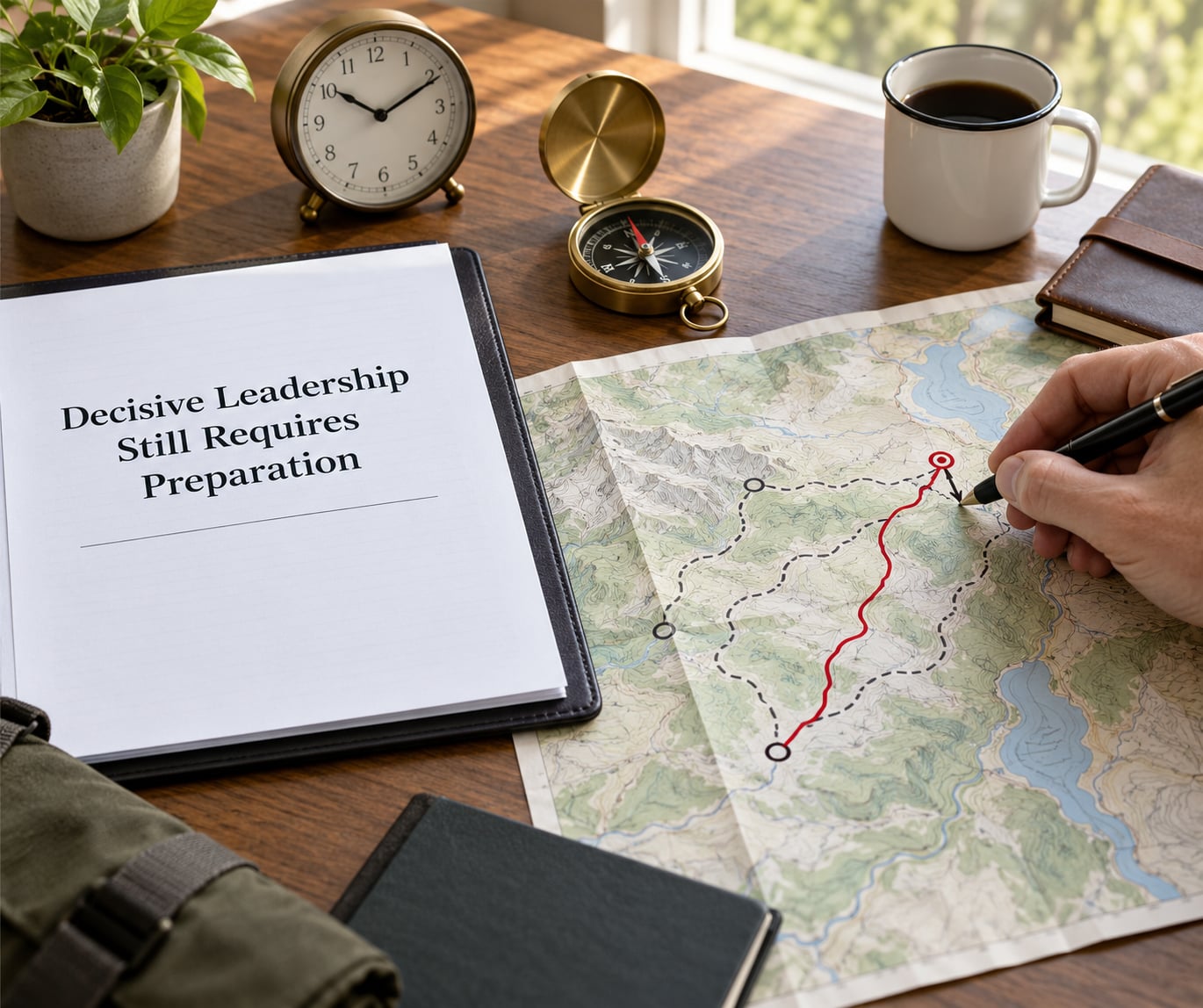
Leaders who admire this quote sometimes hear it as permission to hesitate. It is the opposite. Preparation is what makes fast decisions possible.
Eisenhower committed to the Normandy invasion months before the landing, against significant Allied objection, and then held the date while the only ingredient still missing, usable weather, was negotiated. That is what a prepared decision looks like: the choice is made on the evidence available, the conditions you cannot control are watched separately, and the plan does not collapse because one assumption slips.
Give your own decisions the same shape. Set a date by which you decide, before you have all the information, and write down what evidence would change your mind. That single line does most of the work — it converts hesitation into a specific question you can go and answer.
The failure mode is waiting for certainty that never arrives. A leader with a prepared plan knows the difference between a new fact and a new feeling, because the plan already says what the important variables are.
Decide against the best information you have, keep the date, and revise the route rather than the objective.
10. Begin with a Clear Objective and a Review Date
Pull the ten lines together into one routine that takes about fifteen minutes and works for a launch, a hire, a course or a personal year.
Step one, write the outcome with a date. One sentence, measurable, dated. Everything else hangs from this.
Step two, list what you have. Time, money, people, tools, access. Being honest about the shortage shapes the plan better than optimism does.
Step three, assign the next three actions. Named person, named date, no ambiguity. Three is enough to start, and starting produces information that planning cannot.
Step four, name two risks and write what you would do about each. Two is enough to change behavior. Eleven would not be done.
Step five, put a review date in the calendar before you leave. This is the step people skip, and it is the one that keeps the plan alive. An unreviewed plan becomes a stale plan, and a stale plan becomes a prison, which is exactly the warning in the modern restatement of Eisenhower’s idea: plans can make a prisoner of us all, while the act of planning stays valuable.
Repeat the routine whenever conditions shift. Fifteen minutes, twice a year, does more for most projects than a large planning document nobody updates.
Frequently Asked Questions
Did Dwight Eisenhower say “Plans are nothing, but planning is everything”?
He said it, but not first in that form. Eisenhower used versions of the line in a 1950 letter and in a speech on November 14, 1957, where his fullest phrasing was “In preparing for battle I have always found that plans are useless, but planning is indispensable.” The short version everyone quotes was popularized after his presidency by Richard Nixon in the 1962 book Six Crises. Eisenhower also credited an unnamed Army soldier with the underlying idea.
What does “Plans are worthless, but planning is everything” actually mean?
It separates the act of planning from the finished plan. A plan is a set of assumptions written down at one moment, and those assumptions break as soon as circumstances move. The planning behind it forces you to examine the problem, weigh options, anticipate contingencies and decide what matters most. That judgment survives the failure of the document, which is why the second half of the line matters more than the first.
Who actually originated the saying about plans and planning?
Nobody can pin it down completely. Eisenhower told the 1957 audience he had heard it in the Army and believed it came from a soldier he could not name. Quote researchers also trace related statements to Moltke the Elder in 1871 and to Winston Churchill in 1941, which suggests the idea circulated in military circles long before Eisenhower repeated it. He popularized it; he did not invent it.
What is a famous quote about the importance of planning?
Beyond the Eisenhower material, the most widely cited lines are Helmuth von Moltke the Elder’s insistence that plans are only the first step and that circumstances must be studied continuously, and Winston Churchill’s warning in 1941 that surprise is the most dangerous enemy and that preparation is the answer to it. Sun Tzu’s line that victory belongs to the side whose preparation meets the moment is the oldest of the group.
What is the main message of Eisenhower’s 1957 speech?
The November 14, 1957 address to the National Defense Executive Reserve Conference argued that no plan survives contact with events, so nations should spend peace-time effort on planning rather than on the reassuring appearance of a settled plan. Eisenhower also noted that an emergency, by definition, is the thing nobody planned for, which is precisely why preparation has to happen before it arrives.
Conclusion
The lesson underneath every version of Eisenhower’s line is not prediction. It is disciplined preparation: know the objective, name the risks, prepare alternatives, and revise the route when the facts move. Plans fail on schedule, and good planning is what stops that failure from becoming confusion.
Do one thing today. Write a single objective with a date on it, put a review date in your calendar before you close the tab, and keep the plan loose enough to change. That is the whole method, and 2026 is a fine year to start using it.