
Verifying a Bible quote before posting it takes about sixty seconds: search the exact wording in a trusted online Bible, open the reference it returns, name the translation, and read the surrounding verses before you hit share. If the search returns nothing, the line is a paraphrase or an invention, and you can trace it to the closest real verse or leave it alone.
This guide is about checking quotations, not about whether scripture is true. Both are reasonable questions and they need different tools, and mixing them up is how arguments go sideways.
Here is the whole method in six moves:
- Search the exact wording in a Bible search box, inside quotation marks.
- Open the reference the search returns and read the whole verse, not the fragment.
- Name the translation every single time you repost the line.
- Read the paragraph around the verse, not the verse alone.
- Check punctuation and quotation marks for dropped or added words.
- Post the citation with the quote, so the next person can check you in five seconds.
Table of Contents
- 1What You Need to Verify a Bible Quote
- 2Step-by-Step: How to Verify a Bible Quote Before Posting It
- 31. Identify the exact verse and claimed source
- 42. Check the wording against a trusted Bible source
- 53. Confirm the translation and citation details
- 64. Read the surrounding context
- 75. Check punctuation, quotation marks, and formatting
- 86. Perform a final source and shareability check
- 9Common Mistakes in Verifying Scripture
- 10Frequently Asked Questions
- 11What is the most reliable way to verify a Bible quote?
- 12How do I check whether a Bible verse was copied correctly?
- 13Is it acceptable to combine wording from different Bible translations?
- 14How much context should I include when sharing a Bible verse?
- 15Can I post a Bible verse paraphrase as a direct quote?
- 16Why do different Bible translations use different wording?
- 17Check the Reference and the Translation First
What You Need to Verify a Bible Quote
You need five things, and four of them are free and already on your phone. The whole setup takes about two minutes once and then you are done for good.
- The quotation exactly as it appears, punctuation and capital letters included. Screenshot the original rather than retyping it, because retyping is where words quietly change.
- The claimed reference, if there is one. A quote with no reference is not a verse yet, it is a sentence someone likes the sound of.
- A trustworthy online Bible with a search box and version labels printed next to every passage.
- A second source for anything that looks odd, plus a concordance or commentary when you need to see how a word is used elsewhere.
- A decision about which translation you will use, made once, so your captions stay consistent.
These are the free sources I would keep open in tabs. None is more correct than another; they differ in what they show you.
| Tool | What it does | Best for |
|---|---|---|
| Bible Gateway | Searches many translations side by side | Comparing wording across versions |
| Bible Hub Interlinear | Shows the original Greek or Hebrew word by word | Checking what a key term actually means |
| Blue Letter Bible | Splits the text into original words with definitions | Verifying a single phrase against the original language |
| STEP Bible | Layered word study and translation comparison | Digging into one verse properly |
| Bible Study Tools | Concordance, cross-references and topic searches | Finding where an idea appears elsewhere |
| Logos Bible Software | Large library of books and commentaries, paid | Deeper study once you outgrow free sites |
Whichever you pick, cite the translation in parentheses at the end of the quote. Forum readers treat a missing version label as the end of the conversation, and they are right to.
Step-by-Step: How to Verify a Bible Quote Before Posting It
1. Identify the exact verse and claimed source
Before you open a single Bible app, write down four things: the wording, the reference, the translation, and who said it. That last one gets skipped more than any other, and it changes how you check everything else.
If the quote has no reference attached, that is your first finding. There is nothing to verify yet. Search the distinctive part of the sentence, and treat the result as a lead rather than a confirmation.
Watch for the pattern of stitched-together quotes, where a line pulls from one verse and the next from another and gets posted as a single passage. If two references turn up, it is two quotes.
2. Check the wording against a trusted Bible source
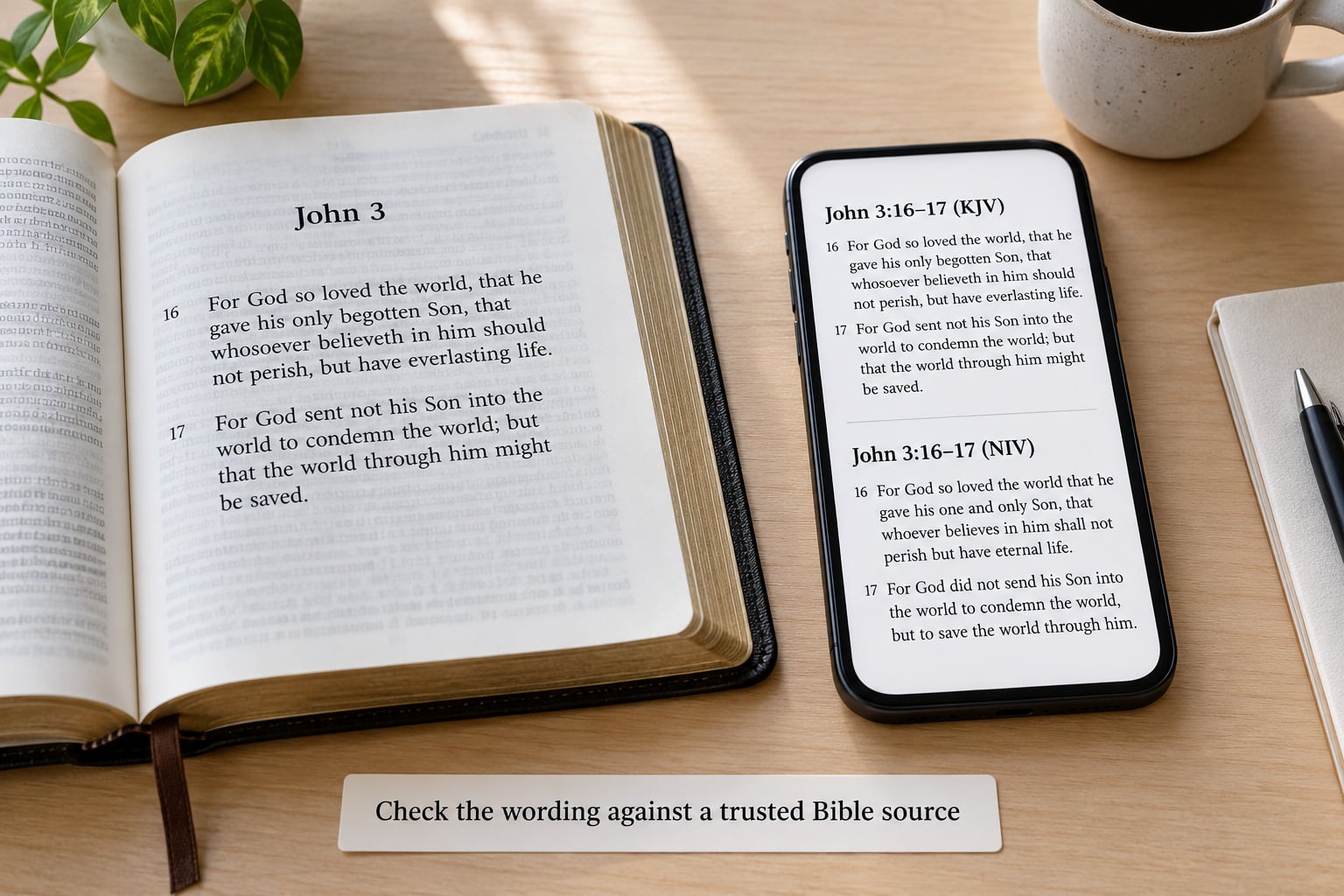
Paste the wording into a Bible search box with the exact phrase in quotation marks. Punctuation will throw a search off, so strip it and keep the distinctive run of five or six words.
No results means one of three things: the line is a paraphrase, it is a misquote of a real verse, or it was invented. All three are worth knowing about, and all three send you back to the same next move, which is tracing the phrase to the closest real verse.
Then open the reference the search gives you and read the complete verse, not the fragment you were given. A dropped half-verse can change the entire meaning of a line, which is exactly how a proverb becomes a slogan.
One more thing here, and it trips people up constantly: a handful of passages appear in some translations and are footnoted, bracketed or omitted in others. Matthew 17:21, Mark 7:8-9, Acts 8:27-28, John 7:53 through 8:11, and 1 John 5:7-8 are the ones people ask about most. If a verse you found on one site is missing from the version you quote, that is a translation and manuscript question, not proof that somebody made the verse up.
3. Confirm the translation and citation details
Once you have the verse, check the same reference in two or three translations and see which one you are actually quoting. The differences are small and they are enough.
John 3:16 in the King James Version says “only begotten Son.” The New International Version says “one and only Son.” If you quote the second and someone checks the first, they will conclude you invented it, and you will spend a day defending a verse you quoted correctly.
The same thing happens with Greek and Hebrew terms that English flattens, and with passages where a translation chooses to smooth out a rough phrase. Pick the version, say so, and the argument ends before it starts.
4. Read the surrounding context
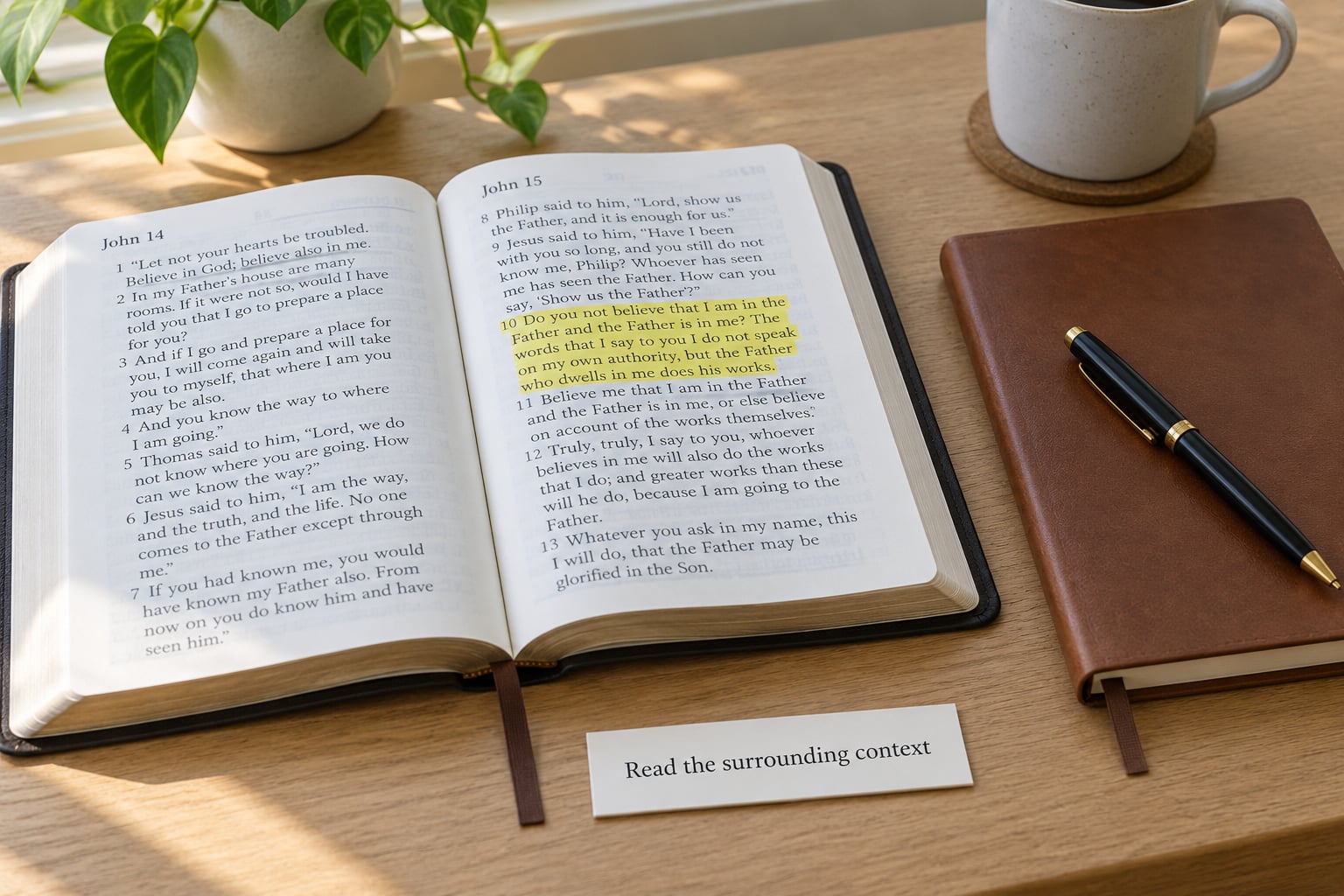
Read the paragraph on both sides of the verse. A single line lifted out of a paragraph can be technically accurate and completely misleading at the same time, and that combination is what gets people in trouble in comment sections.
Notice who is speaking and who is listening. Proverbs 26:4 and Proverbs 26:5 sit one verse apart and appear to contradict each other: one tells you not to answer a fool according to his folly, the next tells you to. Translations handle that tension differently, and translators often footnote it. If you are quoting either line, read the pair.
Then ask whether the saying appears in the Gospels, in a letter of Paul, in a proverb, or in a narrative about someone else. A line that is widely shared as something Jesus said may be a proverb from the Old Testament wearing a beard and a quote mark.
Verification checks the quotation. Whether the verse supports the point you are making is a separate question, and a good answer to one is not an answer to the other.
5. Check punctuation, quotation marks, and formatting
Formatting tells you whether a quotation is honest. If words were removed from the middle, there should be an ellipsis. If the translator added a word to make the sentence read properly, that word belongs in square brackets. If nothing is marked and the sentence reads too neatly, something was taken out.
Watch for all caps on words that are not all caps in the text, which usually means someone is adding emphasis the original does not carry. Watch for verse numbers pasted into the middle of a sentence, and for a colon where a semicolon should be.
One habit helps more than the rest: copy the verse straight from the Bible source rather than retyping it from a graphic. Every retyping is a chance to change a word without noticing.
6. Perform a final source and shareability check
This last pass is how to verify a Bible quote before posting it without overthinking it. Read the citation you wrote one more time: book, chapter, verse, translation. Then read the quote and ask whether you would be comfortable with someone checking it line by line, because for anything above a few hundred views, someone will.
Remove any claim in the caption that scripture does not actually make. The verse gets you the attention; the extra claim is what causes the comment war. And if the line is your own summary of a passage, label it as a paraphrase rather than putting it in quotation marks.
If you already posted something wrong, do not quietly delete it. Correct it where it spread, name what was wrong, and quote the real verse underneath. Public corrections build more credibility than a clean feed ever will.
The rule I keep coming back to is simple. If you would not repost a headline from a clickbait site without checking it, do not repost a verse you found on a meme.
Common Mistakes in Verifying Scripture
Almost every error comes down to skipping one of the steps above. These are the five that show up most often, and what to do about each.
- Trusting the graphic. A beautifully typeset verse card still has no source. Treat the design as decoration and the text as a rumour until you have searched it.
- Checking in one translation only. A correct quote in the ESV can look fabricated to someone searching in the KJV. Search in the version you plan to quote, then spot-check a second one.
- Accepting a partial reference. “Somewhere in Psalms” is not a reference. Open the book and chapter, because Psalms and Proverbs both have verses that read very differently from their neighbours.
- Posting one line as the whole message. Read the paragraph first, every time. It is the cheapest step in the process and it prevents most of the “you took it out of context” replies.
- Quoting a paraphrase as scripture. If you rewrote the sentence, drop the quotation marks and write “loosely paraphrased from.” Nothing else on the internet is held to this standard.
These are the lines that turn up most often in the “verses” category, and each one fails in a different, teachable way.
| The line people share | What is actually there | What went wrong |
|---|---|---|
| Spare the rod, spoil the child | Proverbs 13:24 (NIV): “Whoever spares the rod hates his own child.” | Truncated and reversed, and the saying itself is a 17th-century line from Samuel Butler’s poem Hudibras |
| Money is the root of all evil | 1 Timothy 6:10 (NIV): “the love of money is a root of all kinds of evil” | Two words dropped and “kinds of” removed. Even the KJV opens the verse with “the love of money” |
| Do not go to bed with anger in your heart | Ephesians 4:26 (NIV): “Do not let the sun go down while you are still angry.” | Folk paraphrase. The verse never mentions a bed |
| The lion shall lay down with the lamb | Isaiah 11:6 (NIV): “The wolf will dwell with the lamb” | The wolf became a lion, and the wording changed with it |
| Pride comes before the fall | Proverbs 16:18 (NIV): “Pride goes before destruction, a haughty spirit before a fall.” | First half of the verse removed, which changes the point |
| God works in mysterious ways | No verse. It alludes loosely to Isaiah 55:8 and Romans 11:33-34. | Hymn wording, commonly traced to an 18th-century hymn by William Cowper |
| Cleanliness is next to godliness | No verse in any translation. | A secular line usually traced to Francis Bacon in 1605 and to a John Wesley sermon in 1778 |
| God helps those who help themselves | 2 Thessalonians 3:10 (KJV): “if any would not work, he should not eat.” | An old fable about Hercules and the cart, and the verse points the other way |
One category deserves its own warning. AI chatbots produce confident, well-formatted verse references that do not exist, complete with a plausible translation name. The sentences read beautifully, which is exactly the problem. Never post a verse an AI gave you before you have opened it in a real Bible text yourself, and if you did already post it, fix it in public.
Frequently Asked Questions
What is the most reliable way to verify a Bible quote?
Search the exact wording in a trusted online Bible, then open the reference it returns and read the full verse in the translation you plan to quote. If the search returns nothing, the line is a paraphrase or an invention rather than a Bible verse. Add the translation in parentheses every time you share it.
How do I check whether a Bible verse was copied correctly?
Paste the wording into a Bible search box inside quotation marks, with punctuation removed, and keep the most distinctive run of five or six words. A match gets you a reference; no match means you should trace the phrase to the closest real verse instead of posting it. Then read the whole verse rather than the fragment you were handed.
Is it acceptable to combine wording from different Bible translations?
You can, as long as you say so. Woven-together quotations are a legitimate literary device and older versions of scripture are written in that style. The problem is presenting the result as a verbatim quotation from one version. Mark it as a paraphrase, or keep each quoted line in a single translation and cite that one.
How much context should I include when sharing a Bible verse?
Read the whole paragraph to yourself before you post, and include more of it than feels necessary. A single line can be accurate and still misrepresent the passage, which is the fastest way to get called out in replies. If the surrounding verses change the meaning, they belong in the post too.
Can I post a Bible verse paraphrase as a direct quote?
Not as a direct quote. If you rewrote or condensed the wording, drop the quotation marks and label it a paraphrase with a reference to the passage you drew from. This is also the fairest handling of translation copyright: short quotations of one or two verses are normal use, but reproducing long sections of a modern version is not.
Why do different Bible translations use different wording?
They are translating from different manuscript traditions, and they handle idiom, gender and difficult Greek or Hebrew phrases differently. A verse can read smoothly in one version and awkwardly in another without either being wrong. This is also why a correct quote gets flagged: the reader checked a different version than the one you posted.
Check the Reference and the Translation First
If you do only one thing, search the exact wording before you do anything else. It takes ten seconds and it is the step that catches every fabricated verse, every stitched-together quote and every dropped half-verse on this page.
After that, name your translation and post the citation with the quote. Accuracy is the cheapest credibility a quote account can buy, and readers notice when you give them the reference.