A quotation is a fixed piece of text attached to a name. What most people are seeing decades later is a shape that only resembles the original. Attribution gets lost through a small number of recurring causes: retelling, memory error, shortening, careless sourcing, and endless copying by strangers who never checked where the line came from.
Knowing how quote attribution gets lost over time matters most to the people who repeat them. A misquoted line borrows the authority of whoever it is credited to, and that borrowed credibility is what lands it in wedding speeches, school essays, branding campaigns, and quote accounts with hundreds of thousands of followers.
Table of Contents
- 1How Quote Attribution Gets Lost Over Time
- 2Why Do People Misattribute Quotes?
- 3The 5 Main Causes of Misattributed Quotes
- 41. Retelling through intermediaries
- 52. Compression and paraphrase drift
- 63. Weak documentation
- 74. Speaker and source confusion
- 85. Online repetition and dead sources
- 9How to Trace a Quote Back to Its Source
- 10What Makes a Quotation Credible?
- 11Frequently Asked Questions
- 12How can I find the original source of a quote?
- 13Are quotes from famous people always correctly attributed?
- 14Why do quote websites repeat incorrect attributions?
- 15What should I do if I cannot verify a quotation?
- 16How does shortening a quote affect its meaning and attribution?
- 17Conclusion: Verify Before You Share
How Quote Attribution Gets Lost Over Time
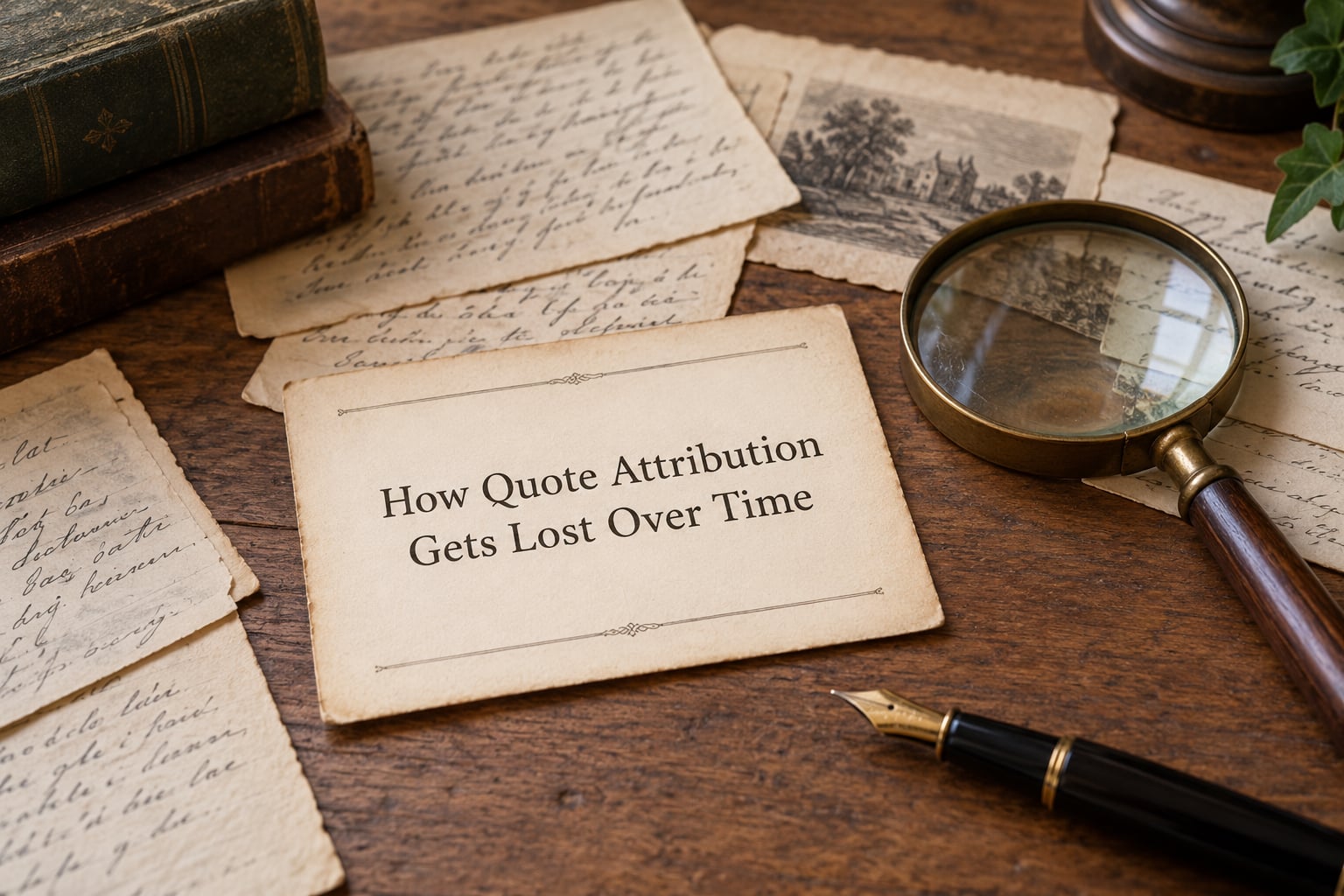
Quotation attribution rarely collapses in one step. It thins out across a chain of six stages, and each retelling drops a different piece. The words survive because they are memorable, while the details that made them checkable go first.
- Context disappears. The line travels without the situation that produced it, so a remark made in frustration or negotiation gets read as a calm principle.
- The container is lost. People remember the sentence and forget whether it came from a novel, a speech, an interview, a press conference, or a private letter.
- The line shrinks. Long sentences get trimmed to their punchiest clause, and trimming changes the claim being made.
- The speaker gets swapped. An actor is replaced by their character, a modern paraphraser by the writer they were paraphrasing, a translator by the original author.
- The source becomes unreachable. The book goes out of print, the interview was never published, or the link behind a quote card quietly breaks.
- Repetition hardens the error. Each new copy of the wrong version makes it look older and more authoritative than the true origin.
Once that chain completes, the surviving version feels original. Most people never encounter the source text that the misquote replaced, so nothing in their reading pushes back on it.
Why Do People Misattribute Quotes?
Four things drive it. Memory is reconstructive rather than a recording, so people confidently recall a quote in the shape they heard it. Context gets dropped because a line without context travels better. Publication practice does the damage too, where an editor, a speechwriter, or a summary rounds off a qualified remark. And a fourth path runs straight through invention, with lines composed for a caption or a quote card and credited to whoever made them sound good.
It helps to keep three failures apart, because corrections aimed at the wrong one miss. A misquotation changes the words. A misattribution changes who said them. A misinterpretation leaves both intact and reverses the meaning. Frost’s closing lines are the clearest case of the third kind, where the poem ends by describing how the speaker will be remembered as a person who took a strange road, which is close to the opposite of the confident adventurer most readers hear.
The 5 Main Causes of Misattributed Quotes
The five causes below are not equally common. They stack, and a single famous misquote usually has several of them in its history.
1. Retelling through intermediaries
Most quotes reach you through a person rather than a book. Baseball’s Leo Durocher is the standard example. He said his team would finish in seventh place in 1950, and a reprint in Baseball Digest printed “Nice guys finish last” under his name. He never said it, and the reprint made him its owner forever.
The verification clue is the same each time: ask who physically changed the line. If you can name the person, the publication, or the year, you have found the fork in the road.
2. Compression and paraphrase drift
Shortening a quote for a wall or a card feels like tidying, but it can flip the claim. The KJV line “Money is the root of all evil” drops the setup in 1 Timothy 6:10, where the phrase describes the greed of money handlers, not money as an abstract object. The shortened version turns a warning about behaviour into a diagnosis of a thing.
Clue: look for words that make the line tidy. A quotation that ends on a rhyme, a verb, or a memorable noun is usually a machine with the last few words removed.
3. Weak documentation
Some widely printed lines have no documented source at all. “Be the change you wish to see in the world” has never been traced to anything Gandhi wrote or spoke. “Well-behaved women rarely make history” carries Marilyn Monroe’s name with no reliable appearance behind it. Abraham Lincoln’s supposed warning about quotations being attributed incorrectly on the internet is itself only an internet attribution, and nobody can point to a Lincoln text containing it.
Clue: when a source cannot be named, that is not a mystery to solve later. It is the finding.
4. Speaker and source confusion
Two swaps produce a lot of famous errors. The first is actor for character, where a line written for a role gets credited to the actor who performed it. The second is paraphraser for original author, where Evelyn Beatrice Hall, writing long after Voltaire died, summarised his Treatise on Tolerance in a line so quotable that “I disapprove of what you say, but I will defend to the death your right to say it” is now known as Voltaire’s.
Clue: check the dates. If the supposed author and the supposed speaker are decades apart, you are looking at a two-step transmission.
5. Online repetition and dead sources
This is the modern accelerator. Quote accounts and quote-image generators attach a name to a line without checking anything, and the underlying post may link only to another quote post. Those secondary links rot, which removes the trail that might have settled the question. Researcher Anil Dash wrote about this specific failure in 2013, describing an unsourced Jean-Luc Godard line that could only be traced back to Jim Jarmusch’s essay in MovieMaker magazine.
Computer language models now add a further layer. They absorb the popular version, reproduce it fluently, and present it with the same confidence as a documented line. Reddit users have noticed the pattern in both directions, with one thread devoted to inventing fake quotes in famous mouths, which shows how well known the gap has become.
Here is the comparison this topic usually gets wrong in passing. The popular column is what most readers carry; the second column is what the record actually supports.
| Popular version | What the record supports | How it got that way |
|---|---|---|
| “Nice guys finish last” — Leo Durocher | Durocher said his team would finish in seventh place | Reprinted with a different line by Baseball Digest in 1950 |
| “Let them eat cake” — Marie Antoinette | No such record from her; Rousseau wrote that a great princess was served brioche, and cake entered later | Translated retelling and royal outrage outran the French original |
| “I disapprove of what you say…” — Voltaire | A paraphrase in Evelyn Beatrice Hall’s 1906 book | Paraphraser took the credit for the original thinker |
| “Be the change you wish to see in the world” — Gandhi | No traced appearance in his writings or speeches | Composed and adopted during the twentieth century, then credited backwards |
| “God is in the details” — Mies van der Rohe | Mies used a similar phrasing; the stated quote is assembled | His approval of the aphorism was reported second-hand and hardened into a quotation |
| “An unsourced quote by Godard” — Jean-Luc Godard | First found in Jim Jarmusch’s MovieMaker essay | Repeats of the line pointed at quote posts rather than the original essay |
Notice the pattern in the third column. Every entry names a transmission event, not a vague sense that something went wrong. That is also the difference between a correction people accept and one they argue with.
How to Trace a Quote Back to Its Source
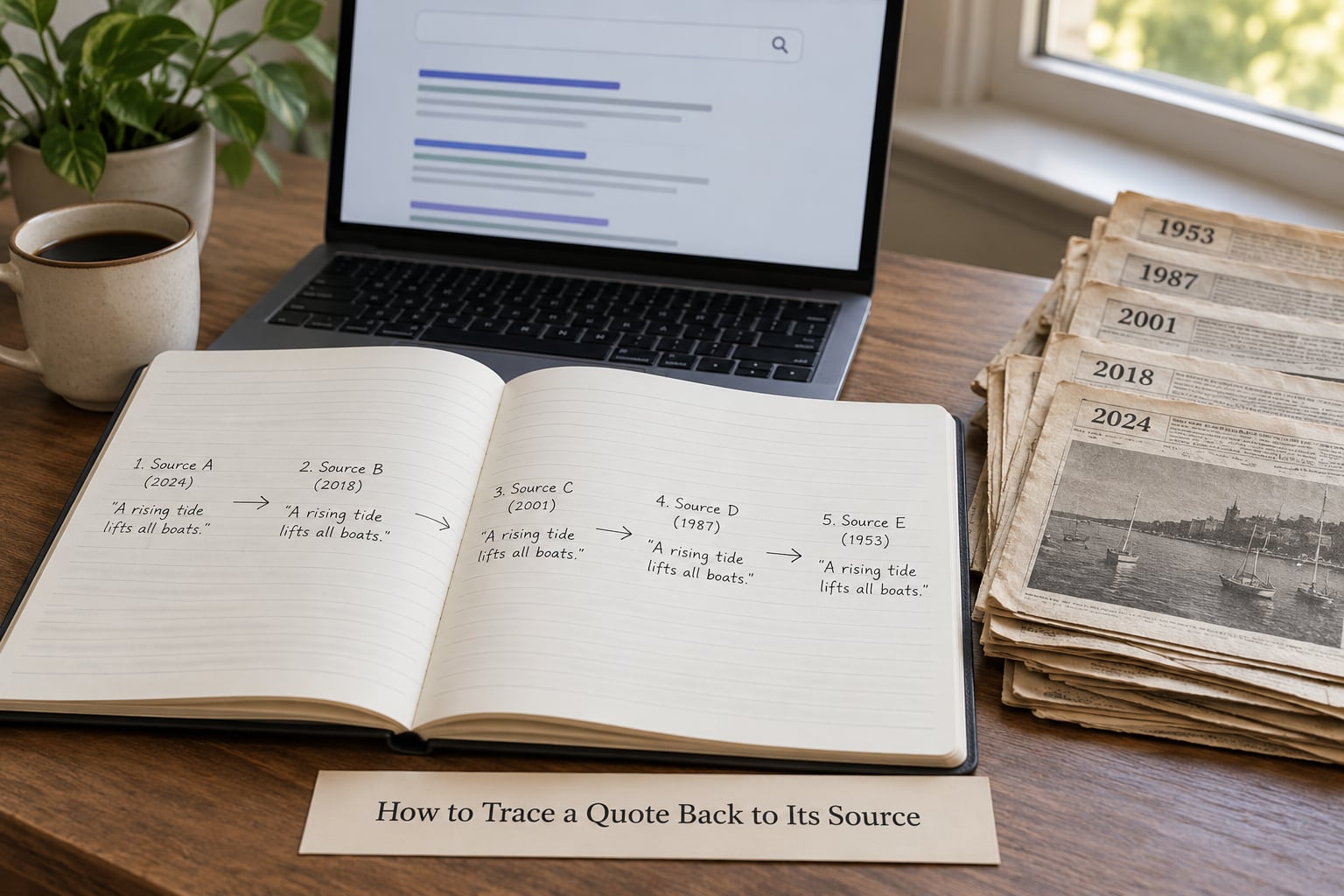
This method takes about ten minutes for most lines. Work through it in order, and stop as soon as you reach a text you can actually read.
- Search the exact wording in quotation marks. Whatever version you were given, type it as printed. If nothing matches, you are probably holding a modern rephrasing rather than a quote.
- Find the earliest appearance you can date. Not the most popular page. Look for the first result with a real date attached to a book, newspaper, court record, or interview.
- Go past aggregators. Quote sites, listicles, and image generators are secondary sources. Keep going until you reach something that was published by the person or the archive holding the text.
- Read the surrounding paragraphs. You are checking the setup and the aftermath, because that is where a truncated quote reveals that it was never saying what the meme claims.
- Check whether the speaker and the writer are the same person. Translators, interviewers, ghostwriters, and the person being quoted all get confused. Dates settle it fast.
- Record what you could not confirm. Write down the honest answer, including “no traceable source,” rather than passing the line along unchanged.
If a step fails, the fix is usually to go back to step 2 with a shorter fragment of the line. Searching three or four distinctive words often pulls up the original, because you are no longer matching the version you were handed but the part nobody bothered to change.
A note on tools. Quote Investigator documents specific corrections with dated evidence, and Snopes covers the political claims that circulate most. For scholarly material, a library catalogue or a full-text archive search beats any general web engine, because the record of a published book or paper does not vanish when a page does.
What Makes a Quotation Credible?
Credibility here is not about how a line sounds. A smooth sentence about leadership gains nothing from sounding like leadership. Five things carry weight instead.
- A reachable primary text. You should be able to open the book, page, recording, or transcript where the words appear. If the only trail leads back to another quote card, you have found a loop rather than a source.
- A dated, named publication. “From a 1950 interview” beats “widely attributed to.” The venue tells you who was listening and why the remark was made.
- Intact context. A credible citation keeps enough of the surrounding argument to survive without changing its claim.
- An honest account of doubt. Neil Armstrong’s moon-landing words are still argued over, with the astronaut insisting he said “a man” and a 2006 audio analysis reading it the other way. Sources that admit a case is disputed are usually more reliable than sources that flatten it.
- A source willing to be checked. Any page that names the book, chapter, verse, interview, and date is one you can verify. A page offering only the quote and a name is asking for trust instead of evidence.
One more practical test. Ask what the person would have had to know to refute it. If refuting takes a library and the quote is doing persuasive work in a caption, the balance is badly tilted in favour of not repeating it.
Frequently Asked Questions
How can I find the original source of a quote?
Search the exact wording in quotation marks, then look for the earliest dated appearance in a book, newspaper, recording, or transcript. Skip quote aggregators and image-based quote sites, which are secondary sources that recycle one another. If nothing traceable turns up, treat the absence of a source as your answer rather than assuming the attribution is simply old and obscure.
Are quotes from famous people always correctly attributed?
No. Famous names attract unattributed lines constantly, because the name carries more appeal than the sentence does. Gandhi has no traced source for the change-the-world line, and Marilyn Monroe has no reliable appearance behind well-behaved women rarely making history. A celebrated speaker makes a line easier to believe, not better documented.
Why do quote websites repeat incorrect attributions?
Most operate on speed and volume, with each page drawing on the same widely circulated version rather than the original text. Their links often point at other quote pages, so the trail forms a closed loop that never reaches a primary source. Correction is slow and has no search traffic, so the error keeps circulating while the fix stays invisible.
What should I do if I cannot verify a quotation?
Say so where you would normally share it, and credit it as an unattributed saying rather than naming a person. That small change costs you nothing and keeps a false claim out of circulation. If the line matters to an argument or a published piece, leave it out until you can reach the text. If somebody else stated it wrongly, naming the real source quietly is usually better received than a public correction.
How does shortening a quote affect its meaning and attribution?
Truncation frequently removes the condition that made the original accurate, so a qualified remark turns into a flat claim. Money is the root of all evil drops the setup in 1 Timothy 6:10, where the phrase describes the greed of people who handle money. A shortened quote is also harder to trace, since searchers no longer have the words needed to find the passage it came from.
Conclusion: Verify Before You Share
Do one thing before you repost a quotation: search the exact wording in quotation marks and see what the earliest dated source actually says. Ten minutes of that separates a line somebody said from a line somebody made up, and it is the single step that stops how quote attribution gets lost from continuing without you.
When you cannot reach the text, say the line is unattributed. That is a small habit, and it is what keeps a quote site, a speech, or a classroom from becoming another hop in the chain.