
“Put your mental health first. That’s more important than any other medal you could win.” That is the Simone Biles line most often quoted, and it is the one most often mangled on its way through social media. If you are collecting quotes about Simone Biles and mental health you can actually use, they are below: ten of them, each with the situation she said it in and a note on where the original wording lives.
I built this list after noticing how many pages get the attribution wrong. The famous “It’s OK to not be OK” line belongs to Michael Phelps, not Biles, and it turns up under her name constantly. Nearly every other roundup I found was written in 2021 and stopped there, missing everything she has said since.
One honest note before we start. A few of these lines come from press conferences, interviews, short video clips and social posts, and wording sometimes shifts slightly between a clip and a transcript. Check the original before you present one as a fixed sentence. The verification checklist at the end covers how.
Table of Contents
- 1Quotes About Simone Biles and Mental Health at a Glance
- 21. “Put your mental health first. That’s more important than any other medal you could win.”
- 32. “It’s been a long year.”
- 43. “It was beautiful just like that.”
- 54. “I’m in a really good mental health spot.”
- 65. “I said, no. I know I’m gonna be fine eventually, but I can’t risk a medal for the team, so I know I need to call it.”
- 76. “I’m still scared to do gymnastics.”
- 87. “My mind and my body are simply not in sync.”
- 98. “I’m happy that I can be a leader for the survivors.”
- 109. “The best you can do is forgive yourself, take a deep breath, and get to work on the next challenge.”
- 1110. “I’m loving my life again.”
- 12How to Use Quotes About Simone Biles and Mental Health Responsibly
- 13Frequently Asked Questions
- 14What did Simone Biles say about mental health?
- 15How can I verify quotes attributed to Simone Biles?
- 16What is the most important context behind Biles’s mental-health statements?
- 17Can these quotes be used in school presentations or social posts?
- 18How can I discuss Simone Biles and mental health without diagnosing anyone?
- 19What support should I suggest to someone struggling with anxiety or burnout?
- 20Conclusion
Quotes About Simone Biles and Mental Health at a Glance
| Quote | Theme | When she said it | Best used for |
|---|---|---|---|
| “Put your mental health first. That’s more important than any other medal you could win.” | Priorities over medals | Around the Tokyo 2020 Games and repeatedly afterward | Opening a talk, a card, a team meeting |
| “It’s been a long year.” | Admitting exhaustion | 2021, in coverage of her return to competition | Normalizing a hard season |
| “It was beautiful just like that.” | Worth beyond the score | Her beam final withdrawal, Tokyo 2020 | Reframing a walk-away |
| “I’m in a really good mental health spot.” | Ongoing maintenance | Before the Paris 2024 Games | Showing progress over a snapshot |
| “I said, no. I know I’m gonna be fine eventually, but I can’t risk a medal for the team, so I know I need to call it.” | Trusting your own read | Recalling the Tokyo team final decision | Decisions that disappoint other people |
| “I’m still scared to do gymnastics.” | Honest self-awareness | Shortly after Tokyo, in a televised interview | Admitting fear without shame |
| “My mind and my body are simply not in sync.” | The twisties | Tokyo 2020 press conference | Explaining why rest is not laziness |
| “I’m happy that I can be a leader for the survivors.” | Speaking for others | After Tokyo, on advocacy | Awareness posts and talks |
| “The best you can do is forgive yourself, take a deep breath, and get to work on the next challenge.” | Self-compassion | Courage to Soar, her memoir | After a setback |
| “I’m loving my life again.” | Hope and agency | After the Tokyo withdrawal | Closing a talk on recovery |
1. “Put your mental health first. That’s more important than any other medal you could win.”
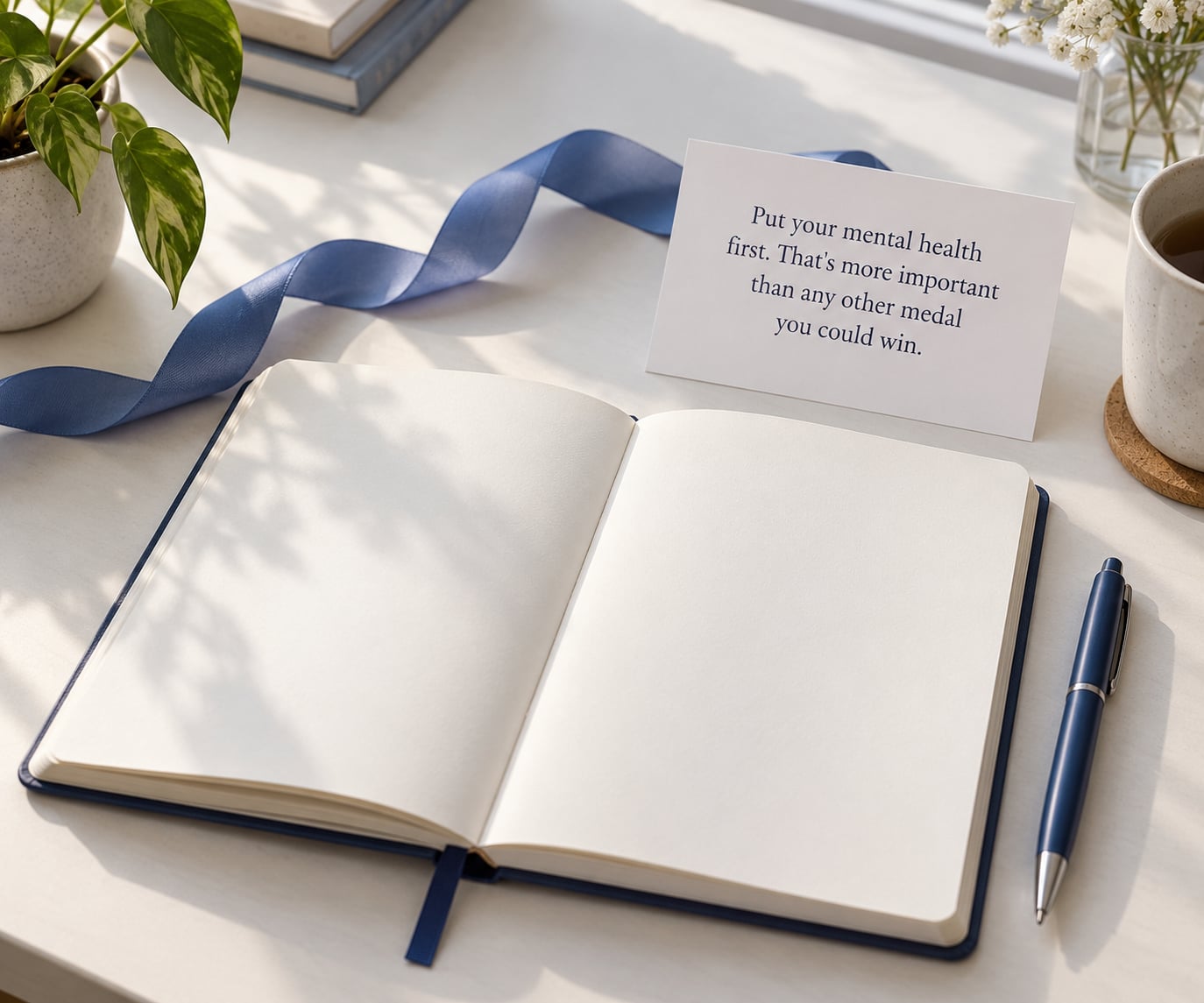
This is the line to lead with if you only need one. Biles said it around the Tokyo 2020 Games and has returned to it since, and it works because it is not humblebrag rhetoric. She is not saying she would have won another gold. She is saying the ranking itself was wrong.
Use it when you need to hand someone permission to change their mind about a commitment. It lands hardest with people whose whole identity is attached to one result.
It is also the line most often stolen. If you see “It’s OK to not be OK” printed under a photo of Biles, that one is Michael Phelps, from a widely reported 2021 interview. Photos travel; captions change. Double-check the name before you share either line.
2. “It’s been a long year.”
Short, unglamorous, and the most useful of the ten for ordinary people. Athletes and teachers and parents all say some version of it, and Biles said it publicly rather than dressing it up as burnout or a training block.
It is a good line for a team check-in because it names a feeling without demanding a solution. Pair it with a practical action and it stops being a slogan.
What it challenges is perfectionism dressed as dedication. The pressure to appear fine is what makes a hard year stay private, and naming it out loud is the first step toward someone offering help.
3. “It was beautiful just like that.”
Biles used this about pulling out of the Tokyo beam final. There was no dramatic exit and no announcement mid-routine. She simply finished, walked off, and said the thing was beautiful as it was.
The quote works because it detaches worth from the scoreboard. A routine that goes wrong on live television can still be a good piece of gymnastics, and a decision to stop can still be a good decision.
That is the angle to take in a classroom or a staff room discussion: what gets measured is not the same thing as what is good. It reframes a visible mistake without pretending the mistake did not happen.
4. “I’m in a really good mental health spot.”
She said this before Paris 2024, and it is worth reading carefully. The phrasing is present tense. It describes where she was that week, not a permanent state she had achieved.
That is the honest way to talk about emotional health: as maintenance rather than a finish line. Nothing here suggests the Tokyo period is erased or that the difficulty is over.
Use it in a wellness article or a team newsletter to make room for check-ins that are routine rather than emergency. It also models how to report progress honestly, without overclaiming.
5. “I said, no. I know I’m gonna be fine eventually, but I can’t risk a medal for the team, so I know I need to call it.”
This is Biles describing her own reasoning around the Tokyo team final, and it is the least romantic line in the collection. She did not claim she would be fine right away. She said eventually, and she made the call anyway.
Read it as a decision made with incomplete information rather than a leap of faith. That is the part people miss. She was not certain, she still chose.
For anyone facing a choice that will disappoint teammates, a client, or a family, this is encouraging without being dishonest. It is not a motto about winning. It is a method: gather input, check your own read, then decide.
6. “I’m still scared to do gymnastics.”
Said in a televised interview shortly after Tokyo. The honesty of it is the point: she was the most decorated gymnast in Olympic history and still frightened, and she said so rather than performing confidence.
This is a quotation about self-awareness, not a diagnosis. She described a feeling and a situation. It does not tell you anything about your own condition, and it should not be used to explain a symptom to yourself.
The responsible way to use it is next to professional support, never instead of it. Talk to a doctor or a therapist about anything persistent, and in the US the 988 Suicide and Crisis Lifeline is reachable by call or text.
7. “My mind and my body are simply not in sync.”
This is how Biles described what gymnasts call the twisties. In the air, her sense of where her body was in space stopped matching reality, and the disorientation made landing safely the issue.
Explained plainly, it is a disconnect between internal signals and what is actually happening around you. That is why it is not the same as being scared or rusty, and why pushing through it can be genuinely unsafe.
Use this line when you want people to stop treating a break as a reward to be earned. Rest after a mental health or physical setback is part of the return, not a detour around it, and it does not replace treatment.
8. “I’m happy that I can be a leader for the survivors.”
Biles has spoken about other people, not only her own experience. That shift matters, because a story about one athlete reaches one athlete, while a story about survivors reaches everyone who felt ignored while it happened.
Several public figures backed her up after Tokyo, and the volume of that support made the message harder to dismiss. Taylor Swift, for instance, posted publicly after the Tokyo final calling Biles an inspiration and pushing readers to talk about mental health. Those posts circulate widely as screenshots with altered captions, so read the original post rather than the graphic.
For a school, workplace, or awareness post, this quote works best when paired with something actionable, such as where support is available locally. Advocacy without a next step tends to fade by the following week.
9. “The best you can do is forgive yourself, take a deep breath, and get to work on the next challenge.”
From her memoir, Courage to Soar, and the most instruction-shaped line she has written. Notice that it does not say the setback did not matter. It says three things happen next, in that order.
Self-compassion is often mistaken for excusing a mistake. This line is the opposite: forgive yourself, breathe, then do the work. The forgiveness is what makes the next attempt possible instead of self-punishing.
A related line she has used publicly is “I’d rather regret the risks that didn’t work out than the chances I didn’t take at all.” Use that one with a younger audience or a team considering something new. Neither line belongs on a card without the sentence around it.
10. “I’m loving my life again.”
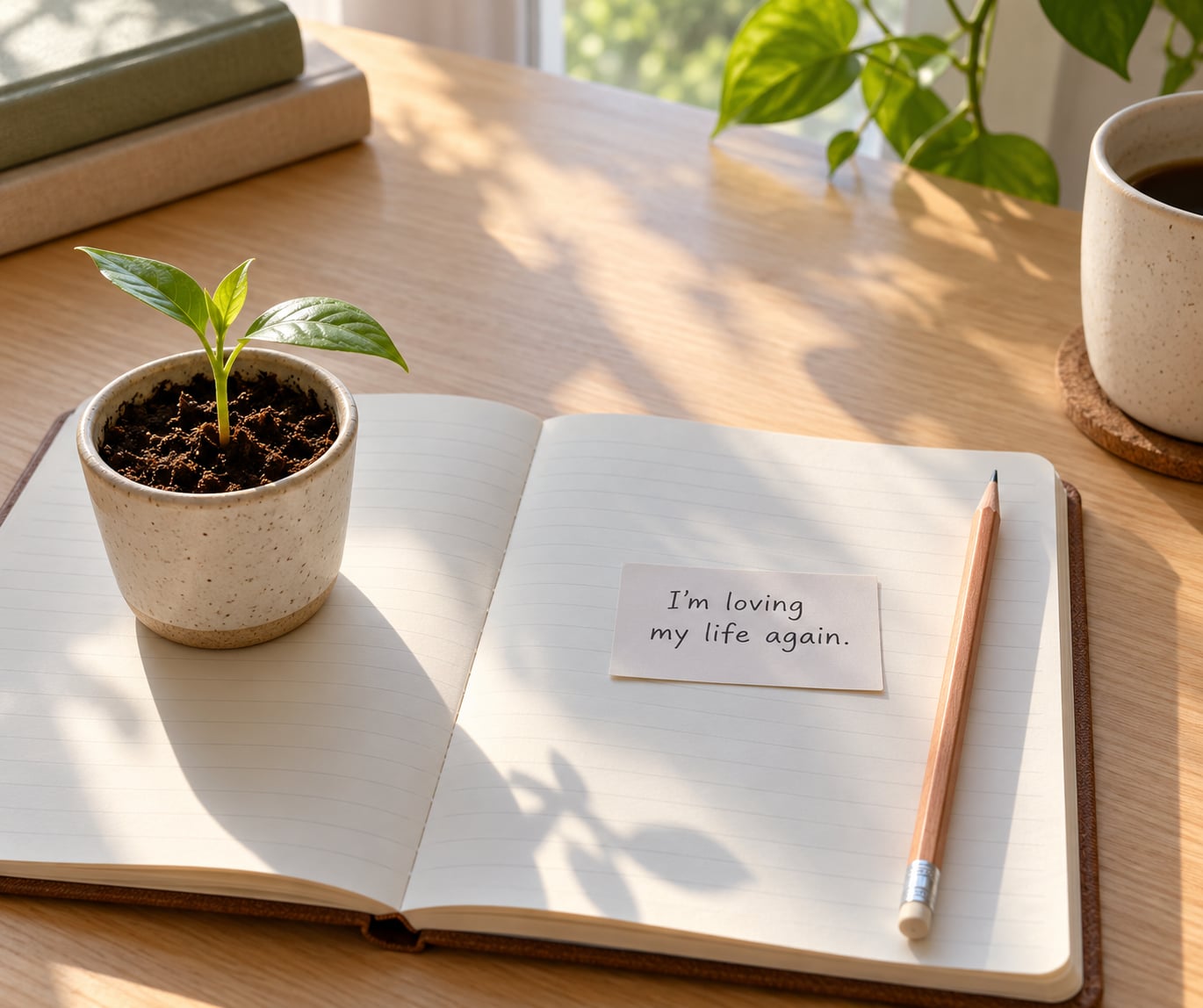
Said after the Tokyo withdrawal, and the plainest line in the list. It does not promise a specific outcome, which is exactly why it holds up over time. Anyone can say it without knowing how your story ends.
Recovery and personal growth move at their own pace, and a sentence like this survives contact with a hard year. It leaves room for the reader to believe things can improve without believing in a timeline.
Use it to close a talk, an assembly, or a wellness article. Keep the frame honest: this is one athlete describing her own experience, and anyone struggling should be encouraged toward real support rather than inspired to wait it out.
How to Use Quotes About Simone Biles and Mental Health Responsibly
Find the original before you quote. A press conference, a published interview, or her own verified social post beats a screenshot every time. If you cannot locate the source, leave it out.
Keep the wording intact. Shortening a line into something punchier usually changes its meaning, and misquoted mental health messages travel further than accurate ones.
Attach the occasion. A line about pulling out of a final means something different from the same line used as a general life motto, and readers deserve to know which one they are getting.
Never use these lines to diagnose yourself or anyone else. If a discussion moves toward symptoms, route it to a doctor or therapist, and note crisis resources when someone seems to be in distress.
Last updated for 2026. Every competing roundup I found was written in 2021; this one includes her statements from after Tokyo and into Paris 2024.
Frequently Asked Questions
What did Simone Biles say about mental health?
Her most repeated line is that putting your mental health first matters more than any medal you could win. Around the Tokyo 2020 Games she also described her mind and body no longer being in sync, admitted she was still scared to do gymnastics, and later said she was loving her life again before returning to competition.
How can I verify quotes attributed to Simone Biles?
Search for the original recording rather than the graphic. Press conferences, published interviews, her verified social accounts, and her memoir Courage to Soar are reliable. Be especially careful with lines shared as quote images, because captions get reassigned constantly. If you cannot find a primary source, treat the line as unverified and leave it out.
What is the most important context behind Biles’s mental-health statements?
Most of the widely shared lines come from a short window after she withdrew from events at the Tokyo 2020 Games, including the team final and the beam final. Understanding the twisties, a disconnect between her sense of body position and reality, explains why she stepped back. Without that context the quotes read as generic inspiration.
Can these quotes be used in school presentations or social posts?
Yes, with attribution. Name the source, keep the wording accurate, and add the occasion when it matters. Check whether your school or workplace requires a citation style for quoted material. Avoid presenting any line as medical advice, and pair general encouragement with a real pointer to where support is available locally.
How can I discuss Simone Biles and mental health without diagnosing anyone?
Describe what was said and when, then stop. Avoid linking a quotation to a specific condition in a friend, a student, or yourself, since a public statement is not a clinical assessment. If someone describes persistent or severe symptoms, encourage them to speak with a doctor or licensed therapist, who can actually evaluate what they are experiencing.
What support should I suggest to someone struggling with anxiety or burnout?
Start by listening rather than fixing, and take the description seriously. Practical steps like a GP appointment, a therapist, adjusted workload, and time off all help. In the US, call or text 988 for the Suicide and Crisis Lifeline; elsewhere, contact your local emergency number or crisis line. If someone is in immediate danger, stay with them and call for help.
Conclusion
Ten lines, and the pattern underneath them is simple: Biles keeps describing her own judgment as trustworthy, and her own discomfort as information worth acting on. That is the useful part, and it survives the context of elite sport.
Verify the wording before you use any of it, keep the occasion attached, and never let a quotation stand in for professional help. Pick the line that matches the person in front of you rather than the one that looks best on a card.