To turn a favorite quote into a daily affirmation, you rewrite the quote’s central message in your own first-person, present-tense words. Pull out the belief, drop the attribution, cut every negative, and trim the result to a line you can say out loud without wincing. Five minutes of work, one sentence to repeat.
Most people stall on this because they think an affirmation has to sound impressive. It does not. A line like I start today, not when I am ready beats I am an unstoppable force of productivity every time, because you can actually picture yourself saying the first one.
Starting from a quote you already love also solves the resistance problem. You are not trying to invent something wise from scratch; you are translating something that already works on you.
Table of Contents
- 1What You Need
- 2Step-by-Step: How to Turn a Favorite Quote Into a Daily Affirmation
- 3Find the Core Idea
- 4Rewrite It in the First Person
- 5Make It Personal Without Distorting It
- 6Check That It Sounds Positive and Believable
- 7Choose How You Will Repeat It
- 8Test It for Seven Days
- 9Common Mistakes
- 10Frequently Asked Questions
- 11Do I need to credit the person who said the quote?
- 12Can I change the wording of a quote to make it an affirmation?
- 13What makes a good daily affirmation for beginners?
- 14How long should a daily affirmation be?
- 15Can I use a favorite quote as an affirmation at work?
- 16Conclusion
What You Need
You need one quote, five quiet minutes, and a pen. That is genuinely the whole list.
The quote can come from anywhere: a line in a book you are reading, a card someone sent you, a gravestone, a speech, or a screenshot you have looked at more times than you would admit. Favorite quotes are rarely the cleverest ones. They are the ones you reach for.
Then you need somewhere to put the finished line. A journal page works if you enjoy writing. An index card taped somewhere you already stand works better for most people, because it removes the decision of whether to use it today. A note in your phone works if you check your phone first thing anyway, and a voice memo works if speaking out loud in an empty room makes you cringe, which it does for plenty of us.
Nothing else is required. No app, no course, no journal with a specific format.
Step-by-Step: How to Turn a Favorite Quote Into a Daily Affirmation
- Find the belief inside the quote.
- Rewrite it in your own words.
- Put it in the first person, present tense.
- Delete every negative and every judgment of others.
- Cut it to under twelve words.
- Say it out loud, and keep it only if you believe it.
The last step is the one people skip, and it is the one that decides whether the whole practice survives past week two. More on that below.
Find the Core Idea
Most quotes are one idea wearing decorative clothing. Tolkien’s Not all those who wander are lost has a memorable image, but the idea underneath it is simple: being between places is allowed.
Ask yourself what a person would have to believe for that quote to make sense. Then say that belief back as a statement about you. You have your theme: I am allowed to be between places.
If a quote has two halves, pick the half that is about a person rather than about the world. Half of most quotes is scenery.
Rewrite It in the First Person
A quote is usually third person or second person. An affirmation has to be first person, because the whole point is that you are the subject of the sentence.
Three openings cover almost everything: I am, I can, and I choose. Hemingway wrote that courage is grace under pressure. Third person, metaphor, nobody in it named. Your version: I stay steady when it counts.
Present tense does real work here. I will be braver points at a future you cannot touch. I am learning to be braver is happening today.
Make It Personal Without Distorting It
This is where a converted quote either becomes yours or stays a stranger’s. Attach the line to something real: a value, a habit, a goal you are actually working on this month.
Courage is a good example because it is abstract and vague. I speak up in meetings even when my voice shakes is the same belief made concrete, and it is now something you could do on Thursday.
Progress-framed lines hold up better than identity claims. The difference is that you have made progress even though you have not finished. I am still learning survives a bad week. I am a master does not, and the contrast is instructive. An identity claim has to be defended every single day; a progress claim only needs to be true.
Check That It Sounds Positive and Believable

Believability is the whole ballgame. A line like I am worthy. I deserve good things can be physically hard to get out, because the statement is far larger than anything you can back up. That reaction is not a failure of discipline. It is accurate feedback.
Four checks, in order:
- No negations. I am not anxious plants the word anxious. Use I am calm or I am steady instead.
- No claims about other people. Affirmations that depend on someone else behaving differently fall apart the moment that person does.
- Nothing you cannot back up with evidence from the last month.
- Short enough to say in one breath. Under twelve words.
Here is the method applied to nine well-known quotes, with the specific change named at the end of each one.
- Not all those who wander are lost (J.R.R. Tolkien) becomes I am allowed to be between places. The wanderer became your in-between season.
- Courage is grace under pressure (Ernest Hemingway) becomes I stay steady when it counts. Metaphor replaced with a behavior you can picture.
- The best time to plant a tree was twenty years ago; the second best time is now (Chinese proverb) becomes I start today, not when I am ready. Past-tense regret turned into present-tense action.
- Whether you think you can or you think you cannot, you are right (Henry Ford) becomes My thinking shapes my results. The either-or trap removed, the claim kept.
- Everything you can imagine is real (Pablo Picasso) becomes I let my ideas exist before I prove them. Abstract noun swapped for a concrete verb.
- The future belongs to those who believe in the beauty of their dreams (Eleanor Roosevelt) becomes I keep working toward what I want. Passive ownership replaced by your effort.
- Well-behaved women seldom make history (Laurel Thatcher Ulrich) becomes I make my own history. The qualifier about everyone else cut entirely.
- Fall seven times, stand up eight (Japanese proverb) becomes I get up again. Four words, one action verb.
- What we think, we become (commonly attributed to Buddha) becomes My thoughts shape who I am. We narrowed to I.
Read the conversions back to yourself. If you wince at any line, scale the claim down one notch and say it again. I am a strong leader becomes I lead when the moment calls for it, and that one you will keep.
Choose How You Will Repeat It
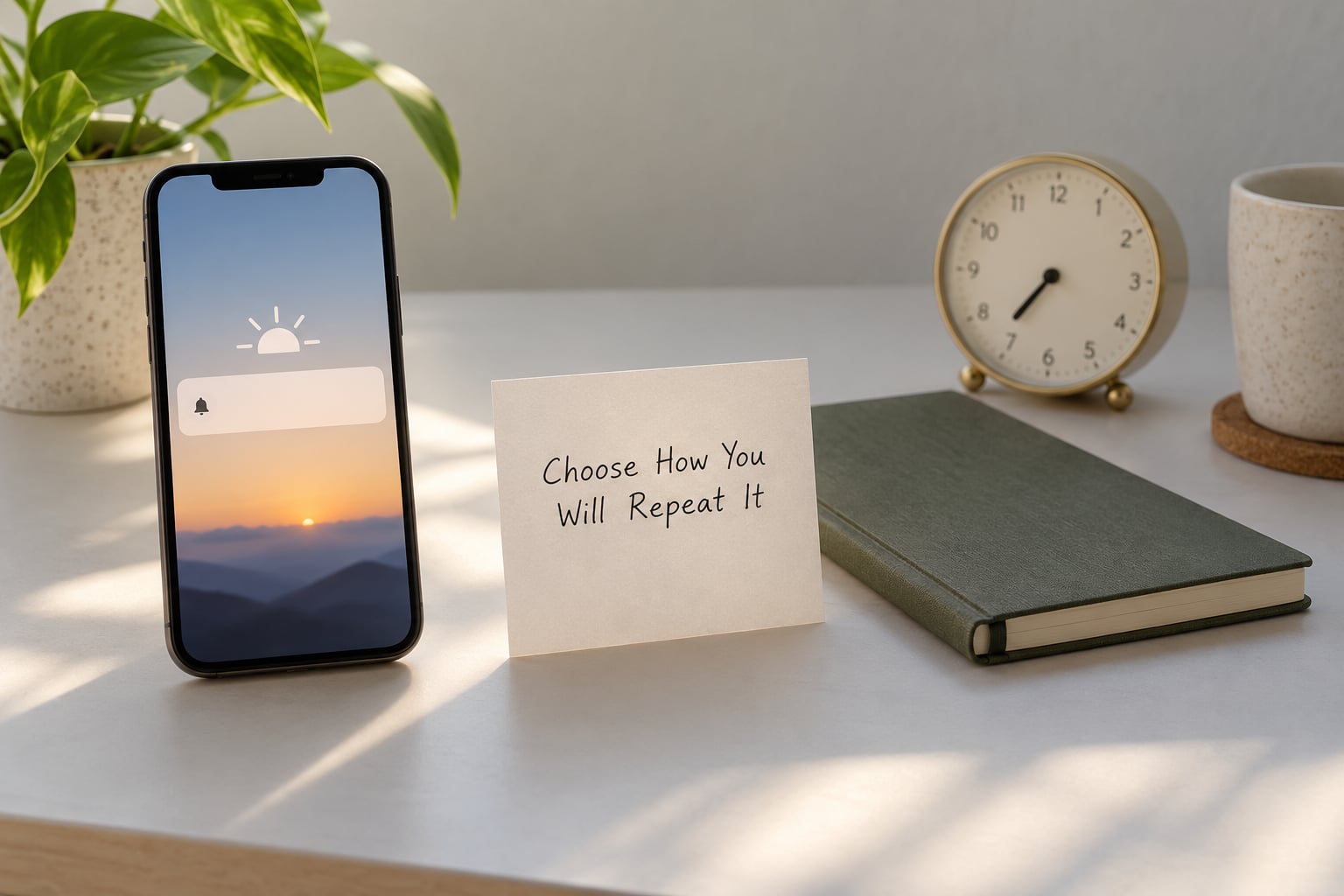
Pick one place and one time, then stop deciding. The most common working setups:
- Morning, written. Write the line, close the notebook, do not reread it that day. Writing it carries more weight than reading it.
- The commute, recorded. Say it into a voice memo and play it back while driving. Nobody is watching, which is exactly the point.
- Index card on the mirror or the kettle. Physical, and it disappears from view the moment you stop needing it.
- Phone note or reminder. Set the text to fire before you touch your notifications. Ten seconds of your morning.
- Paired with one action. Attach the line to something you do anyway: say it before opening your laptop, before the first sip of coffee, before the hard phone call. A cue beats willpower.
Some people do best with none of the above and instead sit with the line for two minutes and think about one specific situation where it applies. That is reflection rather than recitation, and reflection tends to stick longer than repetition.
Test It for Seven Days
Give the line a week and watch three things: whether you can recall it without looking, whether it feels supportive rather than hollow, and whether it connects to anything you actually did.
Most lines fail the third test. If nothing changed because of it, either it is too vague or it belongs to a different season. Swap it for a new conversion rather than forcing it.
On day seven, read your journal entries. If the line helped on three of seven days, keep it. If it never did, rewrite from the same quote with a different angle. A monthly review after that catches lines that quietly went stale.
Common Mistakes
Copying the quote unchanged. Repeating someone else’s third-person sentence does not make it yours. Rewrite it: Comparison is the thief of joy becomes I compare less and live more.
Making it too long. A long affirmation cannot be recalled without effort, and anything you cannot recall is not a daily affirmation. Trim it.
Leaving negative language in. I am not the person who gives up is still a sentence about giving up. Say what you are instead.
Forcing optimism. Claims far beyond your evidence reinforce doubt rather than confidence. Scale down until it is dull rather than thrilling, then build from there.
Choosing a statement unrelated to your goals. A quote about patience is not useful if your actual problem is saying no. Match the life area to the week you are in.
Treating it as a cure. Affirmations are a practice, not a treatment. They are no substitute for therapy, medication or medical advice when you are dealing with anxiety, OCD or intrusive thoughts, and anyone struggling should talk to a qualified clinician.
Frequently Asked Questions
Do I need to credit the person who said the quote?
Yes, and the good news is that crediting does not break the first-person framing. Keep the original quote and the name together in your journal, card or phone note, and let the shortened converted line live on its own. That way the idea stays traceable to its author and you are not claiming someone else’s words as your own.
Can I change the wording of a quote to make it an affirmation?
That is the entire method. What you should not do is present your rewritten version as the original quote, which misattributes words that are not yours. Quote it accurately, name the author, then present the conversion as your own adaptation of the idea.
What makes a good daily affirmation for beginners?
Short, present tense, first person, and small enough that you would nod hearing it. Beginners often start with claims far larger than their experience, which makes the whole practice feel fake. Progress beats identity here: I am still learning survives a bad week in a way that I am a master never will.
How long should a daily affirmation be?
Under twelve words, ideally one breath long. Length is not about brevity for its own sake; a long line has to be looked up, and anything you have to look up stops being daily. If your conversion runs to two sentences, the second one is probably a goal rather than an affirmation.
Can I use a favorite quote as an affirmation at work?
Yes, and work is where a converted quote earns its keep. Keep the claim about your own conduct rather than anyone else’s, since you do not control colleagues or managers. A line like I prepare before the meeting is safe anywhere a colleague can hear you.
Conclusion
Turning a favorite quote into a daily affirmation is six small edits: find the belief, rewrite it in your words, put it in the first person and present tense, cut the negatives, trim it under twelve words, and say it out loud before committing to it.
Do the first one today. Take the quote you return to most, write the belief it is really about, and put the converted line somewhere you will see before you leave the house. Then test it for a week and let the week decide whether it stays.