A memorial service program is a booklet that tells guests what will happen, in what order, and who is being remembered. Learning how to write a memorial service program takes about two focused hours once the information is gathered: collect the names, dates, music and readings, then build the booklet section by section in the order below. You can do this at home in Microsoft Word or Google Docs, and most families finish in an evening.
What follows is the sequence I would follow myself, the exact wording that works for each section, and the small decisions that trip people up when they are already tired.
Table of Contents
- 1What You Need
- 2How to Write a Memorial Service Program Step by Step
- 31. Decide the format and page count first
- 42. Write the cover page
- 53. Build the order of service
- 64. Write the obituary or life story
- 75. Add the tributes, readings and poems
- 86. Add the acknowledgments and the donation note
- 97. Proofread, then print two weeks early
- 10Common Mistakes to Avoid
- 11Frequently Asked Questions
- 12How many pages should a memorial service program be?
- 13Can a memorial service program be written without religious language?
- 14How do I include children in a memorial service program?
- 15What paper should a memorial program be printed on?
- 16Who should I coordinate the final program with before the service?
- 17What to Do First
What You Need
Gather everything before you open a blank document. Writing a memorial service program goes much faster when you are filling in blanks instead of deciding what belongs in each blank as you type.
- The core details: full legal name, preferred name, dates of birth and death, and maiden or birth surname if you want it listed.
- Service logistics: date, start time, venue name and address, room name if the building has more than one space, and whether the service will be livestreamed.
- People: officiant or celebrant, speakers and their relationship to the person who died, readers, musicians, pallbearers or urn bearers.
- Music: the prelude, the recessional, and any hymns, anthems or songs requested during the service.
- Readings and tributes: poems, scripture passages, a scripture reference if a clergy member chose it, and short messages from family and friends.
- Decision list: in lieu of flowers wording, memorial donation details, whether to include a photo collage, and who prints and distributes the programs.
Ask the family for preferences in one conversation rather than several. A single email with a short list of questions — dark or light cover, poems or scripture or neither, printed only or printed plus digital — settles most of the disagreement before it starts.
Two things people forget to collect. First, the officiant’s name spelled exactly as it should appear, since it gets printed large and misspelled names are noticed. Second, a phone number or email for the person handing out programs, so late arrivals can be given one.
How to Write a Memorial Service Program Step by Step
1. Decide the format and page count first
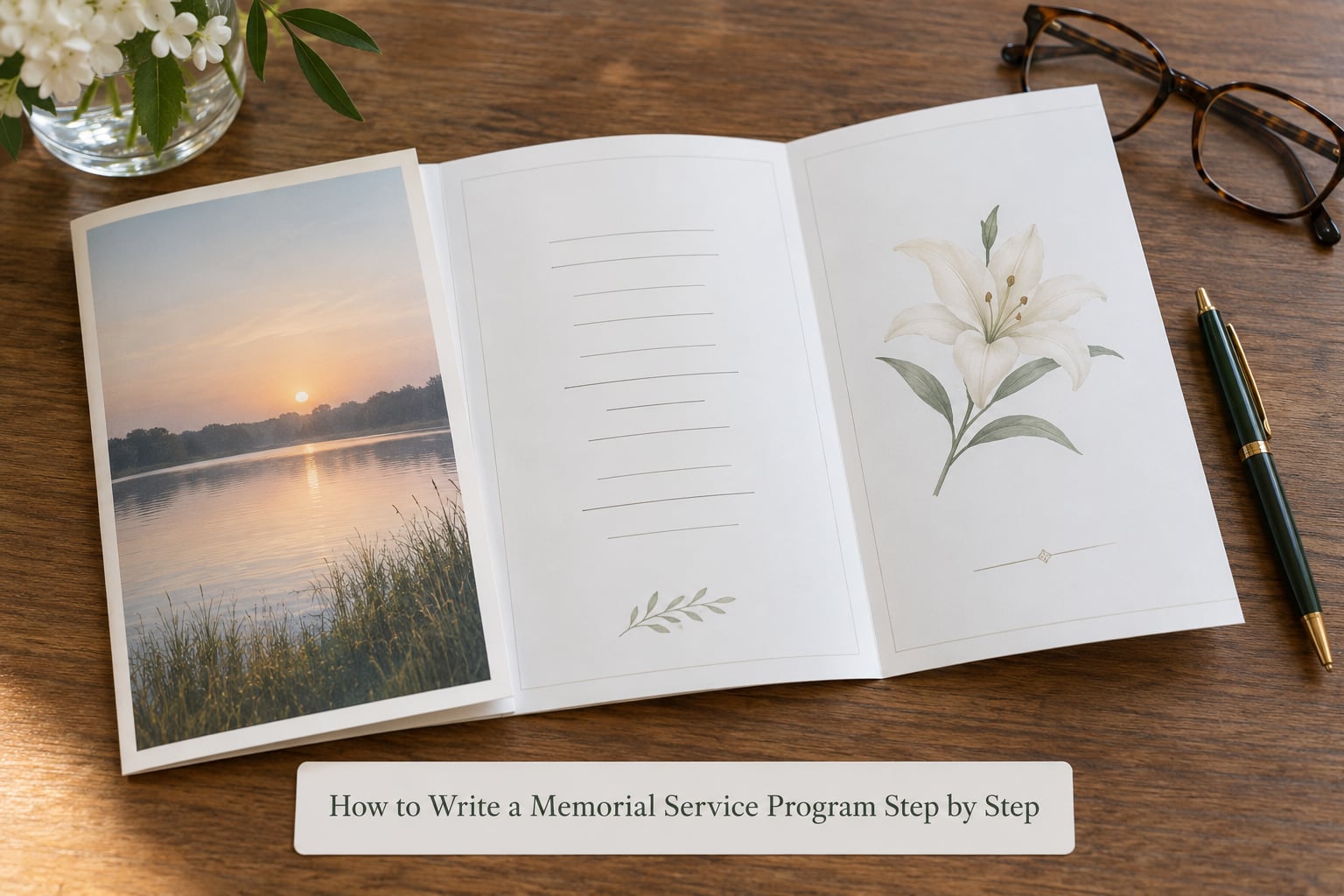
A service program is usually 6 to 8 pages, printed double-sided on a single sheet folded in half. Four pages feels thin, and more than ten stops being readable. If the service includes a full life story and several tributes, go to eight. If you are printing something simpler, four folded pages is perfectly respectable.
2. Write the cover page
The cover carries the photo, the name, the dates, and the service details. This is the one page every guest will look at, so type it last in your draft and set it first in the document.
In loving memory of
Eleanor Margaret Casey
March 4, 1938 — November 12, 2026
A Celebration of Life
Saturday, January 17, 2027 at 1:00 PM
Riverside Community Hall, 42 Mill Street
Pick one photo and let it fill most of the page. A collage works too, but give it breathing room — six small photos with space around them look intentional, nine crammed together look like a school project.
3. Build the order of service
This is the functional heart of the program. List every element in the order it will happen, name who leads each one, and keep timings realistic. Add minutes only if the service is long enough that people need them; a thirty-minute program does not require a clock.
A standard non-religious order runs like this: welcome and reflection, opening music, opening remarks, a reading, a moment of silence or remembrance, the life story, eulogy or tribute, music, prayers or a second reading, closing words, and recessional music. Religious services follow the same shape with hymns, scripture, a sermon and a benediction in the middle.
Welcome — Margaret Ellis, daughter
Welcome Music — “Somewhere Over the Rainbow”
Words of Remembrance — Reverend Daniel Okafor
Reading — “The Lonesome Roads” by James Agee
A Moment of Silence
The Life of Margaret Casey, 1938–2026
Eulogy for our mother — Thomas Casey, son
Reflection — “Bridge Over Troubled Water”
Closing Words and Blessing
Recessional Music — “What a Wonderful World”
Write a separate one-page script for whoever is speaking and for the music lead. The program tells guests what is happening; the script tells people exactly when to begin, so nothing stalls in the middle of the service.
4. Write the obituary or life story
Decide which one you are writing. An obituary is factual: dates, places, schooling, career, marriages, surviving relatives. A life tribute is warmer and can be first person, following the arc of a life rather than a resume.
Most families do better with the tribute. Write it in plain present tense, keep paragraphs short, and resist the urge to explain every job or move. Six to eight short paragraphs usually fits on one page; anything longer usually means the eulogy has run away with it.
5. Add the tributes, readings and poems
Limit the written pieces to two or three. A reading by a grandchild, one poem someone chose, and a short message from the funeral home for comfort notes is plenty. Print poem and song titles in italics, and check that any lyrics are not included unless every performer has agreed to share them.
6. Add the acknowledgments and the donation note
The final content page thanks the people who made the day possible: the funeral home or celebrant, the place of service, the musicians, the readers, and the volunteers who passed out programs. Keep it general unless someone specifically asked to be named by name.
In lieu of flowers, memorial contributions may be made to the Casey Family Scholarship Fund at the Community Credit Union.
If the family wants cards and letters rather than donations, write that instead, and add a line saying where they can be sent or that they can be shared with the family privately.
7. Proofread, then print two weeks early
Print one copy at full size and read it out loud. Check the name, the dates, the venue address, the start time, and every speaker’s name. Send the file to the print run two weeks before the service if you can, or at least a week; same-week runs are where layout errors survive to the funeral. Most people who search how to write a memorial service program skip this step, and it is the one that matters most.
Common Mistakes to Avoid
Most of the problems families hit when they look up how to write a memorial service program come from one of these ten. Each has a simple fix.
- Overfilling the pages. Dense text exhausts a room of grieving people. Cut anything the service does not actually need and move it to a keepsake page at the back.
- Inconsistent names. Pick one form of the name and use it everywhere, including inside a poem or a quote where you quote it exactly.
- Missing or wrong titles. Aunt, niece, lifelong friend — ask rather than guess. It is a small correction now and an awkward one later.
- Timings that do not add up. If you show minutes, add them up and make sure the total matches the length of the room you have booked.
- Quotations chosen for the writer, not the person. A clever line about death or a saying aimed at the guest list will be remembered more than the service. Pick something the person who died would have recognized.
- Printing in a font that is hard to read. Body text should be at least 11 or 12 point, and a slab serif or clean serif in black on cream or white reads better at a distance than a thin script.
- No extra copies. Print 20 to 25 percent more than the guest count. Programs travel home as keepsakes, and the extras go to the officiant, the musicians, and the people who could not make it.
- Leaving out grief support. A short list of local counseling resources and a community line for after the service takes one line and gets used.
- Saving the file in a format someone else cannot open. Export a PDF for printing and keep the editable document for yourself.
- Waiting for everyone to agree. Set a decision deadline early, give the family one week to object rather than one week to respond, and let the family member closest to the service make the final call.
Frequently Asked Questions
How many pages should a memorial service program be?
Most programs run six to eight pages printed double-sided and folded, which gives room for a cover, the order of service, the life story, one or two tributes, and an acknowledgments page. Four folded pages works for a short service with no long tribute. More than ten pages gets heavy in the hands and nobody reads past the order of service.
Can a memorial service program be written without religious language?
Yes, and many families prefer it. Replace hymns with music, scripture readings with poems or short essays, and the benediction with closing words or a moment of silence. Keep whatever language the person who died actually lived with. A non-religious program still follows the same structure, only the content of each segment changes.
How do I include children in a memorial service program?
Ask the children to read a poem or say a few words, and give them a rehearsal with a specific cue for when to stand. Keep their part to something a nervous eight-year-old can finish in under a minute, and print it in the program so nobody is surprised when it happens.
What paper should a memorial program be printed on?
Standard letter paper folded in half is the usual choice, printed double-sided. Cardstock feels more permanent and makes a stronger keepsake, but it folds poorly unless the score is set up properly. Use uncoated or matte paper rather than glossy, since gloss reflects the room lights and makes small text hard to read.
Who should I coordinate the final program with before the service?
With the funeral home or celebrant if one is involved, and with the venue if the venue prints anything of its own. Send them the final file at least a week ahead so they can confirm the order of service matches what the venue expects for room setup and seating.
What to Do First
Start with the name, the dates and the order of service. Those three items take twenty minutes and they are the part every guest actually reads, which makes learning how to write a memorial service program much less daunting than it looks on an empty screen. Build the rest around them, print one copy, read it out loud, and only then worry about design.