
Confidence in an interview is not a personality trait you either have or lack. It is a behavior you can borrow from someone who already does it well, and a set of habits you can rehearse. If you are collecting quotes about interviews to build confidence, the best ones do something specific: they hand you a frame for a moment that is genuinely uncomfortable.
The twelve lines below are grouped by the confidence principle each one carries and the moment in the process where it earns its keep. Every quotation is attributed to a named source, and I have flagged where an attribution is firm and where it is widely repeated but not firmly documented, because misattribution is the fastest way to lose a reader’s trust on a quotes site.
One honest note before the list. A line can steady your breathing, but it will not do your preparation for you. Readers on Quora raise this constantly, and they are right: candidates who exude confidence and still get passed over are common. Demeanor opens the door, evidence gets you through it.
Table of Contents
- 112 Quotes About Interviews to Build Confidence at a Glance
- 21. “Courage is resistance to fear, mastery of fear, not the absence of fear.” – Mark Twain
- 3How to use it when your mind goes blank mid-answer
- 42. “First say to thyself what thou wouldst be; and then do what thou hast to do.” – Epictetus
- 53. “Do what you can, with what you have, where you are.” – Arthur Ashe
- 64. “Success is the sum of small efforts, repeated day in and day out.” – Robert Collier
- 75. “Nothing will work unless you do.” – Maya Angelou
- 86. “Well done is better than well said.” – Benjamin Franklin
- 97. “Great things are not done by impulse, but by a series of small things brought together.” – Vincent van Gogh
- 108. “Be so good they can’t ignore you.” – Steve Martin
- 119. “The successful warrior is the average person with laser-like focus.” – Bruce Lee
- 1210. “What you do every day matters more than what you do once in a while.” – Gretchen Rubin
- 1311. “The secret of getting ahead is getting started.” – Mark Twain
- 1412. “Perfection is the enemy of progress.” – Winston Churchill
- 15Frequently Asked Questions
- 16How can a quote make me feel more confident before an interview?
- 17How do I naturally use a quote in a job interview?
- 18What if I feel nervous even after I memorize my answers?
- 19Can I use the same quote for every job interview?
- 20What should I do if I forget my prepared example during an interview?
- 21Conclusion
12 Quotes About Interviews to Build Confidence at a Glance
| Quote | Source | Confidence principle | Read it |
|---|---|---|---|
| Courage is resistance to fear, mastery of fear, not the absence of fear | Mark Twain | Nerves are normal, so keep moving through them | In the room, mid-answer |
| First say to thyself what thou wouldst be; and then do what thou hast to do | Epictetus | Decide your qualities, then build the proof | While preparing |
| Do what you can, with what you have, where you are | Arthur Ashe | Answer gaps honestly with a plan | Second and final rounds |
| Success is the sum of small efforts, repeated day in and day out | Robert Collier | Consistency beats intensity | The week before |
| Nothing will work unless you do | Maya Angelou | Motivation has to become action | When asked why you want the role |
| Well done is better than well said | Benjamin Franklin | Evidence outranks slogans | On behavioral questions |
| Great things are not done by impulse, but by a series of small things brought together | Vincent van Gogh | Prep is a list of small tasks | Five days out |
| Be so good they can’t ignore you | Steve Martin | Be memorable through value | Portfolio and creative roles |
| The successful warrior is the average person with laser-like focus | Bruce Lee | Answer the question in front of you | Panel interviews |
| What you do every day matters more than what you do once in a while | Gretchen Rubin | Show routine strengths, not one-offs | When asked about consistency |
| The secret of getting ahead is getting started | Mark Twain | Shrink the first step until it’s trivial | When prep feels impossible |
| Perfection is the enemy of progress | Winston Churchill | Sound human, not memorized | When you over-rehearse |
1. “Courage is resistance to fear, mastery of fear, not the absence of fear.” – Mark Twain
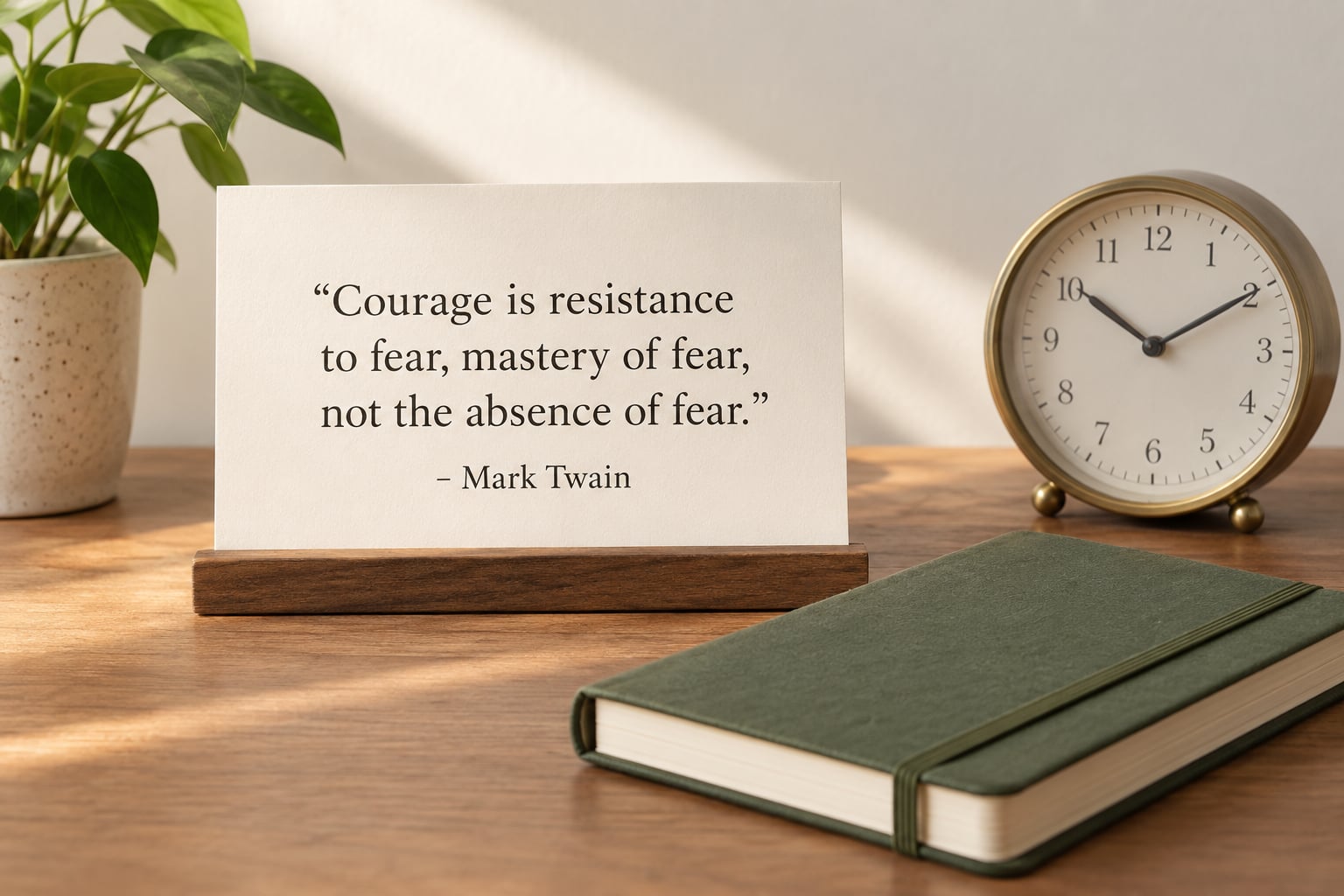
Nervous feelings do not disqualify anyone from a role. Almost every candidate feels something in the first few minutes, and interviewers know that.
What this line asks for is a controllable action rather than a feeling. When a question lands badly, name it silently, take one full breath before you speak, and finish the sentence you started.
How to use it when your mind goes blank mid-answer
Pause, say “that’s a good question, let me think for a second,” and then give the shortest true answer. People posting their worst interview moments on r/tifu describe the same collapse: they walked in prepared, and the moment they started talking, it all fell apart. A pause is the fix. It looks considered, not weak.
2. “First say to thyself what thou wouldst be; and then do what thou hast to do.” – Epictetus
This line turns a vague wish into a preparation plan. Decide which two or three professional qualities you want the interviewer to leave with, then assemble the examples that prove them.
A sample answer: “I’d describe myself as analytical and dependable. Here are two examples that back both up. Last year I reconciled a vendor invoice discrepancy that had been open for four months, and this quarter I built the weekly reporting checklist our team still uses.” That is Epictetus’ first half done before you ever walk in.
3. “Do what you can, with what you have, where you are.” – Arthur Ashe
This is the line to hold when you are asked about an experience you do not have, a tool you have never used, or a career change that does not look linear on a resume.
Structure the answer in four beats: acknowledge the gap plainly, name the skills that do transfer, describe how you would learn what is missing, and connect all three to the open role. A career changer might say, “I haven’t run paid campaigns, but I built and tested a content calendar on my own for a year, and I completed a certification in the platform this spring.”
4. “Success is the sum of small efforts, repeated day in and day out.” – Robert Collier
Behavioral questions reward people who have prepared a story, not people who have lived an impressive life. The same accomplishment can be told badly or told well, and the difference is repetition.
Pick one real accomplishment and run it through Situation, Task, Action, and Result until you can say it in ninety seconds without sounding recited. Most candidates can name three accomplishments when asked cold. Very few can name one and give the specific number at the end of it.
5. “Nothing will work unless you do.” – Maya Angelou
Saying you are excited about a company is not a contribution. This line pushes you past the word “motivated” and into something a hiring manager can picture.
Instead of “I’m highly motivated and would hit the ground running,” try: “Reading your job post, the first thing I’d want to fix is the gap between your weekly sales numbers and the dashboard your managers check daily. In my first 90 days I’d rebuild that report, sit with two reps to see what they need from it, and then hand it over with a written summary.”
6. “Well done is better than well said.” – Benjamin Franklin
Interviewers have heard every polished sentence about teamwork. They have not heard many specific ones.
Before: “I’m a great team player who always supports the group.” After: “On a six-person project, one teammate was out for three weeks before a client demo. I took over his reporting, moved my own ticket to the back of the queue, and we shipped on time. The demo scored highest that quarter.” Name the action, the obstacle, and the result, and confidence stops sounding like a claim.
7. “Great things are not done by impulse, but by a series of small things brought together.” – Vincent van Gogh
Van Gogh wrote this in a letter to his brother Theo in October 1882, and it still describes interview preparation better than most advice articles do. Confidence is the sum of small completed tasks, not a mood you wait for.
A five-day checklist that actually helps:
- Day one: read the job description twice and list every requirement
- Day two: research the organization and write down one specific thing about it
- Day three: select three examples and outline each one
- Day four: rehearse your first sixty seconds out loud, standing, timed
- Day five: test the video setup, the route, the login, and your outfit
8. “Be so good they can’t ignore you.” – Steve Martin
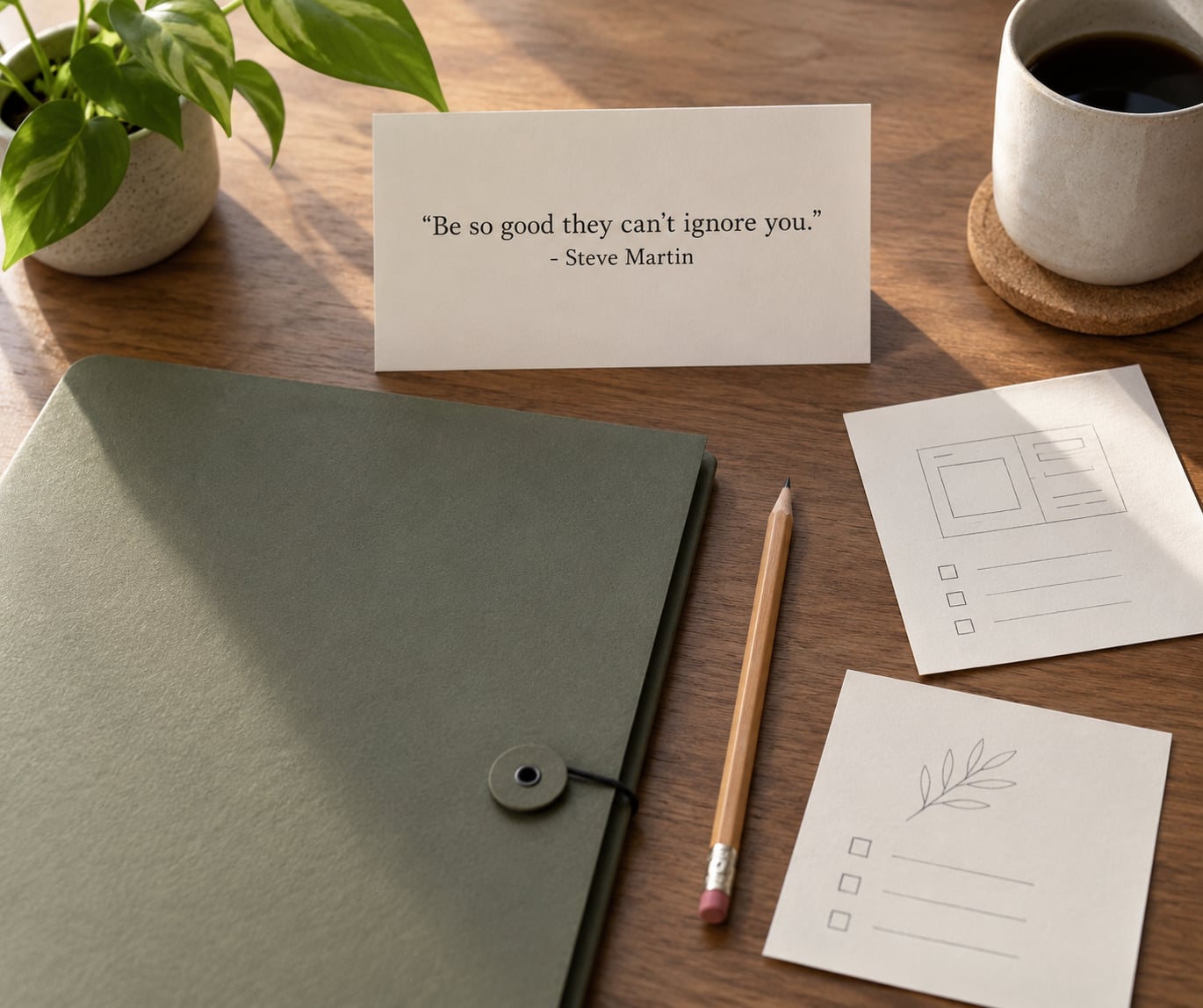
Martin was joking, but the line survives being taken seriously, as long as you read it as professional value rather than self-promotion. Nobody wants to hear you are good. They want to see one thing you did well.
Four things make a candidate memorable, and none of them require boasting: one portfolio result with a number attached, one skill you can explain in plain language, one question that shows you read something the company published, and a two-sentence account of what you would contribute in the first six months.
9. “The successful warrior is the average person with laser-like focus.” – Bruce Lee
Interviews go wrong when candidates answer the question they prepared instead of the question that was asked. Focus means staying with what is in front of you.
A model response for a focused question: “From what I’ve heard, your priority this quarter is cut onboarding time. I have led two onboarding redesigns, one that took new-hire setup from eleven days to four, and one that I documented so other teams could repeat it. Happy to go into the second one. Does that give you what you need to decide?” Name the priority, give two qualifications, support them with one example, and check that you answered.
10. “What you do every day matters more than what you do once in a while.” – Gretchen Rubin
A single spectacular achievement makes a weak career story. The question “tell me about a typical week” is where most strong candidates win, and almost nobody prepares for it.
Describe the routine and the repeated result: “Most weeks I clear about forty support tickets, run a fifteen-minute stand-up, and update the knowledge base. Over the last two quarters I cut average first response time from nine hours to under three, mostly by rewriting twelve of the top articles.” Rubin’s point is that consistency is the actual evidence.
11. “The secret of getting ahead is getting started.” – Mark Twain
Preparation paralysis feels like a motivation problem. It is usually a sizing problem. The task is too big, so nothing happens.
Shrink the first step until it takes under ten minutes: request the job description, list your transferable skills without judging them, choose three examples, and rehearse the first sixty seconds of your introduction. Do only that today. People in Stoicism communities frame failure as data rather than identity, and this is the smallest useful piece of data you can collect.
12. “Perfection is the enemy of progress.” – Winston Churchill
This line is widely credited to Churchill and quoted constantly, though the documentary trail is thinner than the famous line “Success is not final, failure is not fatal.” Worth knowing, since you are quoting it. The practical point survives the attribution question.
Rehearsing an answer word for word makes you stiff, vague, and easy to rattle. Use a five-beat structure instead: brief pause, direct answer, one relevant example, the result, then a short invitation for follow-up. And when you do not have the information, say so plainly rather than claiming certainty you do not have.
Frequently Asked Questions
How can a quote make me feel more confident before an interview?
A quote gives your brain a ready-made frame for a stressful moment, replacing spiraling self-talk with a calmer story. Repeating one short line for two minutes, plus slow breathing, settles the physical intensity of nerves. It works best when the line is tied to a specific prepared example, not when it is just read on the bus.
How do I naturally use a quote in a job interview?
Most candidates should not recite quotations at their interviewer. Where it works naturally is in your own framing: saying that you prepare in small daily efforts, or that you focus on one problem at a time, shows how you operate. Say it once, in your own words, then move to the evidence. A dropped reference reads as filler.
What if I feel nervous even after I memorize my answers?
Memorized answers create more risk, not less, because a single stumble breaks the whole sequence. Practice until you know the beats of an answer rather than the exact words. Memorization also sounds robotic, which is the complaint most often raised about over-prepared candidates. Know your examples, not your script.
Can I use the same quote for every job interview?
You can, but you will get more from it if you swap it out. A line about steady daily effort suits a role built on routine, while one about focus suits a panel interview where several people are asking different things. Pick the quote that matches the pressure point of that specific interview, and it lands instead of sounding rehearsed.
What should I do if I forget my prepared example during an interview?
Say so and buy yourself time. A line like “I have a story on that, let me think for a second” is normal and acceptable, and the pause reads as consideration rather than a gap. If nothing comes back, describe the situation without the polished ending. Missing anecdotes are the most common regret after a strong interview.
Conclusion
Pick the one quotation above that matches the challenge you actually have this week, write one action underneath it, and do that action first. Confidence in an interview is preparation plus delivery, not pretending you feel no fear. Choose the line, do the work it points to, and walk in knowing you have something specific to say.