A wedding ceremony reading works when the quote fits the moment: introduced in a sentence or two, read in full, then tied back to the couple with one specific detail. Most couples planning a wedding in 2026 hit the opposite problem, a beautiful quote that arrives out of nowhere and leaves the room politely silent. This guide shows how to use quotes in a wedding ceremony reading so it sounds like something the reader actually means.
Here is the whole method in five lines:
- Choose a quote that matches the couple’s voice, not its fame.
- Place it in the order of service so it arrives after the emotion is built.
- Introduce it in one or two sentences, out loud, in plain words.
- Connect it to something only this couple would recognise.
- Rehearse the timing at a slow ceremonial pace, roughly 130 to 150 words a minute.
Most ceremonies are better served by one strong quotation than by three, and a two-minute reading is plenty. Most of the work happens before the ceremony day, in the editing.
Table of Contents
- 1What You Need
- 2How to Use Quotes in a Wedding Ceremony Reading: Step-by-Step
- 31. Choose quotes that sound like the couple
- 42. Decide how many quotations to include
- 53. Connect each quotation to the ceremony
- 64. Add a personal detail between quotations
- 75. Write the final line and closing thought
- 86. Read it aloud and adjust the timing
- 9Common Mistakes
- 10Frequently Asked Questions
- 11How many quotes should I use in a wedding ceremony reading?
- 12How do I introduce a reading in a wedding ceremony?
- 13How long should a wedding ceremony reading be?
- 14Do quotes need attribution at a wedding ceremony?
- 15Is it okay to use a movie or TV quote at a wedding?
- 16Conclusion
What You Need
You need five things before you start picking passages, and none of them cost money.
- A theme or tone. One word does it: devoted, funny, steady, brave. Without one, a reader will choose three quotes that disagree with each other.
- Three short passages, not one. Collect more than you need so you can drop the weakest later.
- The couple’s names and a few facts about them. How they met, what they admire in each other, a running joke only some guests get.
- A target length. Decide whether this slot is 60 seconds or two minutes before you start, because that decision does most of the editing for you.
- A printed or digital script in large type, plus approval from the couple and the officiant.
The officiant conversation matters more than people expect. A celebrant will rarely object to anything, while a priest or rabbi may have real constraints on what is read inside a service. Ask early, and ask in writing so the answer survives the next three planning conversations.
How to Use Quotes in a Wedding Ceremony Reading: Step-by-Step
1. Choose quotes that sound like the couple
Start from the couple, not from a list of famous lines. Ask what they read, what they argue about, what they do on a Sunday afternoon. A passage written in plain language by someone the couple already enjoys will beat a beautiful sonnet every time, because guests read tone faster than they read words.
Check two practical filters before anything else. Length: if it runs past 200 words, assume you will cut it, and make sure the surviving lines still stand alone. Tone: if the tone is more sentimental than anything the couple would say out loud in private, it will sound borrowed up there.
On the overused staples, take a position. Love is patient, love is kind from 1 Corinthians 13 is beautiful writing and it has been read at more weddings than any other passage in the English language. Plenty of couples still want it. Plenty have heard it four times this year alone and would rather not. Ask the couple directly instead of quietly swapping it out.
2. Decide how many quotations to include
Two or three readings is the sweet spot for a standard ceremony of 20 to 30 minutes. One reading of 60 to 90 seconds works perfectly well on its own if it is the right one.
Use this guide to match a text to the slot you have.
| Spoken length | Word count at a slow ceremonial pace | Good for |
|---|---|---|
| 30 to 45 seconds | 65 to 110 words | A single line between the welcome and the vows |
| 60 to 90 seconds | 130 to 220 words | One main reading after the vows |
| 2 minutes | 260 to 300 words | A literary passage or a second reader |
| Over 3 minutes | 400 words and up | Rarely works. Guests start checking their programmes. |
If you have three passages, make sure they are not three of the same kind. A short line, a longer passage, and something light reads as a shape. Three love poems back to back read as a waiting room.
3. Connect each quotation to the ceremony
Position decides how a quotation lands. The most reliable slot for a main reading is after the vows and before the ring exchange, because the room has just heard the couple make their promises and a borrowed voice can name what those promises feel like. Putting a reading before the vows works too, but only when it is short, since it interrupts the build.
| Position in the order of service | What comes just before and after | When it works |
|---|---|---|
| After the welcome, before the vows | Officiant welcome, then vows | Short and grounding, 45 seconds or less |
| After the vows, before the ring exchange | Vows, then rings | The best default for a main reading |
| After the ring exchange, before the pronouncement | Rings, then pronouncement and kiss | A celebrant reading you want the room to hear as a closing thought |
| During a candle lighting or unity ritual | Another ritual element | Second marriages and blended families, where the ritual carries the meaning |
Send your placement to the officiant before the final script is printed. Readings inserted on the spot tend to land in the wrong gap, usually after the pronouncement when nobody is listening anymore.
4. Add a personal detail between quotations
This is the step that turns a borrowed line into a reading. Structure every piece the same way: one or two sentences of introduction, the quotation itself, then one sentence that only this couple could be given.
Fill in the blanks and say them out loud:
- “[Name] and [Name] asked me to share a few words, so I’d like to read you something they chose together.”
- “There’s a line about love that [Name] sent me months ago, and it has been sitting in my phone ever since.”
- “If you’d like to close your eyes for a moment, [Name] asked me to read these words.”
- “I’ll read this, and then I’d like you to think about the moment [Name] described to me at [place].”
The personal detail does not have to be dramatic. A specific memory, one quality the guests already know, or a habit like cooking badly on Sundays works better than a grand declaration. Concrete beats grand, every time.
Second marriages and blended families need a different version of this. Speak to the couple about who should be named and acknowledged, and keep the reading about the present rather than what came before it. A parent or an adult child reading is a good fit, and the words should land on what is being built now.
5. Write the final line and closing thought
End deliberately. A quotation that stops mid-air leaves the officiant to rescue the moment. Write one or two sentences of your own after it, something that hands the ceremony back.
- “And that is the wish [Name] and [Name] asked me to pass along to you.”
- “Please join me in raising a glass to [Name] and [Name].”
- “Let that be enough for now. The rest, they will write themselves.”
Then hand back cleanly: “I’ll hand it back to [officiant’s name].” Simple, and it tells the room the reading is over.
6. Read it aloud and adjust the timing
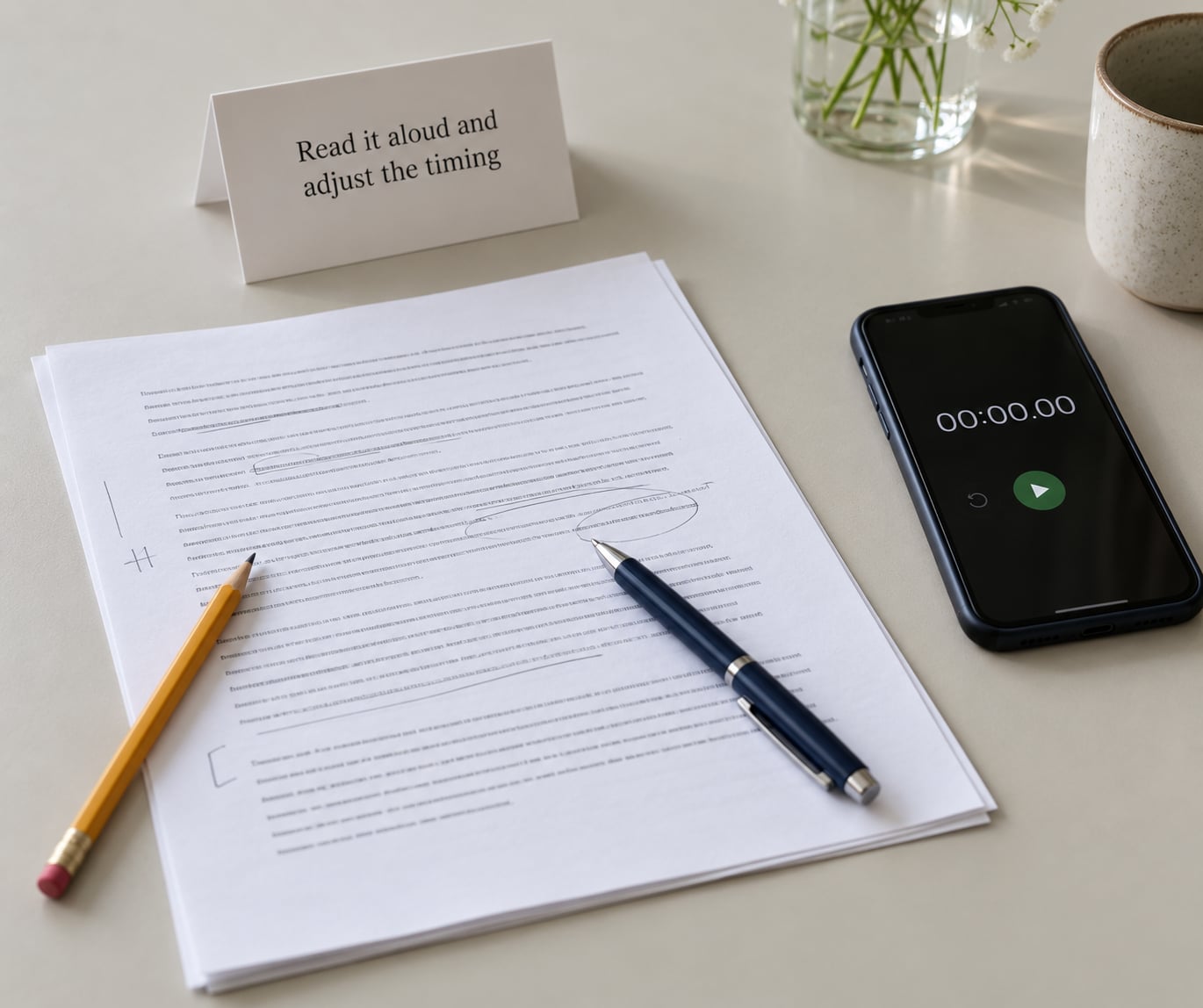
Rehearsal is where the timing gets fixed, and most of the work is cutting rather than adding. Read it aloud, at the pace you would use in the room, not your normal speaking pace. Ceremony reading runs slower than conversation, closer to 130 to 150 words a minute.
Mark pauses. A full stop after a line about commitment is worth more than an extra sentence. Where you will look up matters as much as where you breathe: lift your eyes at the end of a line, not at the end of a paragraph, and hold them for one beat.
Read it from a card in large type. Memorising a long passage is where readers lose their place in front of an audience, and a glance at a card reads as composed rather than unprepared. Bring a second copy if you can, and give it to the officiant so they know how the slot runs.
Common Mistakes
Most disappointing readings fail in one of six predictable ways, and all of them are fixable in the edit.
- Too many quotations. Three or more reads as a reading list. Fix: cut to one strong passage plus one short line, and move the rest to the reception.
- No attribution. Reading a famous passage without naming the author makes the moment feel borrowed. Fix: one sentence before or after, with author and title.
- Passing off a misattribution. Quote graphics get the author wrong constantly. Fix: trace the line to its original publication and check the author and year before it goes on a printed program.
- Too much text. Anything past 200 words loses a room. Fix: cut whole lines, not words, and read it aloud to see what survives.
- No pauses and no eye contact. A wall of sound reads as nerves. Fix: mark a pause after every line you want the room to feel.
- Material that has nothing to do with the couple. Fix: ask the couple for their favourite writers and one memory before you commit to anything.
On copyright and permissions, keep it simple and hedged. Poems, books and song lyrics are usually under copyright, and reading them aloud at a private ceremony is widely treated differently from publishing or recording them, but rules differ by country and no blog is your lawyer. Older works are a separate matter, and The Prophet by Kahlil Gibran, published in 1923, is public domain in the United States while still protected in many other places. This is not legal advice. If the ceremony is being recorded, or a reader is nervous about it, a simple line from a public domain work removes the question entirely.
One last check. Funnier is harder than tender. In-jokes work on the people who were there and land flat with anyone over 65 who is not, so test any humorous line against a guest who has never met the couple.
Frequently Asked Questions
How many quotes should I use in a wedding ceremony reading?
One strong quote is enough for most ceremonies. Two or three works well when they are different in length and tone, for example a short line, a longer passage, and something light. Three love passages in a row feel like filler. If you are unsure, pick the one you would still be glad to hear in ten years and cut the rest.
How do I introduce a reading in a wedding ceremony?
Say who chose it and why it matters, in one or two sentences, then read. For example: the couple asked me to read a few words, or these lines were written for their wedding. Keep it plain, look at the couple while you say it, and hand back to the officiant when the passage ends so the room knows the slot is closed.
How long should a wedding ceremony reading be?
Aim for 60 to 90 seconds, which is roughly 130 to 220 words at a slow ceremonial pace. Keep it under 200 words if the slot sits before the vows, since it interrupts the build. Anything past three minutes pulls attention away from the couple. If a passage is too short, add a specific memory rather than more borrowed words.
Do quotes need attribution at a wedding ceremony?
Yes, and it takes one sentence. Give the author and the title, such as the poet and the work, before or after the passage. Misattributed quote graphics are common online, so trace the line back to where it was first published and check the author and year before it goes on a printed program. Guests notice when a reader gets it right.
Is it okay to use a movie or TV quote at a wedding?
It is fine, and plenty of couples prefer it, but check two things first. The speaker should be able to explain why that line belongs to this couple, otherwise it reads as a joke about the film rather than about them. Second, make sure guests who have not seen it can follow it, which means adding one sentence of context before the line.
Conclusion
Start with one quotation that reflects how this couple actually loves each other, then build around it: place it after the vows and before the ring exchange, introduce it in a sentence, read it slowly, and finish with a specific detail plus a clean closing line. Edit hard, credit the author, and rehearse the words out loud until the pauses feel natural. That is the whole difference between a reading people remember and one they wait out.