Choosing a poem for a funeral reading comes down to four things: who the person was, what you want the room to feel, whether the poem fits the beliefs of the service, and whether you can read it aloud without rushing. Pick those first and the search narrows fast. Most people spend their time on the wrong question, hunting for a beautiful poem instead of the right one.
It helps to know the shape of the job. A funeral reading runs about 60 to 90 seconds, and you have roughly ten days, sometimes less, to find and learn it. No single poem is the correct choice, and the fear of picking wrong is the thing that paralyses most readers. What matters is whether it sounds true coming out of your mouth.
Table of Contents
- 1What You Need
- 2Step-by-Step: How to Choose a Poem for a Funeral Reading
- 31. Start with the person, not the occasion
- 42. Decide what the poem needs to do
- 53. Match the tone to the service
- 64. Check the length and readability aloud
- 75. Read several finalists with the real audience in mind
- 86. Confirm the choice with the family or funeral director
- 9Common Mistakes
- 10Frequently Asked Questions
- 11Should I choose a poem for a funeral based on religion?
- 12What if the family wants a funny poem at a funeral?
- 13How do I find a funeral poem that feels personal?
- 14Is it okay to read a poem written by someone else?
- 15How should I practice reading a poem at a funeral?
- 16What if I become too emotional to read the poem?
- 17Conclusion
What You Need
Before you open a single anthology, gather five things.
Three defining memories. Specific beats, not general praise. The sound of their laugh, a job they did for thirty years, a garden they never tidied, the holiday they argued about. These are the details that separate a poem about a person from a poem about death.
A sense of the audience. Is this a room of close family or a packed service of people who barely knew them? A poem full of inside jokes will land differently with the first group than the second.
The reading window. Ask the funeral celebrant how long the slot is. Two minutes is common, and anything over about 150 words will feel long in front of people who are trying to hold themselves together.
Your own comfort level with the text. Some people read well aloud. Some do not, and that is fine, but you need to know which you are so you can pick a poem with short lines and plain sentences rather than a dense one you will stumble over.
Permission and preferences from the family. This is the step people skip and regret. Funeral celebrants hit the same snag repeatedly: one relative assumes they are choosing the poem, while the person coordinating the service settled it weeks earlier. Ask early, and ask everyone who has a stake in it.
Step-by-Step: How to Choose a Poem for a Funeral Reading
1. Start with the person, not the occasion
Read your three memories back and ask what they share. If they all point to a person who was stubborn, quick with a joke and impatient with sentiment, a solemn elegy will be wrong for them. If they point to a quiet person who kept bees for forty years, a poem about gardens will land harder than a grand one about the soul.
This is also where faith and culture come in. A person who never set foot in a church should not be sent off with a psalm, and a devout family may find a secular poem oddly cold. Check what the person actually believed, not what the family says they believed this week.
Then think about tone. Some people want acknowledgement of the reality of the death first, with hope arriving in the last stanza. Others want the door left open on a good life. Both are legitimate, and the difference is a conversation worth having before you read anything.
2. Decide what the poem needs to do
A funeral poem is doing one of a handful of jobs, and picking the job first makes everything else easier.
- Comfort. It names the pain without trying to fix it. This is the safest and most requested category.
- Remembrance. It paints a specific picture of a life, which is why it suits a grandchild or a close friend better than an official.
- Gratitude. It thanks the person for something particular they gave you.
- Reassurance. It speaks about continuing on, often for a parent reading to siblings who will need looking after.
- Humour. It draws on the person’s wit. Powerful, and easy to get wrong.
- Spiritual reflection. It sits inside a religious or humanist frame rather than outside it.
- Closure. It gives the room a sense of an ending, which a memorial service held years later may need more than a funeral does.
Choose one. Trying to make a single poem comfort, amuse and close the service usually leaves it doing none of those well.
A note on the obvious favourite. Auden’s Funeral Blues is well known and widely loved, which is exactly why it shows up when you search. If you land on it, that is a fine reason. If you land on it because it was the first result, you have chosen a reading for the search engine rather than for the person in the coffin. Something plainer can hold a room better. Frost’s After Apple Picking is one of those: an ordinary afternoon and a pile of apples, no religious language at all, and grief sitting right underneath it.
3. Match the tone to the service
Tone is not a matter of taste, it is a matter of fit. The setting, the beliefs of the people in the room and the way the deceased would have wanted to be spoken about all push the tone in a particular direction.
| Tone | Who it suits | When to use it |
|---|---|---|
| Reassuring and calm | A partner or an adult child reading to siblings | When people in the room are not holding up and need steadying more than beauty |
| Reflective and quiet | A close friend or a grandchild | Smaller services, graveside readings, memorial services held later |
| Gently humorous | A colleague, a friend, or a relative when the deceased was genuinely funny | Celebration of life services and cremation ceremonies, early in the service rather than at the close |
| Spiritual or devotional | Church, chapel or interfaith services | When the deceased practised a faith and the family expects religious language |
| Plainly secular | Humanist or non-religious services | Any setting where prayer, God or an afterlife would feel imposed |
On humour, use one test: could someone who did not know the person find this funny, and would the person themselves have laughed? Humour aimed at the person, in front of people who loved them, usually works. Humour aimed at their illness, their age or their decline rarely does.
4. Check the length and readability aloud
Reading a poem at a funeral is an audio experience. The room cannot scroll back, and grief makes people miss whole lines the first time. Short lines and clear structure win every time.
Here is a simple timing method. Read the poem aloud at your normal speaking pace and time it, or count the words. Under 100 words reads in about 40 seconds. Between 100 and 200 words runs roughly a minute and a half and is the most common workable length. Over 250 words, ask the celebrant whether the slot genuinely allows it.
Watch for the things that trip readers: long unbroken lines with no commas, metaphors that need explaining, words the audience may not know, and dense punctuation. Rhyme is not a problem, because rhyme is predictable and gives the ear something to hold, but an unexpected metre is.
Print it in a large font. Your hands will shake, and a twelve-point page at two feet away on a lectern is a real problem on the day. A clean printed copy on card beats a phone screen every time.
5. Read several finalists with the real audience in mind
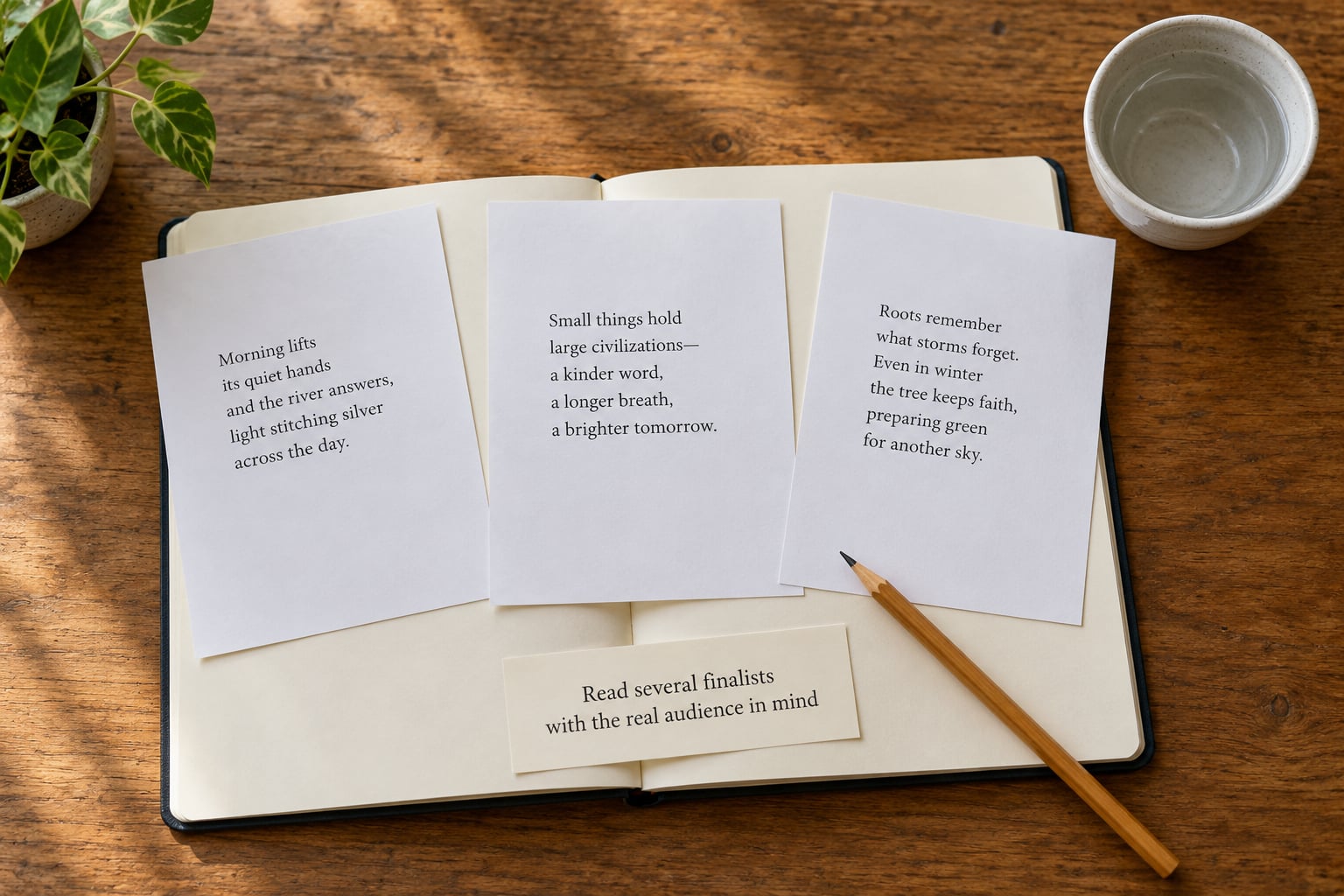
Narrow to two or three, then read each one aloud, standing up, at the volume you would actually use. Where you stumble, your voice will falter on the day. Where your voice cracks with real feeling, you have found the right one.
Then imagine the room rather than the page. Picture the front row. Picture the moment four minutes into the service when people are already tired of holding themselves together. If a poem opens with three lines of slow buildup, ask whether it earns that time.
Ask one trusted person to hear you read each one and tell you which sounds like you talking about your person rather than performing a poem. That single question does more work than any amount of reading about funeral etiquette.
6. Confirm the choice with the family or funeral director
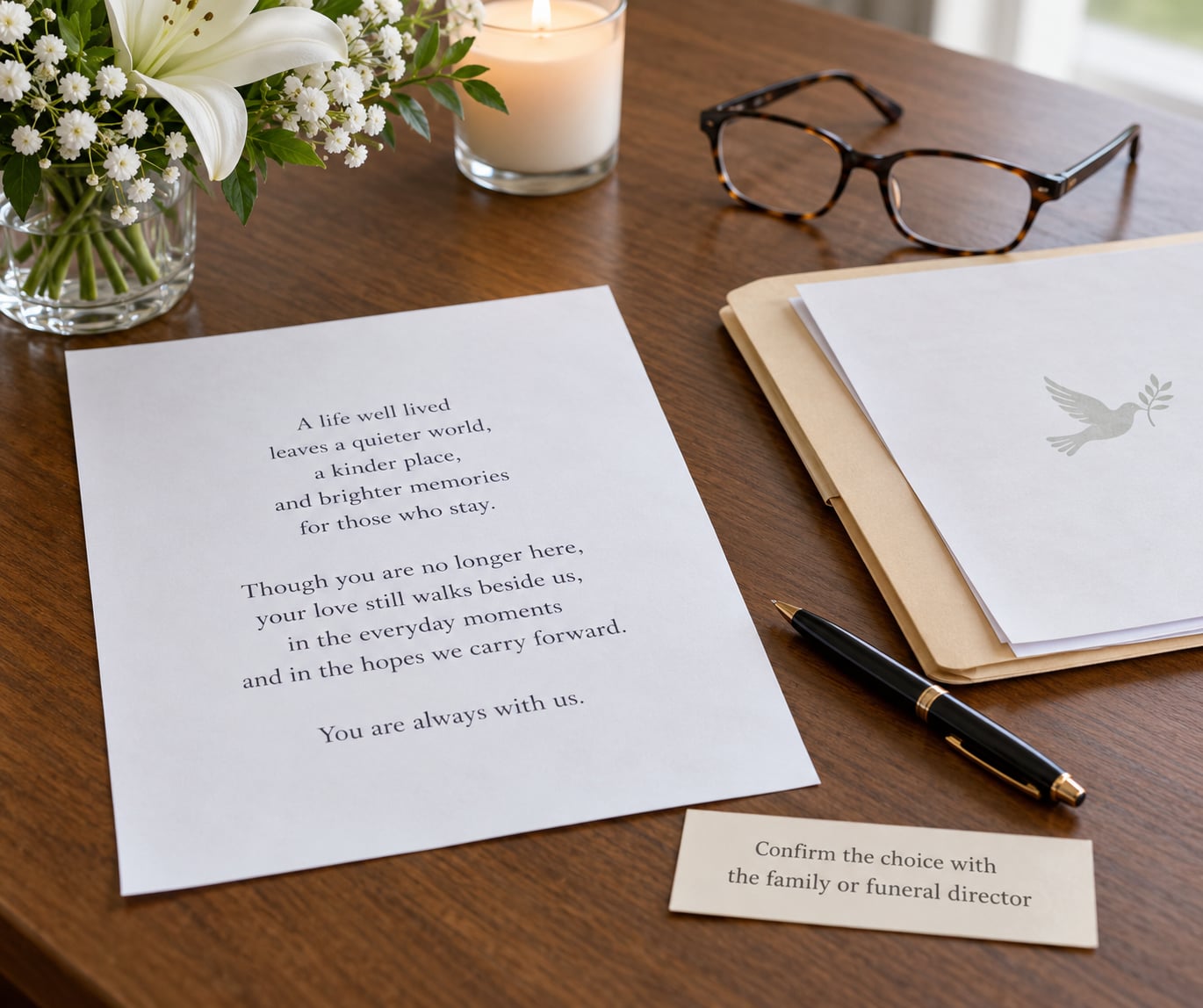
Send your final choice to the person coordinating the service, along with a request for approval and the number of minutes it runs. They will also tell you where in the order of service it sits, whether the celebrant wants a short line introducing you, and how many printed copies the mourners will receive.
Have a backup in your hand, printed, in the same folder. Not because you expect to need it, but because a lost page at the worst moment is a thing you can prevent entirely.
Most readers describe the same two feelings afterwards: that the poem was too short, and that they were glad they picked one they could deliver. Choosing a poem for a funeral reading is mostly a matter of sincerity rather than effect. Nobody in the room is grading you.
Common Mistakes
Picking a long poem because it looks impressive. A twenty-stanza work is a recital, not a reading. If it runs over two minutes, cut it or choose something else.
Choosing humour without testing the room. Light-hearted funeral poems work at a celebration of life for a person who was playful. They do not work in a formal church service, at a graveside in the rain, or after a long eulogy describing an illness. When in doubt, put the funny option second.
Using religious language that does not fit the deceased. Prayers, blessings and references to an afterlife exclude people in the room who believe differently or not at all. In a secular or humanist service, a poem can still offer hope without naming God.
Picking a text you cannot finish calmly. If you break down reading the first stanza at home, you will break down at the service. That is allowed and many people manage it, but choose a shorter, steadier poem if you want to be in control of your delivery.
Going with the first familiar poem. It is the selection people regret most often. The poem should contain at least one detail that could only belong to this person, or it is doing nothing that a card with their name on it would not do.
Writing your own poem on a short timeline. People who write their own poem at the service often describe it as the most meaningful part of the day and the hardest thing they have ever done. It takes more time than people expect, so start it earlier than feels necessary, and be honest with yourself about whether you want that task this week.
Frequently Asked Questions
Should I choose a poem for a funeral based on religion?
Match the poem to the person, not to the building. If they practised a faith, a devotional poem fits a church or chapel service. If they did not, or the service is humanist or secular, choose something that offers hope and comfort without prayer, scripture or an explicit afterlife, so no one in the room feels excluded. Ask the celebrant what the rest of the service assumes, then pick a poem that sits comfortably beside it.
What if the family wants a funny poem at a funeral?
It can work well, especially at a celebration of life, and it is often what the person themselves would have wanted. Two checks first. Would the person have laughed at the joke, and would strangers in the room follow it? Jokes about illness, age or decline are the ones that land badly. If more than one relative is uneasy, read the funny poem at a later gathering instead.
How do I find a funeral poem that feels personal?
Start with a specific memory, then choose a poem built on the same kind of image. Someone who gardened for decades suits a poem about gardens; someone who was a nurse suits a poem about steady hands and long shifts. General poems about loss are the ones people forget afterwards. Your own words, even six imperfect lines, will always sound more like you than anything a stranger wrote.
Is it okay to read a poem written by someone else?
It is the normal choice, and nearly every funeral reading is a published poem. The only real obligation is to attribute the poet by name and title, which takes one line before the reading. Avoid poems of contested reputation or ones where the author was cruel to the people the poem is about. If you want something more personal, you can read a published poem and add a few lines of your own around it.
How should I practice reading a poem at a funeral?
Read it aloud, standing, five or six times over the two or three days before the service. The first time catches unfamiliar words, the second catches your pace, and the later ones build the calm you want. Mark the pauses on the printed copy. Time the final run so you know the reading fits its slot, and stop practising the night before if it starts to feel mechanical.
What if I become too emotional to read the poem?
Expect it to be possible and plan for it, because it is normal and nobody in the room minds. Choose a poem you can deliver in roughly a minute, keep a printed backup, and pause after each stanza if you need to. Tell the celebrant beforehand so they can stand nearby. Many readers manage the tears and finish the poem, and the families who thank them rarely mention it.
Conclusion
There is no wrong poem for a funeral reading. There is a poem that fits this person, this room and your own voice, and that is the only one that matters.
Do three things tonight. Write down three memories specific enough that a stranger would not recognise the person in them. Decide whether the poem’s job is comfort, gratitude, humour or closure. Then read three short candidates aloud and keep the one that sounds like you talking about someone you loved.