
You do not need perfect words to comfort a grieving friend. You need a few honest sentences that name the loss, say you are sorry, and ask for nothing back. Most people freeze because they think the phrase has to be eloquent, and grief rarely responds to eloquence. It responds to presence, memory, and someone who keeps turning up after month two.
This guide walks through how to comfort a grieving friend with words, what to say at the moment you hear the news, what to avoid, and how to keep the friendship ordinary instead of turning every conversation into a memorial. It takes about ten minutes to read and a few seconds to use.
Table of Contents
- 1What You Need Before You Offer Comfort
- 2Pick a setting that lets them set the pace
- 3Give yourself more time than you think you need
- 4Decide between speaking in person, calling, or writing
- 5Step-by-Step: How to Comfort a Grieving Friend With Words
- 61. Reach Out Without Making the Moment About Yourself
- 72. Listen More Than You Speak
- 83. Validate Feelings Instead of Minimizing Grief
- 94. Offer Specific, Practical Support
- 105. Follow Up Gently and Consistently
- 11Common Mistakes When Trying to Comfort Someone Who Is Grieving
- 12Words That Help: Examples You Can Use
- 13For the first message
- 14For the moments they will not talk
- 15For guilt, anger, or numbness
- 16For a sympathy card
- 17For repairing a misstep
- 18For the long months after
- 19Frequently Asked Questions
- 20What to say when someone loses a spouse unexpectedly?
- 21Should I say the name of the person who died?
- 22Is a text message enough, or should I send a card?
- 23What do I say when they keep replying ‘I’m fine’?
- 24When does grief need more than kind words?
What You Need Before You Offer Comfort
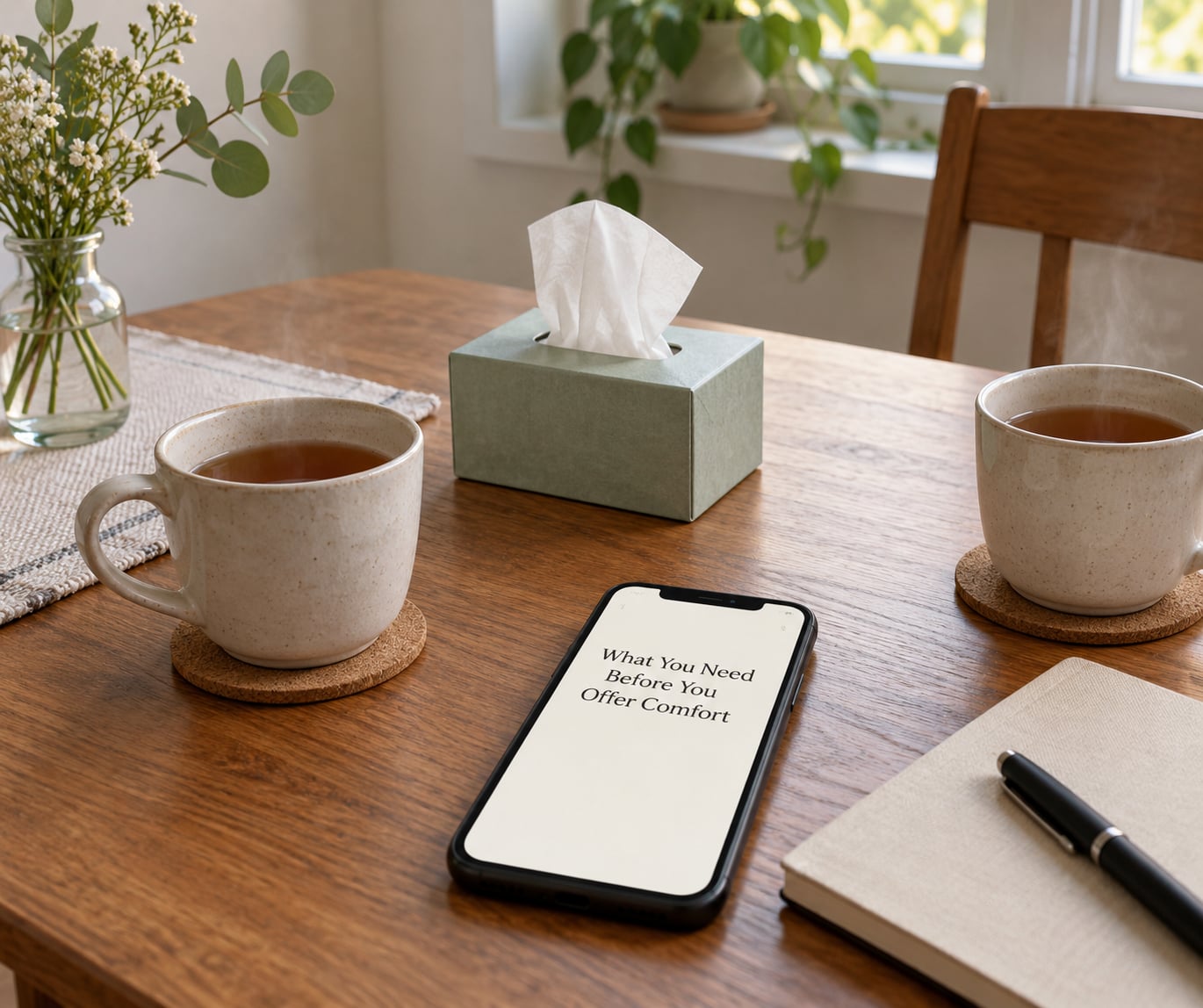
Before you speak, you need three things: a private moment, enough time to stay, and a decision about how you will deliver the words. That last choice matters more than most people expect.
Pick a setting that lets them set the pace
A kitchen table beats a restaurant. Somewhere they can stand up, cry, or end the conversation without making a scene in public. If they are in the middle of a funeral home reception or a shift at work, wait for a quieter window.
Give yourself more time than you think you need
The first visit often runs thirty minutes and the person is exhausted by the end of it. Arrive without a tight schedule. Ten extra minutes of sitting quietly is worth more than a perfect speech you rushed.
Decide between speaking in person, calling, or writing
In person is best for real comfort. A phone call works when you are far away or when a visit would be too much. A message is better than nothing and is often what a grieving person actually wants on day two, because they can answer when they have the energy.
Clinical guidance on supporting someone who is grieving makes the same point in fewer words: acknowledge the loss, be present, and offer concrete help rather than vague sympathy.
Step-by-Step: How to Comfort a Grieving Friend With Words

1. Reach Out Without Making the Moment About Yourself
Open with the name of the person who died and a plain statement of sympathy. “I heard about your dad. I’m so sorry” is enough to begin. Then stop talking.
The mistake people make here is filling the space themselves. A long story about your own similar loss, however sincere, transfers the emotional weather from their room into yours. If your own experience comes up, keep it to a sentence and only if they ask.
Give them control over what happens next. “Do you want company, or would you rather I just check in later?” removes the guesswork and lets them say no without it feeling like rejection.
2. Listen More Than You Speak
Ask permission before going deep. “Do you want to talk about him, or would you rather talk about something else?” is a question most grieving people wish someone had asked.
When they do talk, resist the urge to fix, advise, or improve. Grief is not a problem with a solution, so advice lands as dismissal. Reflecting back what you heard works well: “It sounds like what you miss most is the evenings.”
Silence is not failure. Sitting quietly with someone for twenty minutes does more than a paragraph of talking, and bereaved people consistently say they remember who showed up rather than who said something impressive.
3. Validate Feelings Instead of Minimizing Grief
Grief arrives in more shapes than sadness. People report anger at doctors, guilt about an argument three weeks earlier, relief mixed with horror, or nothing at all for weeks. All of it is normal, and all of it deserves a sentence that says so.
“You’re allowed to feel however you feel, including the parts that don’t make sense” gives permission without demanding a response. Avoid setting a timetable for their recovery. Phrases like “give it time” and “you’ll move on soon” put a deadline on something that does not follow one.
4. Offer Specific, Practical Support
“Let me know if you need anything” is well meant and almost useless. Someone in the first weeks of grief cannot generate a list of errands. Naming a task and a time removes the work of asking.
- “I’m bringing dinner Thursday. I don’t need an answer.”
- “I can drive you to that appointment on the 14th.”
- “I’m handling the litter pickup while you’re at work.”
- “Can I come by Saturday morning and do your laundry?”
Pick the thing you would actually do if they said yes. Bereaved people remember the friend who asked a practical third party what was needed instead of asking them directly, because it spared them the effort of answering.
5. Follow Up Gently and Consistently
Support thins out fastest right when the need grows. After the funeral and the casseroles stop, your friend often falls into a hollow nobody notices.
Put check-ins in your calendar rather than waiting for inspiration. A short, no-pressure message every couple of weeks does the work: “No need to reply. Just thinking of you and your mom today.” Normal company, a shared errand, or an invitation to sit in silence together counts as support too.
Common Mistakes When Trying to Comfort Someone Who Is Grieving
Almost every unhelpful comment falls into one of a handful of patterns. The fix is usually a swap: same warmth, less friction.
| Instead of this | Try this |
|---|---|
| “Everything happens for a reason.” | “I’m so sorry. There is no reason I can see for this.” |
| “At least they lived a long life.” | “That was a whole life, and you were in it.” |
| “She’s in a better place.” | “I miss her too.” |
| “Time heals all wounds.” | “Take whatever time you need. I’m not going anywhere.” |
| “I know exactly how you feel.” | “I can’t imagine it. Tell me what it’s like.” |
| “You need to stay strong for the kids.” | “You don’t have to hold it together for anyone here.” |
| “Have you tried therapy?” | “Would it help to talk to someone who does this for a living? I can help you find one.” |
| “What can I do to help?” | “I’m bringing dinner at six. Nothing to do.” |
| “How are you?” | “How are you feeling today?” |
A second common error is disappearing. The person who sends the most beautiful message in week one is often gone by week eight, and that silence teaches a lesson they will remember.
Words That Help: Examples You Can Use
Swap in the name of the person who died and the details that belong to your friendship. Everything below is designed to be said out loud, sent by text, or written by hand.
For the first message
- “I heard about [name]. I’m so sorry. There’s no rush to reply.”
- “I don’t have the right words, and I don’t think there are any. I’m just glad you called.”
- “[Name] was a good man and I’m glad I got to know him.”
- “Do you want me to come over, or would you rather have quiet for a while?”
For the moments they will not talk
- “You don’t have to talk about it. I’m happy to just sit.”
- “I sent a message with no expectations attached. Read it or don’t.”
- “Not answering is fine. I’m still here in six months.”
For guilt, anger, or numbness
- “Guilt shows up for almost everyone. It isn’t a sign you did something wrong.”
- “You’re allowed to be angry. I’m not going to talk you out of it.”
- “Nothing is happening right now. It’s allowed to be quiet.”
For a sympathy card
Short beats long. Name the person, share one specific memory in a sentence, and say how you’ll keep in touch.
“Thinking of you and your family. I still think about that awful [sport] game we all sat through. [Name] was one of a kind. I’m around whenever you want company. With love.”
For repairing a misstep
If you say the wrong thing, do not bury it in an apology spiral. Name it, own it briefly, and ask for the version you can get right.
“I said something clumsy earlier and I have been thinking about it. That was not what I meant. I’m sorry.”
For the long months after
- “A year ago today. Thinking of you.”
- “The kids asking about [name] is going to be hard this month. I’m here for that.”
- “No news needed. Just wanted you to know I’m around.”
Frequently Asked Questions
What to say when someone loses a spouse unexpectedly?
Skip explanations and offers of comfort about the future. Say their partner’s name, say you are sorry, and stay close: u0022I heard about [name]. I’m so sorry. I don’t have words for this, but I’m here and there’s nothing you have to do.u0022 Then help with logistics in the first week: food, transport, phone calls. Do not ask how they are coping in a way that demands an answer.
Should I say the name of the person who died?
Yes. Saying the name out loud is one of the most valued things a grieving person hears, because it proves the person was real and is not being erased. Keep the name paired with something true and specific: a habit they had, a thing they said, a place they loved. Avoid switching to euphemisms like u0022the departed,u0022 which can feel distant at exactly the wrong moment.
Is a text message enough, or should I send a card?
A text is enough, especially early on, when a grieving person may have no energy for a visitor. Keep it short, name the person who died, and add one line that asks for nothing. A card adds weight when the person is the kind who values paper, or when you want to add a longer memory in your own hand. Sending both is generous and never overkill.
What do I say when they keep replying ‘I’m fine’?
Take it at face value and stop asking. u0022I’m fineu0022 is often a closed door, not an invitation. Switch to statements instead of questions: u0022Thinking of you today,u0022 or a photo of something that reminded you of them. Offer a specific activity with no obligation attached, such as a walk or a drive. If they want to talk, they will tell you when they are ready.
When does grief need more than kind words?
Grief that stays intensely distressing for more than a year, disrupts daily functioning, or comes with inability to sleep, eat, or work may benefit from professional support. A grief counselor, a hospital bereavement service, or a hospice care team can help, and many offer free sessions after a death. In the United States, the 988 Suicide and Crisis Lifeline offers support by call or text at 988 for anyone in crisis.
Do the first thing today, not the perfect thing later: send a short message that names the person who died, says you are sorry, and asks for nothing. Then put the next check-in in your calendar. Grief lasts longer than your awkwardness does, and showing up twice is worth more than saying something brilliant once.
Reviewed for accuracy on October 2026. This guide offers general emotional support information and is not a substitute for professional mental health care. If someone you care about is in crisis, contact the 988 Suicide and Crisis Lifeline by calling or texting 988 in the United States, or your local emergency number.