Picking quotes about foster care for an appreciation gift comes down to tone. You want something that honors the caregiver without turning a child into a story, and something specific enough that a foster parent reads it and thinks you actually know what their days look like. These ten quotes are written to be printed, engraved, handwritten, or read aloud, and each one comes with the gift it pairs with best.
One note before the list. Foster parents say over and over on r/Fosterparents that the words matter more than the object, and that a specific handwritten line beats a generic card every time. So treat the quote as the gift’s spine, not its decoration, and add one detail only you would know.
Table of Contents
- 1Quotes About Foster Care for an Appreciation Gift at a Glance
- 21. A Quote Celebrating Foster Parents as Courageous Caregivers
- 32. A Quote Honoring the Love Shown by Foster Families
- 43. A Quote Recognizing the Strength of Foster Children
- 54. A Thank-You Quote for Foster Parents and Volunteers
- 65. A Quote About Creating a Safe and Stable Home
- 76. A Quote Celebrating Small Wins and Everyday Progress
- 87. A Quote About the Lasting Impact of Foster Care
- 98. A Quote for Celebrating a Child’s Resilience
- 109. A Short Quote for a Handwritten Appreciation Card
- 1110. A Quote About Hope, Healing, and New Beginnings
- 12How to Choose a Foster Care Quote for the Recipient
- 13Frequently Asked Questions
- 14What is a good foster care quote for an appreciation gift?
- 15How do I personalize a quote for a foster parent?
- 16Are there quotes that celebrate foster children respectfully?
- 17What gift can I pair with a foster care quote?
- 18Should an appreciation quote mention a child’s difficult experiences?
- 19Can I use foster care quotes in a card or presentation?
- 20Conclusion
Quotes About Foster Care for an Appreciation Gift at a Glance
The table below matches each quote to the emotion it carries, the gift it fits, and where it usually lands best. Scan it first, then jump to the number that fits your recipient.
| Quote | Emotional focus | Best gift pairing | Best setting |
|---|---|---|---|
| 1. Courageous caregivers | Courage, steady care | Framed print plus handwritten card | Moving-in thank you, anniversary of a placement |
| 2. Love shown by the family | Love, commitment | Family photo book or wall art | Holiday gift, family portrait session |
| 3. Strength of foster children | Dignity, quiet strength | Wall quote print | Adoption day, permanency celebration |
| 4. Thank-you for volunteers | Gratitude, unseen work | Engraved mug or keychain | Caseworker week, volunteer recognition |
| 5. Safe and stable home | Safety, belonging | Household gift, not a child gift | First weeks of a placement |
| 6. Small wins and progress | Growth, ordinary victories | Desk or classroom display | School conferences, progress notes |
| 7. Lasting impact | Long-term memory | Keepsake, commemorative plaque | After a child leaves the home |
| 8. Resilience | Resilience, growth | Presentation slide or poster | School meeting, speech, slideshow |
| 9. Short card quote | Warm gratitude | Blank card, envelope | Quick note, drop-off week |
| 10. Hope and new beginnings | Hope with respect | Keepsake or closing message | Reunification, graduation, new chapter |
1. A Quote Celebrating Foster Parents as Courageous Caregivers
Courage comes in small, ordinary acts: an unlocked door, a lamp kept burning, a chair pulled up to the table.
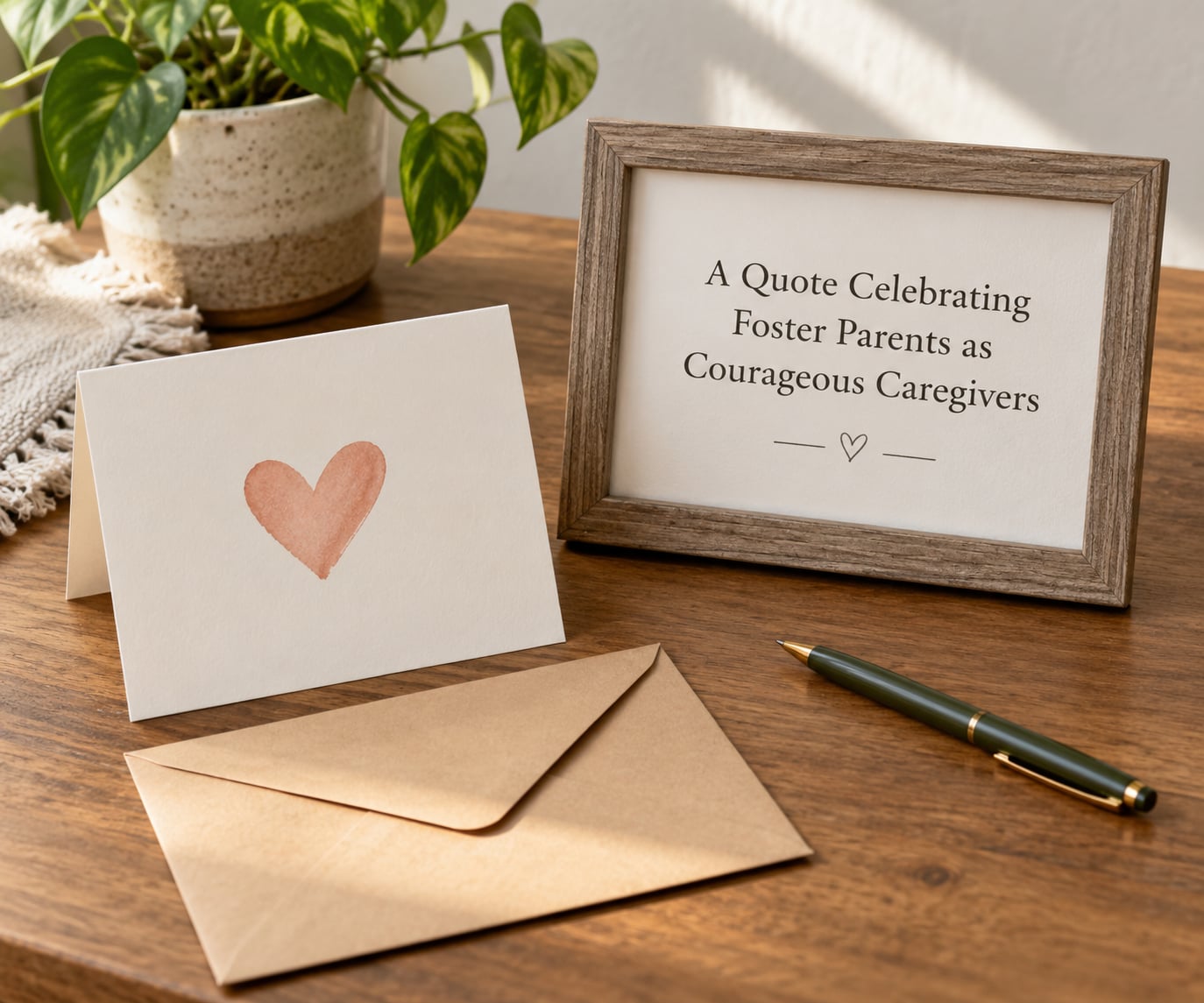
This line works because it defines courage as routine rather than heroic. Foster parents describe the job as wake-ups, paperwork, and a kid who is having a hard week, so a quote that names the ordinary stuff lands harder than one that calls them heroes.
Pair it with a small framed print and a handwritten card. Write the frame line inside the card by hand and sign it with the specific thing you have noticed, such as how the other kids adjusted once the spare room became a bedroom.
2. A Quote Honoring the Love Shown by Foster Families
Love in foster care is not a grand gesture. It is showing up on the tenth ordinary Tuesday.
The Tuesday detail does the emotional lifting here. A family that keeps going long after the excitement of the first placement is the family this line describes, and it says thank you for endurance without sounding like a testimonial.
Add a family name inside the frame if you have permission, or a photo of the child doing something ordinary, like a school play or a garden. Keep the added detail light so the gift does not feel like a spotlight aimed at the child’s hardest year.
3. A Quote Recognizing the Strength of Foster Children
They arrive carrying more than luggage. They arrive carrying a story, and they get to decide how much of it to share.
This is the dignity-first way to do it. It credits children with judgment and privacy instead of describing them as damaged or brave beyond their years, and the second clause quietly tells the caregiver to respect the child’s boundaries.
Print it large and simple, in a room the family chooses, not a bedroom. Keep it off the child’s school things and off anything that travels with them to a new placement.
4. A Thank-You Quote for Foster Parents and Volunteers
You sat across the table with the paperwork, the hard calls, and the long evenings. Few people understand what that costs.
Relatives, mentors, CASA volunteers, and caseworkers carry a version of this role that rarely gets thanked. Naming the paperwork and the difficult phone calls, rather than praising someone in general terms, is what makes this line useful for them.
Engrave it on a mug or a small keychain. Mug text works because of the length, and a volunteer who pours coffee every morning reads it more often than a card tucked in a drawer.
5. A Quote About Creating a Safe and Stable Home
A safe home is built out of ordinary days: the same school, the same breakfast, the same adult who keeps showing up.
Stability is the word child welfare workers use most often, and it is the thing a foster family works hardest to protect. This quote names consistency instead of sentiment, which is exactly what a placement needs in its first weeks.
Pair it with something for the household rather than the child, such as a grocery gift card for the week the placement starts or a delivery credit for the week of a court date. Practical support tends to land better than decorative items, because it is the kind of help that takes a task off the list.
6. A Quote Celebrating Small Wins and Everyday Progress
Progress in foster care rarely looks like a leap. Usually it looks like a kid deciding to eat breakfast.
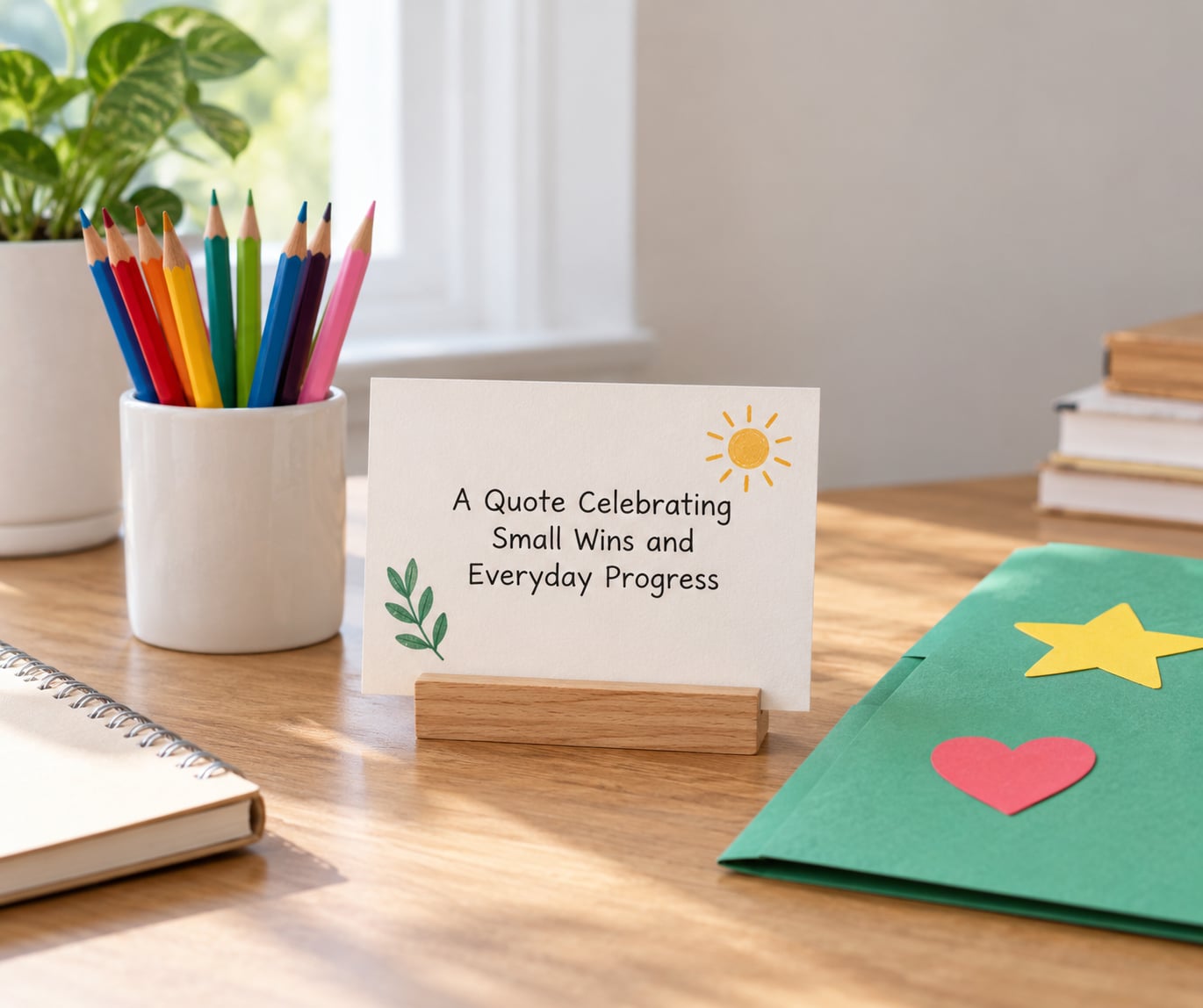
Set expectations in a way that is generous instead of deflating. Caregivers live on tiny measurements, a full night of sleep or a school day without a fight, so this line tells them someone is watching at the scale they actually work at.
It works in a classroom, at a school meeting, or on a card tucked into a report folder. If the child is old enough to want to sign it, let them draw next to it rather than asking them to read your words out loud.
7. A Quote About the Lasting Impact of Foster Care
You are not a stop on the way. You are the place a child remembers learning that home can be kind.
This is the one to reach for after a placement ends. Staying in touch after a child leaves is the part many caregivers say they remember most, so a line about memory rather than outcome respects the relationship instead of measuring it.
Use it on a commemorative gift, a year-in-review photo book, or the close of a speech at an appreciation night. Skip it if the child has just been reunified with their family and the moment needs to stay quiet.
8. A Quote for Celebrating a Child’s Resilience
Resilience is not something you hand a child. It is something you protect, by being boringly, reliably there.
The turn does the work. Most appreciation language credits the child for being resilient, which quietly asks a young person to keep performing strength. This version gives the credit to the adult who protected the conditions for it.
It suits a wall display, a card, or a single slide at the end of a presentation. On a slide, set it on a plain background and read it out rather than letting the room do the work for you.
9. A Short Quote for a Handwritten Appreciation Card
Thank you for making home feel safe.
Seven words, so it fits any card front, envelope flap, or bookmark without crowding the page. Short lines are easier to write by hand neatly, and a neat handwritten note reads as effort, which is the whole point.
Personalize it with a single clause after the period, naming something you observed rather than something you assume, such as the way the household settled after the first week or the evening routine the family built. One detail is enough.
10. A Quote About Hope, Healing, and New Beginnings
Hope is not pretending the hard part is over. Hope is doing the next kind thing anyway.
This closes the list without offering false comfort. It acknowledges that healing takes time while still pointing at something a caregiver can act on this week, which makes it a strong final line for a gift, a keepsake, or the end of a speech.
Pair it with a keepsake that gets used, such as a photo frame for a trip or a recipe card for a family meal. Whatever you choose, keep hope tied to respect for what each family has actually been through.
How to Choose a Foster Care Quote for the Recipient
Match the line to the role first, then to the moment. A caseworker and a foster parent need different words, and a quote written for a volunteer can sound thin when handed to someone doing the daily work.
- Foster parent: lead with stability, ordinary effort, or love, and add one concrete detail from their routine.
- Caseworker or social worker: name the paperwork, the difficult calls, and the coordination nobody sees from the outside.
- Teacher, mentor, or CASA volunteer: keep it short and forward-looking, focused on the child’s ordinary week.
- Kinship caregiver or relative: skip anything about rescuing or saving. Family already knows what they took on.
- Young person reading it: choose lines about safety, belonging, and growth rather than hardship.
Two words to leave out of any foster care appreciation message: saving and forever. The first assigns a rescue role to a caregiver, and the second makes a promise about an outcome nobody in child welfare controls. Replace both with what actually happened, in plain words.
Frequently Asked Questions
What is a good foster care quote for an appreciation gift?
A good quote names what the caregiver actually does, not what they are. Lines about ordinary consistency, safety, and showing up read as sincere because they match daily life in a foster home. Keep it under 25 words so it fits a card, a frame, or an engraving, then add one specific detail that only you would know.
How do I personalize a quote for a foster parent?
Add one observation, not one assumption. A line about the evening routine the family built, or how a sibling settled after the first week, tells the caregiver you were paying attention. Avoid details about the child’s hardest moments unless the caregiver has told that story publicly and wants it repeated.
Are there quotes that celebrate foster children respectfully?
Yes. The respectful ones credit children with judgment and privacy rather than describing them as damaged or heroic. Look for lines that let the child decide how much of their story to share, and place the quote in a room the family chooses, not in a bedroom or on school belongings.
What gift can I pair with a foster care quote?
Pair short gratitude lines with a handwritten card or an engraved mug, and pair longer lines about stability with something for the household. Photos, recipe cards, and photo frames work well for keepsake wording. Caregivers usually find practical help and continued contact more meaningful than decorative gifts.
Should an appreciation quote mention a child’s difficult experiences?
Usually not. Mentioning hardship in a gift can put the child back at the center of a hard story in front of people they did not choose to tell it to. If the caregiver has shared that story openly, a light reference is fine. Wording about safety, growth, and ordinary days works for nearly every situation.
Can I use foster care quotes in a card or presentation?
Yes. These lines are written to be reused, so print them on a card insert, a wall print, or a closing slide at an appreciation event. In a presentation, read the line out loud and keep it on screen for only a few seconds, then move to a specific story about the caregiver’s work.
Conclusion
Start with the line that matches the role, not the one that sounds nicest. Quotes about foster care for ordinary consistency suit foster parents, ones about paperwork and hard calls suit caseworkers and volunteers, and short lines fit a card without editing. Then add the one detail only you would know, because that detail is what a foster parent keeps long after the frame comes off the wall. Keep in touch afterward, too, since staying in contact is the thank most caregivers actually rank first.