Yes, you can use a quote in a cover letter, but only when it is short, attributed, and tied to a specific reason you are a fit. Drop a famous line into the opening paragraph with no context and it reads as filler. The whole job takes about 20 minutes once your letter is drafted, and most of that time goes to picking the right line and writing the sentence that follows it.
One quick clarification, since search results mix these two up constantly. Here a quote means a quotation, someone else’s words in quotation marks. A quotation document is a price sheet, which is a different thing entirely.
Worth saying plainly: a quote in a cover letter is optional. Plenty of strong letters never use one. What follows is how to add one well if you want it, and how to cut it if you do not.
Table of Contents
- What You Need Before You Pick a Quote
- Step-by-Step: How to Use a Quote in a Cover Letter
- Frequently Asked Questions
- Should you put a quote in your cover letter at all?
- Is it unprofessional to add a quote to a cover letter?
- How do I attribute a quote I did not write?
- How long should a quote be in a cover letter?
- Does an applicant tracking system (ATS) filter out cover letters that include quotes?
- When should I leave a quote out of a cover letter?
- Conclusion
What You Need Before You Pick a Quote
Five things, and you probably already have four of them.
The job description, read closely. Pull the three verbs the posting repeats. If it says collaborate, mentor, and iterate, those are the ideas your quote has to touch.
The employer’s own words. Their mission page, a recent company blog post, or a published statement from a founder. Quoting an employer is doing the opposite of quoting a celebrity: it shows you read something, and the words are about you by default.
One real achievement with a number in it. A specific result you could explain for two minutes if asked. This is the payload the quote carries. Without it you have a decoration.
A quotation you can actually source. Real words, a real author, a real source. If you cannot name where the line came from, it is a paraphrase you invented, and that is a different risk.
A draft letter that already sounds like you. Add the quote last. Writing the letter first means the quote has a job to do instead of pretending to be the letter.
Step-by-Step: How to Use a Quote in a Cover Letter
How to Choose a Quote That Fits the Job
Match the quotation to something in the posting, not to something about you in general. A line about craftsmanship belongs in a letter to a shop that makes things. It has no business in an application to a SaaS company, however much you admire it.
Then run the association test. Picture the hiring manager skimming 40 applications. Could they honestly link those words to you specifically, or could they be pasted into the next ten letters they read? If the answer is the second one, pick a different line.
Famous is not the same as good. A line has appeared in a hundred motivational posts, so it carries no information about you, and readers register it as noise before they finish it.
Connect the Quote to Your Experience
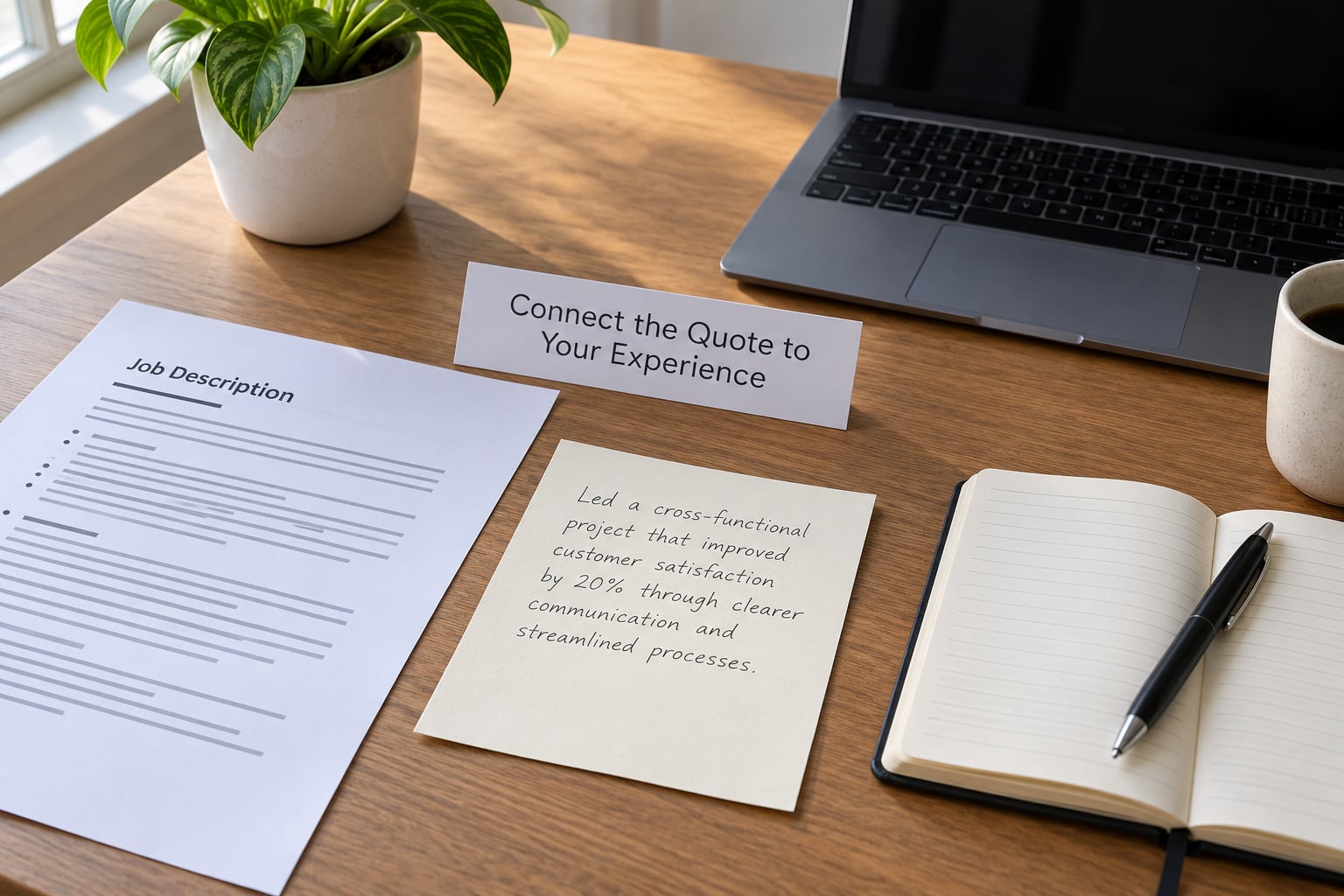
This is the part that decides whether the quote helps or hurts. Immediately after the quotation, write a sentence that proves you live by it, with something concrete behind it.
Weak version. The quote sits alone and the next paragraph starts talking about your enthusiasm. The reader has been given a maxim and no reason to care.
The only way to do great work is to love what you do. I have always believed that passion is the foundation of success, and I am writing because I am excited about this opportunity.
Stronger version. Same quote, one concrete achievement attached.
The only way to do great work is to love what you do. In my four years at the print shop, that meant learning a second press so I could cover a rush order on Fridays without asking anyone for help. I am looking for the same kind of ownership in a role where the work is the point.
What changed is proof. The first version tells the reader you like quotes. The second tells them what you actually did, and the quote just frames it.
If you are quoting a supervisor, client, or mentor, the same rule applies with the attribution doing the work. One line of credit, then the result.
Place the Quote Where It Reads Naturally
Three positions work: the opening hook, a pivot in the middle, or the closing. A fourth position does not, which is the standalone quote in its own centered paragraph at the top. That layout is a poster, not a letter.
The opening hook works when the line is about the work itself and you follow it immediately with your reason for applying. A middle pivot works best for a career changer, where the quote bridges the old field and the new one. A closing quote works when it reframes your motivation, and it is the safest of the three because the reader has already formed an impression.
| Cover letter type | Best placement | Longest useful quote |
|---|---|---|
| Entry-level or internship | Opening sentence, then straight into evidence | 8 to 10 words |
| Career changer | Middle pivot, between the old role and the new one | 10 to 15 words |
| Returning after a career break | Closing, where it reasserts direction | 10 to 12 words |
| Senior or executive | Opening, only if the line is about leadership or craft | 8 to 12 words |
| Creative or portfolio role | Anywhere it reads naturally; voice matters more than position | 10 to 15 words |
| High-volume application | Leave it out | None |
Transitions are where most letters stumble. Keep them to one short clause, then move on.
Into the quote: The thing I keep coming back to is this. Or, when the words come from their materials: Your mission statement puts it better than I could.
Out of the quote: Here is what that looked like in practice. Or, pointing back at your own record: That is the standard I held myself to last year, when…
Edit for Voice, Length, and Relevance
Run these checks after you place the quote, not before.
- Accuracy. Find the original source and confirm the wording character by character. A misquote is a credibility problem you handed the reader.
- Attribution. Name the person and their role or source. A quote floating with no credit looks lifted, because it is.
- Brevity. Eight to fifteen words. If it runs past that, it is a paragraph, and the reader will skip it.
- Tone. Nothing grandiose. If the line sounds like a keynote, cut it.
- Flow. Read the sentence before and the sentence after. Neither should need the reader to pause.
- Relevance. Delete the quote and read the paragraph. If the paragraph is weaker without it, the quote was decoration.
Common Mistakes
The unattributed celebrity line. No name, no source. It reads as something you found on a poster, which is what you did.
The quote with no follow-up. Inspirational words followed by a paragraph about your enthusiasm. The reader learns nothing about you.
The industry mismatch. A line about handmade quality sent to a software company. Relevance is not optional.
The overexplained quote. Two sentences explaining why the line matters to you. If the reader needs that, the quote is too subtle to be doing work.
The misquote. Slightly altered wording, often from memory or a social post. Verify it or drop it.
The formatting clash. Centered, italicized, a different font, standing alone. Any of that signals a greeting card, and hiring managers do describe cover letters that way when they complain about them on r/careerguidance.
The mixed fonts in one line. Italic quote, roman attribution, is fine. A different typeface entirely is not.
Spending more than three sentences on it. If the quotation has taken over the letter, it has replaced your argument instead of framing it.
Tips
Read the passage aloud. If you stumble once, the reader stumbles with you.
Ask whether the employer could associate those words with you and nobody else. That is the entire test, and it takes ten seconds.
Prefer self-authored lines, a supervisor’s words about your work, or a sentence from the employer’s own materials. Those are always safe because they are about you or about them. A public figure’s line is a gamble every time.
Verify famous quotations at the source. Plenty of popular lines are misattributed, and the version circulating on quote sites is often the wrong one.
Use the quote once. Two quotations in one letter turns it into a scrapbook.
Frequently Asked Questions
Should you put a quote in your cover letter at all?
Only when the letter has room and the line is about the work. A quote earns its place by giving the reader a fast frame for why you want the job, something a resume cannot show. If you cannot attach a specific result to it, the letter reads better without one. The strongest version is a short line from a supervisor, client, mentor, or the employer themselves.
Is it unprofessional to add a quote to a cover letter?
No, but an unattributed celebrity line usually is. What reads as unprofessional is a quotation with no source, no connection to your experience, and no reason to be in a hiring document. What reads as thoughtful is a short attributed line followed by a concrete example of you acting on it. Judge each case separately rather than following a blanket rule either way.
How do I attribute a quote I did not write?
Name the person and where the words come from in a single short clause, placed either before the quote or after it. A speech date, a book, a company page, or a talk works well. If you heard the line from your supervisor, say so: that sentence, with their name and title, is a recommendation in miniature, and it carries more weight than any line from a famous person.
How long should a quote be in a cover letter?
Eight to fifteen words. Shorter reads as punchy and stays memorable. Longer becomes a paragraph the reader skims, and you have spent a fifth of your only page on someone else’s words. If the best line you can find runs long, look for a shorter one or write a paraphrase in your own voice, which is safer anyway.
Does an applicant tracking system (ATS) filter out cover letters that include quotes?
Most systems do not reject a letter because a quotation is present. They parse text, so a short quoted line in plain formatting extracts cleanly and will not hurt you. The real risks are formatting that confuses the parser, such as text boxes, columns, or centered text blocks, and applying at volume through a system that only accepts a plain-text paste. Keep the quote inside normal paragraph text.
When should I leave a quote out of a cover letter?
Leave it out when you are applying at volume, when the field is conservative such as law, finance, or government, when the letter has no space left after editing, and when the only line you can think of is a famous one. Also leave it out when your resume already carries a resume objective or tagline. Two framings in one packet reads as repetition, not emphasis.
Conclusion
The method is simple: choose one quote that maps to something in the job description, attribute it honestly, follow it with an achievement you can defend, and cut it if the paragraph is weaker without it. Start today by writing that achievement down in one sentence, then find the line that fits underneath it.