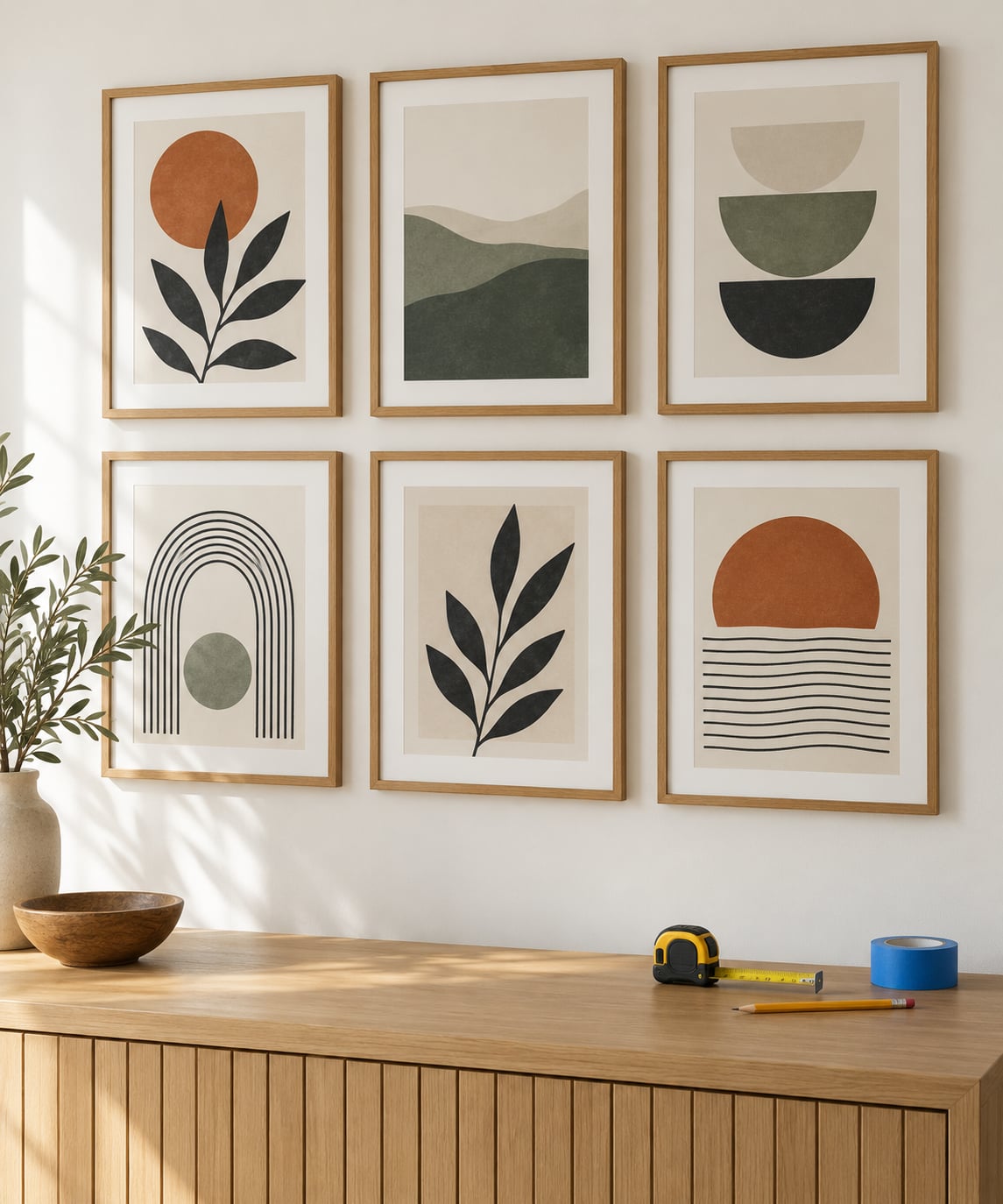
A quote wall art display is a group of printed sayings, lyrics or famous lines, framed or mounted and hung together as one focal piece. Making one at home takes about an afternoon, costs less than a single framed print from a shop, and the only hard part is spacing everything evenly.
The trick most people miss is planning on the wall before anything gets drilled. Pick your quotes, print them at one consistent size, tape paper templates where each frame will go, then hang from those marks. If you follow that order, a display that looks like it took a professional never gets a crooked corner.
What You Need
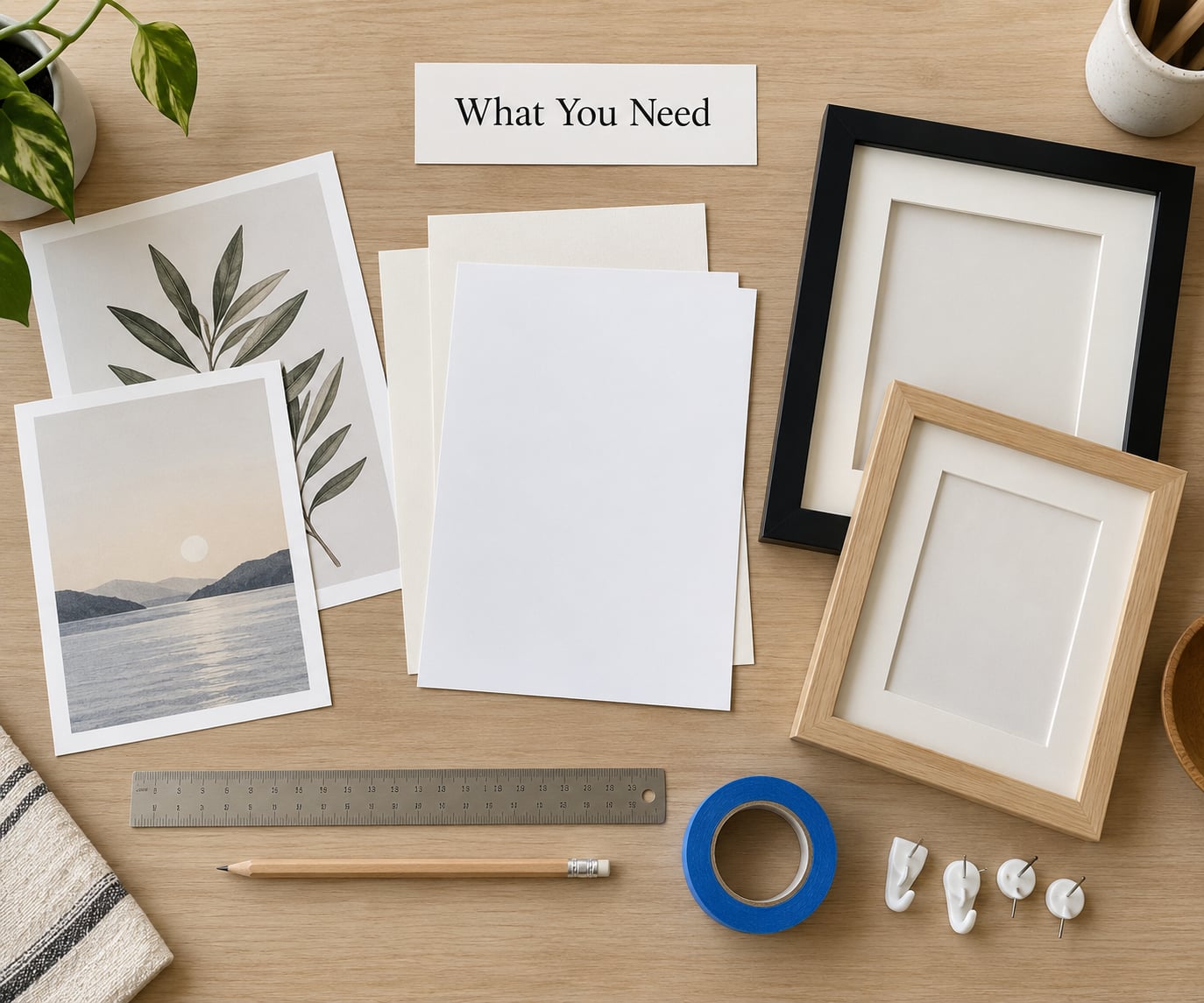
Start with the words. Five to nine quotes is the sweet spot for a first display, since a small set looks curated and a large one hides the individual prints.
- The quotes. Typed out in a document or written out by hand. For famous-author lines and public domain writing there are plenty of sources to work from.
- Paper or canvas. Regular 8.5 x 11 inch paper for a simple display, heavier cardstock if you want it to hang unframed, or canvas panels for a sturdier, more gallery-like finish.
- A printer, or a print service. Home printing suits paper prints. For canvas or large sizes, an online custom print shop handles the stretching and framing.
- Frames. The same frame in three or four sizes is the safest route to a coherent wall. Thrifted frames work if the profiles match closely.
- Mat board. A wide white or cream mat makes an 8 x 10 print sit inside a standard 11 x 14 frame and gives the text breathing room.
- Layout tools. A tape measure, a pencil, a small spirit level, painter’s tape, and scrap paper cut to the exact size of each frame.
- Hanging hardware. D-rings and picture wire for frames, or heavy-duty adhesive strips and hooks if you rent.
A few swaps work for beginners. Scrapbook paper cut slightly larger than the print makes a quick mat when you have no mat board. Painter’s tape does the job of a level for a small frame, since it shows a half-centimetre tilt over half a metre.
Step-by-Step
Here is the whole process in six steps: choose the wall and theme, print the quotes at one consistent size, map the layout with paper templates, frame and finish the pieces, mark and hang them level, then add one or two finishing touches.
Choose the space and quote theme
Measure the wall before you buy anything, and measure the furniture under it too. A quote display wants roughly two-thirds to three-quarters of the width of the wall segment, or of the sofa or bed below it. Too wide and it fights the room; too narrow and it reads as an afterthought.
Then pick a theme, because a wall of unrelated sayings has no through-line. Families tend to do well with one line each from the parents plus a few short favourites. Home workers usually pick discipline or patience lines. The length of the quote matters more than people expect: anything over 12 words stops being readable from across a room, so trim long passages down to their sharpest sentence.
Select and print the quotes
Set every quote in the same typeface and the same size, with the same margins. That single decision does more for coherence than any frame choice. One serif for a literary wall, one plain sans serif for a modern one, and the author name set smaller underneath in the same face.
Print one test copy first and check it in the room’s actual light. Ink from a home printer often prints flatter and darker than expected, which is why printing a dark background across a whole sheet tends to look muddy.
On sourcing, stay on the right side of it. Public domain authors, your own lines, and lines from friends or family are all safe. Song lyrics and lines from modern books usually still belong to someone else, so treat those as personal keepsakes rather than prints to sell or give away. If you want a one-off gift, a single line with attribution is a much lighter lift than a full reproduction.
Plan the layout
Cut scrap paper or card to the exact outer size of every frame, including the mat, and tape each template to the wall in the arrangement you are imagining. Step back two paces and look. This is the step that saves you, and it costs nothing but ten minutes.
Three arrangements do most of the work:
- Structured grid. Best with matching frame sizes in a formal room. The result is orderly, calm and easy to align, though it looks empty if the frames are small for the wall.
- Salon style. Best with mixed sizes and orientations, and it reads as collected and personal. It needs one shared colour or frame finish, or it turns to clutter.
- Vertical stack. Best for narrow walls, stairwells and hallways because it works in tight spaces. It is easy to hang crooked across a long run, so check the level twice.
Whatever you pick, keep the gaps consistent. Five to eight centimetres between frames is the range most designers land on, and the consistency matters far more than the exact number.
Frame and finish the pieces
Put the largest print, sometimes called the anchor piece or headliner, in the middle or slightly above centre, then build outward. Odd numbers read as deliberate: three, five or seven prints look settled where four or six can look accidental.
For a mat, cut the window so the text has equal margins on all four sides, and cut the window opening a few millimetres smaller than the print so nothing shows at the corners. Back it with plain acid-free board and use double-sided tape on the back of the print to hold it flat against the backing. A print that sits slightly proud of the frame face collects dust in weeks, and the fix afterwards is annoying.
Mark, level, and hang the display
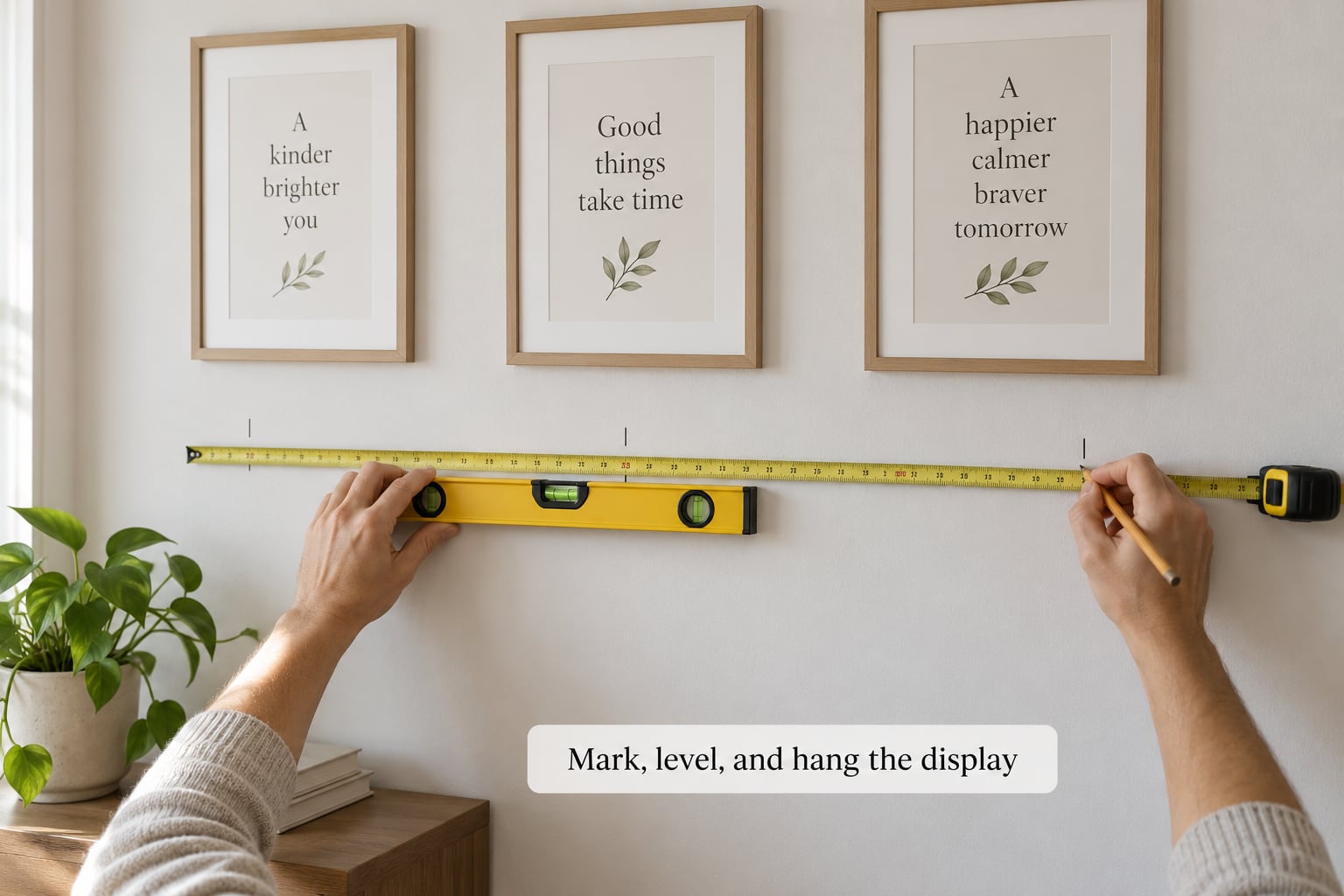
Mark the centreline first. A quote wall centre sits at about 145 to 150 centimetres from the floor, which is roughly eye level for most adults, and the middle of the group goes on that line rather than the top edge. When the group hangs above a sofa or headboard, the bottom of the lowest frame lands 15 to 20 centimetres above it.
Then check your layout rule of thumb: the group should span about two-thirds to three-quarters of whatever it hangs over. After that, mark each frame position, check the horizontal line with a spirit level, and hang from the strongest anchors first.
Before you drill anything, put a dab of toothpaste on the end of a nail and press it against the wall. It leaves a mark you can check against your template without leaving a hole, which is the trick decor communities keep recommending over drilling blind.
If you rent, skip the drill. Heavy-duty adhesive strips rated well above the weight of your frames will hold paper prints and light frames, provided the wall is painted rather than textured wallpaper. A clip rail hung from a single adhesive strip lets you swap prints whenever you like, and you can carry the whole thing with you when you move.
Add finishing touches
Stop here if the wall already reads well. The most common mistake after hanging is adding too much, so the finishing touches should number one or two: a small picture light aimed down at the group, or a narrow shelf underneath holding one object that repeats a colour from the frames.
Matte paint on the wall behind the frames also helps, since it diffuses light rather than throwing glare across the glass. If the display sits in a dim corner, one warm light source at a shallow angle makes the difference between prints you read and prints you squint at.
Common Mistakes
Most disappointing quote walls fail on six or seven small points rather than one big one. Here is what goes wrong and what fixes it.
- Quotes that are too long. Cut any quote over 12 words down to its best line, or split it across two prints.
- An overcrowded wall. Leave the same gap around the outside of the group as between the frames. Air around the edges is what makes it look deliberate.
- Too many styles at once. More than two frame finishes or two typefaces turns a display into a jumble. Pick one frame colour and one font.
- Hanging too high. Measure from the floor to the centre of the group and aim for 145 to 150 centimetres.
- Buying frames before planning. Tape paper templates up first, then buy exactly the frames that fit the marks.
- Even numbers of prints. Three, five or seven gives the eye somewhere to rest. Four and six leave an awkward gap in the middle.
- No check before drilling. Mark, step back, photograph the taped layout if you like, and only then put a hole in the wall.
One last tip: stand where you actually sit or lie down and read the wall from there. If a quote is unreadable from the sofa, it will be unreadable from every other angle too, so shorten it before you rehang anything.
Frequently Asked Questions
How much spacing should I leave between frames on a quote wall?
Leave 5 to 8 centimetres, or 2 to 3 inches, between frames and keep that same gap everywhere in the group. Consistent spacing is what makes a mixed-size display look planned rather than scattered. If you are using a paper template to plan, add the gap to your template sizes so the mock-up matches the real thing. Wider gaps suit large frames; tight gaps suit small prints.
How high should I hang a quote wall above a sofa or bed?
Put the centre of the whole group at about 145 to 150 centimetres from the floor, which is roughly eye level for most adults. Over furniture, the bottom of the lowest frame should sit 15 to 20 centimetres above the top of the sofa back or headboard. Hang the group centre on the eye-level line, not its top edge, or the whole display ends up looking too high.
What is the rule of 57 for hanging art?
The rule of 57 says the centre of a piece of art should hang about 57 inches, or 145 centimetres, from the floor. It is a measurement you can check with a tape measure rather than by eye. For a group of prints, apply it to the middle of the entire arrangement instead of to each frame individually, and the wall immediately reads at the right height.
How do I hang quote art in a rental without damaging the wall?
Use heavy-duty adhesive strips or hooks rated well above the combined weight of your frames, and check that the wall is smooth paint rather than textured wallpaper, where strips rarely hold. A single clip rail hung from one strip gives you a whole arrangement you can change whenever you like and take with you at move-out. Keep the prints light, and avoid anything heavier than a few hundred grams per frame.
What are common gallery wall mistakes with quote prints?
The usual problems are quotes that run too long to read from across the room, spacing that changes from frame to frame, more than two frame colours or typefaces mixed together, a group hung too high, and frames bought before the layout was planned. Fixing any one of these changes the wall more than adding another print. Tape paper templates to the wall before you drill and most of them never happen.
Conclusion
The easiest path to a quote wall that looks finished is the one that starts on the wall, not at the printer. Measure the space, choose three to seven short quotes in a single typeface, tape paper templates where each frame will sit, and test one balanced layout before you hang anything. Once the group is level and the gaps match, the hardest part of the project is already finished.