Socrates left no writings of his own, so every quotation attributed to him reaches us through Plato’s dialogues and, to a lesser extent, Xenophon’s Memorabilia. Collected below are twelve of the most useful lines for anyone who wants to think better: what the words mean, which work they come from, and how to actually use them.
These quotes about Socrates and asking questions are not really about questioning as a trick or a way to win an argument. The Socratic method — Plato’s elenchus — was a sequence: ask a plain question, let the other person answer, then keep probing the answer until it falls apart. What remains is aporia, the uncomfortable realization that the definition you were using was never as solid as it looked.
One note before we start. Socrates was tried and executed in Athens in 399 BC, partly on the charge of corrupting the young by asking persistent questions. Knowing that changes how the quotations read.
Table of Contents
- 1Quotes About Socrates and Asking Questions at a Glance
- 21. “The unexamined life is not worth living.”
- 32. “What is piety?”
- 43. “What is courage?”
- 54. “What is justice?”
- 65. “What is beauty?”
- 76. “What is wisdom?”
- 87. “What is knowledge?”
- 98. “What is the good for?”
- 109. “What follows from that?”
- 11How the exchange actually unfolds
- 1210. “Then why should we care?”
- 1311. “What would persuade you?”
- 1412. “How do we know?”
- 15Frequently Asked Questions
- 16Did Socrates really say, ‘I know that I know nothing’?
- 17What is the Socratic method, and how is it used?
- 18Are all popular sayings attributed to Socrates authentic?
- 19How can teachers use these Socrates and questioning quotes in class?
- 20What is the best way to paraphrase a Socratic quotation correctly?
- 21Conclusion
Quotes About Socrates and Asking Questions at a Glance
Here is the short version. Every quotation below is attributed to a dialogue, with the idea it carries and the place it works best.
| Quotation | Source | Central idea | Best used for |
|---|---|---|---|
| The unexamined life is not worth living | Plato, Apology | Test what you inherited | Journaling, first-week class |
| What is piety? | Plato, Euthyphro | Definitions hide contradictions | Ethics discussions, honesty debates |
| What is courage? | Plato, Laches | Endurance is not the same as courage | Team meetings, risk conversations |
| What is justice? | Plato, Republic | No single definition holds | Workplace fairness disputes |
| What is beauty? | Plato, Symposium | Sort a vague answer into kinds | Creative work, editing a draft |
| What is wisdom? | Plato, Meno | Facts are not understanding | Study habits, exam panic |
| What is knowledge? | Plato, Theaetetus | Believing is not knowing | Checking a claim before sharing it |
| What is the good for? | Plato, Republic | Goals need justifying, not choosing | Career and study planning |
| What follows from that? | Across the dialogues | Implications expose assumptions | Debate, editing an argument |
| Then why should we care? | Plato, Apology and Crito | Motives are fair game | Policy, purchases, rules at work |
| What would persuade you? | Plato, Gorgias and Republic | Confidence is not argument | Debate practice, hiring reviews |
| How do we know? | Plato, Theaetetus | Evidence before assertion | Research, fact-checking anything |
Source note: Socrates wrote nothing. The dialogues of Plato are dramatizations, and his character is often sharper than a careful historian would allow. Xenophon’s Memorabilia is friendlier to Socrates but was written decades later by a former student. Lines that circulate widely without a source — several printed on posters — are paraphrases or later inventions, not translations.
1. “The unexamined life is not worth living.”
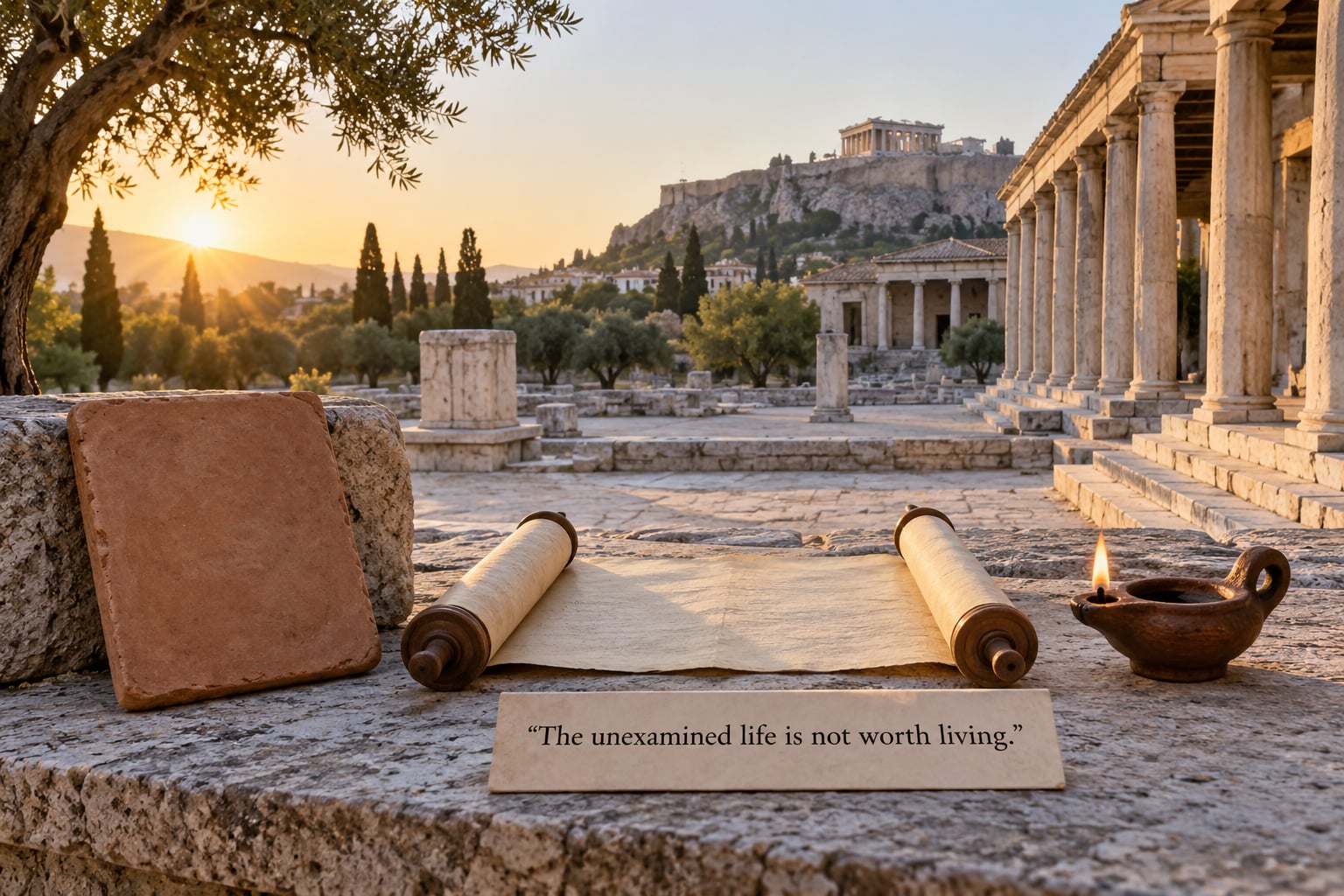
Plato records Socrates saying this at his trial, Apology 38a, when the jury asked how he could judge other people’s lives if his own were not in order. It is not a dismissal of tradition, family, or the beliefs of a city. Socrates lived among them and loved Athenian life. It is a demand that you should be able to give reasons for what you hold.
In a classroom, it becomes a first-week audit: each student writes three claims they would defend and one they have never tested. In a journal, it is a weekly column headed what would have to be true for this to be wrong?
2. “What is piety?”
The opening question of Plato’s Euthyphro is four words long and takes the whole dialogue apart. Euthyphro answers with several confident definitions, and each one, followed a few questions later, implies something his position cannot tolerate. That is the engine of the method: not a clever reply, but a patient request that someone state precisely what they mean.
A modern version works the same way. Ask someone what honesty means at work, then ask whether protecting a colleague from a known problem counts as honest under their own definition. You have not cornered anyone. You have shown them the edge of their own word.
3. “What is courage?”
In Plato’s Laches, Socrates and his companion Clinias try to settle courage once and for all, and the dialogue only deepens. Endurance is offered, then endurance without knowledge turns out to be persistence in the wrong direction. Knowledge is offered, then a man who knows his danger and holds firm still needs a reason for standing firm.
This is useful in a workplace or a school. When a team calls someone brave for pushing through a failing project, ask what makes holding on valuable rather than merely stubborn. Often the honest answer is that they had not examined whether the project deserved to survive.
4. “What is justice?”
The question drives Plato’s Republic, and the refusal to settle it is the point. Justice gets defined as doing what is best for the soul, then as giving each person their due, then as the advantage of the stronger, and each version collapses under its own implications. No single sentence survives.
Try it on a live disagreement. Two departments argue over who should absorb a missed deadline. Ask for the definition of fairness being used, write both definitions side by side, and notice which one each side reaches for. The argument often ends not with agreement but with two people finally naming the same word and meaning different things.
5. “What is beauty?”
In Plato’s Symposium, the search for beauty starts as a wide first answer and slowly gets sorted. Beautiful bodies, beautiful laws, beautiful practices, and beautiful ideas are separated out, and the wide first answer turns out to be a mixture rather than a failure. Socrates here is not scolding anyone. He is helping someone see that their category has no edges.
Writers use this constantly. When a draft describes something as elegant, ask which kind of elegance: spare, ornate, fast, deliberate? Same for a product brief, a lesson plan, or an argument. The vague first word is not wrong, but it cannot be improved until it is split.
6. “What is wisdom?”
Socrates treats wisdom as an active search rather than a stored pile. In Plato’s Meno he asks whether virtue can be taught, and the answer that follows — the famous paradox that you can neither look for what you know nor for what you do not know — is a problem about the nature of knowledge itself. He also argues that real teachers are the ones who make the learner look, not the ones who simply pour in information.
That reframes study failure. Knowing plenty of facts is not the same as knowing how to find the ones you lack, and admitting the gap is the first move of finding it. Students who say I don’t know yet, and here’s what I’d need to check are answering this quotation properly.
7. “What is knowledge?”
Plato’s Theaetetus offers three candidate definitions of knowledge and eliminates all three. The last, that knowledge is true belief plus an account of why it is true, is close to what most of us actually mean when we insist on sources. Believing something is true and being able to say why you believe it are different acts, and only one of them can survive scrutiny.
Everyday version: a friend tells you a statistic about a health study. The belief is easy. The account of why it is true is where the work sits — who ran it, how many people, what the comparison group did. Most arguments in the group chat die on that step, not the other one.
8. “What is the good for?”
The Republic’s central question is not what is good but what the good is for, and Socrates treats a goal that cannot survive that question as a preference wearing a costume. Pleasure, wealth, victory, and knowledge each get proposed and then asked to justify themselves. A thing that is only ever a means cannot explain why the means are worth having.
Applying it to a career is uncomfortable and quick. Take the goal you are working toward this year and finish the sentence: so that because. When the answer is a number rather than a reason, you have your own version of the Republic’s central difficulty, and it is worth sitting with for an afternoon.
9. “What follows from that?”
This is the least quotable and most useful of the twelve. It is not a line Socrates wrote so much as a move that recurs in almost every dialogue: take the claim that was just made and follow it one step, in plain language, without heat. Most bad arguments survive their first round because nobody insists on the consequences.
Say a colleague argues for a new approval process because it will slow bad decisions. Follow it: what will it slow besides the bad ones? How many months will a good decision take now? Who absorbs that delay? Nobody has to be the bad guy in that conversation. The assumptions simply surface on their own.
How the exchange actually unfolds
Four steps, every time. Ask a simple question with no clever wording in it. Let the person answer in their own words. Ask what follows from that answer, and again. Then stop at the point where they say they are not sure. That stopping point is aporia, and it is the goal, not a failure to be rescued with a lecture.
10. “Then why should we care?”
Socrates uses this one in the Apology and the Crito, and it is the question people resist most. Applied to a rule, a purchase, a career move, or an opinion, it moves the conversation off the level of preference and onto motives: is the answer resting on evidence, on values, on fear of disapproval, or on habit you have never inspected?
Most of the time the honest answer is a mix. That is fine. What changes is that you now know which part is doing the work, and you can go check the part that is a claim rather than a feeling. Ask it kindly and it is a normal conversation. Ask it as a trap and nobody tells you the real answer.
11. “What would persuade you?”
This question runs through the Gorgias and the Republic, and it does something quietly radical: it hands the floor to the other person and makes them name the standard their evidence has to meet. Often they cannot. Sometimes the standard turns out to be something no one in the room has, which is a considerably more useful discovery than losing the argument.
It works well in a debate club and better in a real meeting. Before a decision is made, ask each person what evidence would change their mind. People who are bluffing discover it fast, because they have nothing behind them but confidence.
12. “How do we know?”

The final question is the one the Theaetetus keeps asking, and it is the most modern of the twelve. Knowledge is not the same as opinion, and opinion is not the same as assumption wearing an opinion’s clothes. The question is short, cheap to ask, and it separates the two immediately.
A workable routine takes five minutes. Write the claim as a sentence. Write down where it came from, not just that it sounded right. Find one source that contradicts it. If you cannot find a contradicting source, say so in your own notes rather than quietly treating the claim as settled. That habit, repeated, is more of the Socratic method than most philosophy courses are.
Frequently Asked Questions
Did Socrates really say, ‘I know that I know nothing’?
Probably not in those words. Socrates left no writings, and Plato’s Apology uses a garbled sentence about a man who knows he does not know wisdom. The modern slogan is a later compression of that idea. What he did insist on, in the Theaetetus, is that he was not simply claiming to be clever — he had examined his own thinking and found it thinner than he assumed.
What is the Socratic method, and how is it used?
It is a structured conversation: ask a simple question, let the other person answer, follow the answer to its consequences, and repeat until they reach a state of puzzlement. In Plato’s terms the probing is the elenchus and the puzzled state is aporia. In practice it means listening more than correcting, and using the other person’s own words as the next question.
Are all popular sayings attributed to Socrates authentic?
No. Lines such as ‘Life is full of questions. Idiots are full of answers’ and ‘Everything flows’ have no traceable ancient source. Genuinely Socratic material comes from Plato’s dialogues and Xenophon’s Memorabilia, and even there it is a dramatized portrait. Readers in philosophy forums tend to check the dialogue name before sharing anything.
How can teachers use these Socrates and questioning quotes in class?
Start with the elenchus sequence as a procedure rather than a philosophy topic. Give students a claim they have accepted all term, then have them write what it assumes, what would count against it, and what would change their mind. In a seminar, the instructor’s job shifts from lecturing to asking what follows from the last claim said.
What is the best way to paraphrase a Socratic quotation correctly?
Name the source work rather than the collection you found it in. Say ‘Plato, Apology’ or ‘Plato, Meno,’ not ‘a famous quote by Socrates’ or the name of a website. Keep the quotation short, keep it in quotation marks, and do not splice two sentences from different dialogues into one line — that is how fake quotes get invented.
Conclusion
Take one belief you currently hold without much evidence and put it on paper this week. Then take it apart in the order Socrates would: what does it actually mean, what evidence would back it, and what follows if it turns out to be false. That sequence is the whole method, and it takes about ten minutes.
The value of these quotes is not in how they sound in a quotation graphic. It is in the discipline behind them — the willingness to hold your own definitions up long enough for them to fail. Athens found that discipline dangerous enough to punish. Most of us just find it uncomfortable, which is a far better problem to have. Updated for 2026, these twelve remain the shortest route into that habit I know of.