Benjamin Franklin (1706-1790) built his habits on paper rather than in his head. He woke at 5 a.m., asked himself one question before starting the day, worked in fixed blocks, and reviewed the evening before sleeping, all while tracking himself against a weekly grid of 13 virtues.
Most searches for quotes about Benjamin Franklin and daily habits stop at the aphorisms. The useful part is that each of those lines came attached to a time of day, a written record, and a score he could check.
He was a printer, publisher of the Pennsylvania Gazette, and the voice behind Poor Richard, a fictional composite character he used to publish common-sense advice between 1732 and 1758. Poor Richard’s Almanack and The Way to Wealth carry most of the habit lines; The Autobiography of Benjamin Franklin carries the schedule and the 13 virtues.
One thing worth saying up front: Franklin treated his own schedule as a draft. He wrote that he kept revising it rather than obeying it rigidly, which is why the routine below adapts to a modern week better than it would to an 18th-century printing shop.
Everything here was checked against Franklin’s own published writing in 2026. Where a popular saying turns out not to be his, it gets flagged instead of repeated.
Table of Contents
- 1Quotes About Benjamin Franklin and Daily Habits at a Glance
- 21. Wake at the same hour, including weekends
- 32. Say the plan out loud before the day starts
- 43. Treat the working hours as the scarce thing
- 54. Finish the work instead of describing the work
- 65. Guard against the urge to hurry
- 76. Show up on the days with no feeling in them
- 87. Reduce wants, order the surroundings
- 98. Track the small leaks
- 109. Read and write something worth the hour
- 1110. Close the day with the second question
- 12What Was Benjamin Franklin’s Daily Routine?
- 13How many hours a night did Ben Franklin sleep?
- 14Why the routine is a draft, not a script
- 15What Are Benjamin Franklin’s 13 Virtues?
- 16How the weekly scoring chart worked
- 17How to Build Franklin’s Routine in Your Own Day
- 18Benjamin Franklin Quotes That Are Misattributed
- 19Frequently Asked Questions
- 20What was Benjamin Franklin’s daily routine?
- 21How many hours a night did Ben Franklin sleep?
- 22What did Benjamin Franklin say about time management?
- 23What are Benjamin Franklin’s 13 virtues?
- 24What are some of Benjamin Franklin’s most famous quotes?
- 25How do I build habits like Benjamin Franklin?
- 26Start With One Question Tonight
Quotes About Benjamin Franklin and Daily Habits at a Glance
Each line below is matched to the habit it actually builds and the hour it was meant for.
| Quote | Habit it builds | Best time of day |
|---|---|---|
| Early to bed, and early to rise, makes a man healthy, wealthy, and wise. | Fixed sleep and wake time | Morning, 5 a.m. |
| What good shall I do this day? | Deciding before you are busy | Morning, 5 a.m. |
| Lost time is never found again. | Protecting the working hours | Before the day fills up |
| You may delay, but time will not. | Starting on time, not perfect timing | When you keep stalling |
| Well done is better than well said. | Finishing instead of announcing | End of a work block |
| Haste makes waste. | Slowing the start of a repeat task | Before a rushed deadline |
| Diligence is the mother of good luck. | Showing up on bad days | Midday, when motivation dips |
| Order your soul. Reduce your wants. | Fewer competing desires | Evening, during review |
| Beware of little expenses; a small leak will sink a great ship. | Tracking small spending | Sunday or payday |
| An investment in knowledge pays the best interest. | Daily reading and writing | Evening, 6 to 9 p.m. |
| Speak little, do much. | Winding down without noise | Night, 10 p.m. |
1. Wake at the same hour, including weekends
Early to bed, and early to rise, makes a man healthy, wealthy, and wise.
Poor Richard’s Almanack, 1735
The common worry about this line is that it has been mangled online, and it has. The Almanack version includes the words makes a man, which many shortened versions drop, and the fuller line continues into a passage about the merchant, the countryman, and the miser who all prosper on the same early hour.
How to use it today: Pick a wake time and hold it seven days a week, including days off. Franklin’s own experiment was not heroic effort; it was repetition at the same hour until the hour stopped needing a decision.
2. Say the plan out loud before the day starts
What good shall I do this day?
The Autobiography of Benjamin Franklin
This is the one habit of his that costs nothing and gets skipped most often. In the Autobiography he describes asking that question on waking and a second, different one at night, which is what turned his schedule from a plan into a review loop.
How to use it today: Write one sentence before you get out of bed. Not a list of ten things, one sentence naming the single most useful thing the day could produce, and let the rest of the day bend around it.
3. Treat the working hours as the scarce thing
Lost time is never found again.
The Autobiography of Benjamin Franklin
He paired that line with a second one from the Almanack for 1746: You may delay, but time will not. Together they make a scheduling argument rather than a motivational one, which is why they sit here with the schedule instead of in the inspiration pile.
How to use it today: Decide what your two best hours are, then defend them. A calendar block that nobody can move is worth more than a longer to-do list, and it is the modern version of a printer’s two working stretches.
4. Finish the work instead of describing the work
Well done is better than well said.
Poor Richard’s Almanack, 1738
He also used the motto Whatever is worth doing at all is worth doing well on his certificate of membership in the Royal Society. Both lines are about the same standard: the reputation follows the finished thing, and only the finished thing.
How to use it today: Pick one deliverable and close it before you tell anyone about it. Announcing work in progress is the easiest way to substitute a feeling of progress for actual progress, and it is hard to notice while you are doing it.
5. Guard against the urge to hurry
Haste makes waste.
Poor Richard’s Almanack, 1738
The Almanack expands it into a line about sloth being the road to poverty, and elsewhere prints the companion proverb There are no gains without pains. The point is not slowness for its own sake. It is that rushed work gets redone, and redoing costs more than waiting would have.
How to use it today: Add ten minutes of setup before a task that you keep redoing. If you have redone the same work three times, the speed problem is upstream of you, and the fix is a slower start rather than a faster finish.
6. Show up on the days with no feeling in them
Diligence is the mother of good luck.
Poor Richard’s Almanack, 1748
From Industry and Idleness (1764) he added the bluntest version: A little more persistence, a little more effort, and what seemed hopeless failure may turn to glorious success. The Almanack line is the one people remember, and the 1764 line is the one that survives contact with a bad week.
How to use it today: Define a floor, not a goal, for the days you dislike. Fifteen minutes of the work counts as a kept day, because a habit that only operates when you feel good is a mood rather than a routine.
7. Reduce wants, order the surroundings
Order your soul. Reduce your wants.
Poor Richard’s Almanack, 1734
This was the motto Franklin wrote at the top of his orderliness chart, and the temperance entry beside it ran to Temperance is the best tool (1742). Both are about subtraction, which is the part of self-improvement advice that most people skip and most people need.
How to use it today: At review time, remove one recurring want rather than adding one recurring task. Unsubscribe from the newsletter, close the tab, stop buying the thing you did not plan. Fewer competing desires is easier to sustain than a stricter schedule.
8. Track the small leaks
Beware of little expenses; a small leak will sink a great ship.
Poor Richard’s Almanack, 1736
He wrote a frugal man as someone who asks not so much what a thing costs as what it will do for him, which is a purchasing question rather than a budgeting one. The ship in the image was doing real work: a leak too small to notice sinks more than any single flood.
How to use it today: Look at what recurs rather than what is large. Subscriptions, daily delivery orders, and the small convenience purchases are the leaks in most household spending, and they are the only ones you can see by looking at a month of statements.
9. Read and write something worth the hour
An investment in knowledge pays the best interest.
The Autobiography of Benjamin Franklin
He also wrote the long version of a line that circulates in shortened form: If you would not be forgotten as soon as you are dead, either write something worth reading or do something worth writing. The Autobiography closes on the knowledge line, and he meant it commercially as well as morally, having started as a printer with no formal education.
How to use it today: Keep a fixed reading block in the evening where his schedule puts company and correspondence, and end it by writing four lines about what you read. The writing is what turns reading from consumption into a habit.
10. Close the day with the second question
Speak little, do much.
The Autobiography of Benjamin Franklin
The Almanack prints the same idea as Do not squander time; for it is the stuff life is made of (1746). Together they describe the last hour of his day, which was short on conversation and long on the written review he did before sleeping.
How to use it today: Ask what good you actually did today, then stop talking about the plan. An evening review that takes ten minutes beats a morning intention that took no review at all, because the review is the part that corrects the intention.
What Was Benjamin Franklin’s Daily Routine?
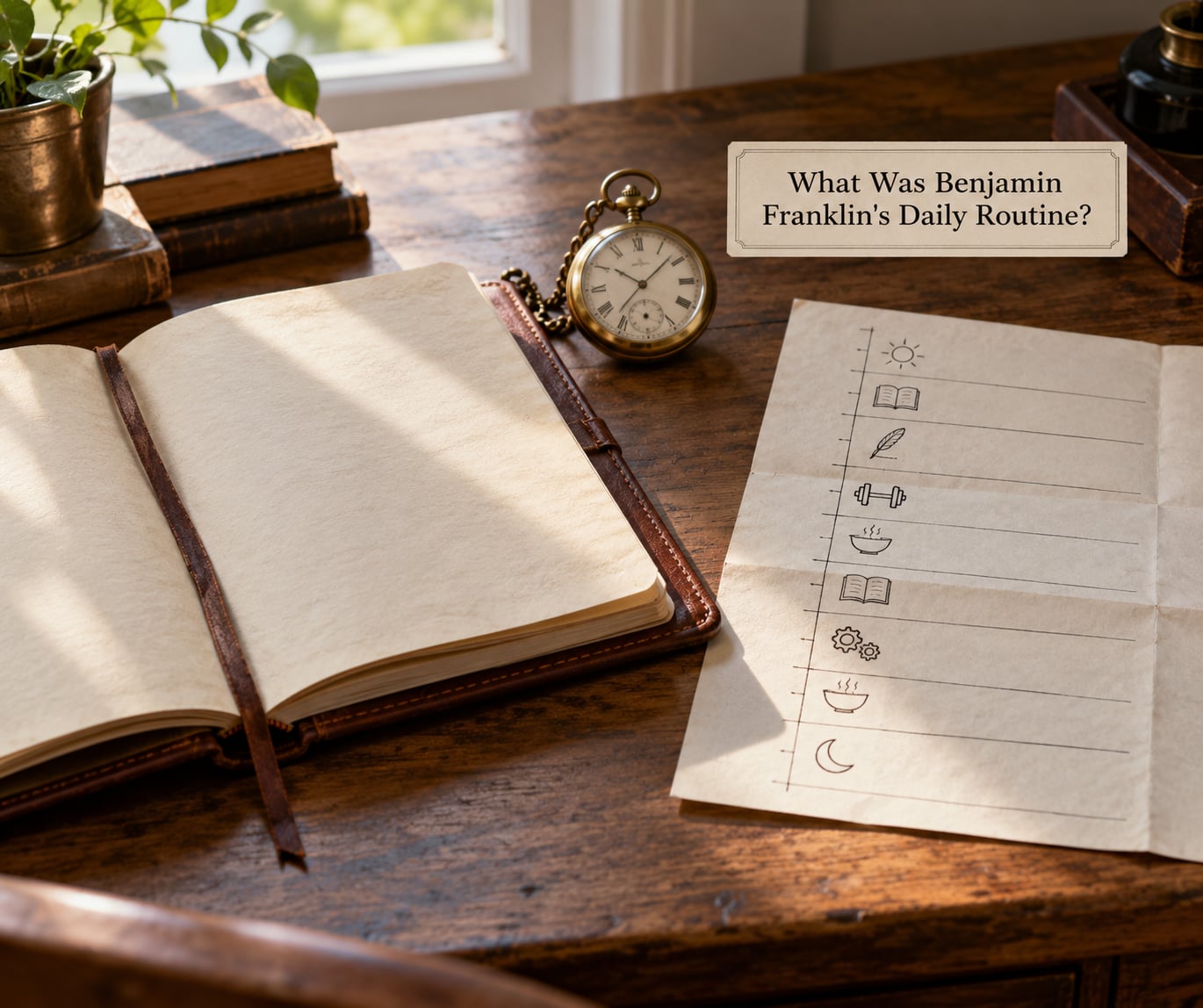
Franklin’s daily routine is a written account of his own day, and the times are his own. He rose at five in the morning, asked what good he could do that day, worked from six until noon, ate at one, worked again from one until five, and was asleep by ten.
| Time | What he did | Habit being trained |
|---|---|---|
| 5:00 a.m. | Woke, asked what good he should do this day | Deciding before the day argues |
| 5:00 to 6:00 a.m. | Broke his fast, then went straight to the day’s work | Starting the first task with no warm-up |
| 6:00 a.m. to 12:00 p.m. | First working block, in the shop or the study | Unbroken focus on one kind of work |
| 12:00 to 1:00 p.m. | Dinner, taken away from the work | A real break rather than a stolen one |
| 1:00 to 5:00 p.m. | Second working block, on the larger project | Doing the hard work when the body is already tired |
| 5:00 to 6:00 p.m. | Walk, and a plain meal eaten without company of business | Movement between blocks |
| 6:00 to 9:00 p.m. | Evening with friends, letters, and reading; kept from turning into idle time | Using social hours deliberately |
| 9:00 p.m. | Supper | Closing the eating day early |
| 10:00 p.m. | Asked what good he had done that day, then slept | Review before memory edits it |
How many hours a night did Ben Franklin sleep?
Seven. With a five a.m. wake and a ten p.m. lights-out, that is the seven hours his schedule allows, and it is the number most of his modern copycats actually copy. He never presented it as a rule; it was simply what the rest of the day was built to fit around.
Why the routine is a draft, not a script
In the Autobiography he says plainly that he revised the schedule, played with it, and improved it as he went. Treat the chart above as a set of positions rather than a fixed timetable, and keep the two questions intact even when you move everything else.
What Are Benjamin Franklin’s 13 Virtues?
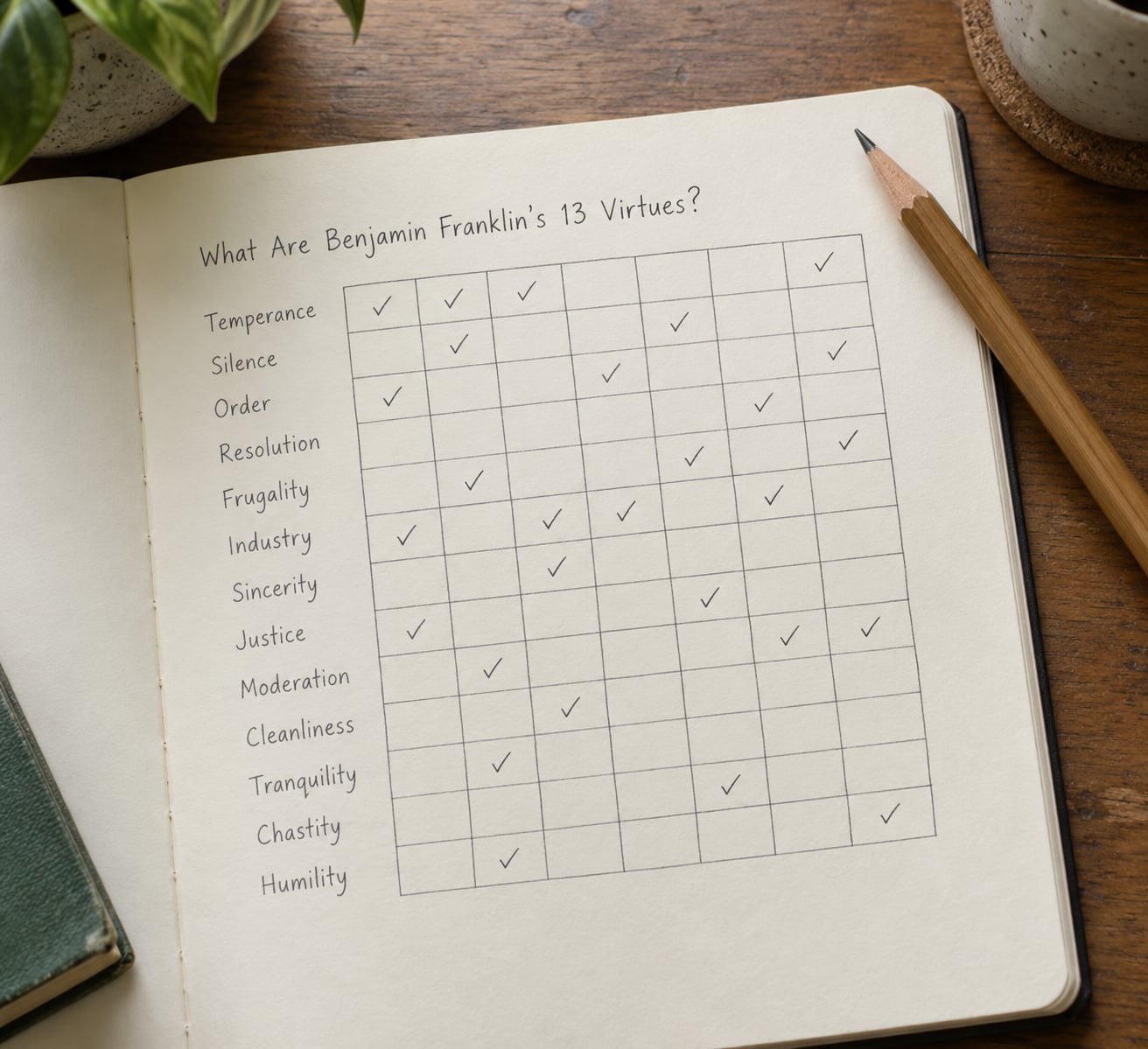
The 13 Virtues are the character traits Franklin assigned to himself one at a time, starting with temperance and ending with humility. He did not attempt them together. He took one, practiced it for a week, and only moved to the next when the week was done.
| Virtue | What it meant in practice |
|---|---|
| Temperance | Eat nothing that is not needed, drink nothing that dulls the head |
| Silence | Speak nothing that will not benefit another person |
| Order | Let nothing be out of place in your affairs or your rooms |
| Resolution | Resolve to do what is right, whatever it costs |
| Frugality | Waste nothing, sell nothing you do not need |
| Industry | Work at something all the time, and work until it is finished |
| Sincerity | No flattery, no hypocrisy, no envy |
| Justice | Give no cause for offence, and take none |
| Moderation | Do not overeat, and do not tire the body past what serves it |
| Cleanliness | Keep the body, the clothes, and the quarters clean |
| Tranquility | Do not worry about trifles, or about what cannot be helped |
| Chastity | No looseness, no excess, nothing that weakens the work |
| Humility | Do not claim preeminence; imitate rather than assert |
How the weekly scoring chart worked
He drew a grid, gave each day of the week its own virtue, and marked each evening whether he had lived up to it. A blank meant no attempt, a mark meant the day had been kept, and a full week told him plainly which traits he had been faking.
The mechanic matters more than the list. One virtue at a time turns a character goal into a single checkable question, and a question with a box next to it gets answered more often than a resolution held only in the head.
How to Build Franklin’s Routine in Your Own Day
The published schedule assumes a man whose workplace was a few steps from his bedroom. Rebuilding it for a commute, a job with fixed hours, or a night shift takes the same five moves in a different order.
1. Keep the two questions and drop the clock times. A morning question and an evening question survive any schedule, including one that starts at 6 p.m. The questions are the habit; the hours are the wrapper.
2. Protect two blocks instead of one long stretch. Franklin’s morning and afternoon work blocks are two things. Two protected ninety-minute blocks in a workday hold up far better than one four-hour ambition.
3. Fix the wake time before the bed time. People try to fix sleep by going to bed earlier, which fails for anyone whose evening does not allow it. Fixing the wake time moves the bedtime in the right direction on its own.
4. Run one virtue per week, not thirteen at once. Reproduce the grid on paper, give each day of the week one virtue, and mark it that night. Thirteen simultaneous habits produce thirteen blanks.
5. Review the marks, not the mood. On the seventh day, look at which squares got filled. That is Franklin’s whole method, and it is the part almost everyone skips in favour of feeling productive.
If your week is genuinely fragmented, a shift worker can keep the evening question and the weekly grid and ignore every clock time in the table. Consistency of timing over strictness of content is the version of this that actually survives contact with a real life.
Benjamin Franklin Quotes That Are Misattributed
Quote sites are where Franklin’s reputation took the most damage, because a handful of lines that sound exactly like Poor Richard appear on wall art and mugs and in school newsletters without appearing in anything he wrote.
By failing to prepare, you are preparing to fail. The most widely printed Franklin line in print shops and offices, and it appears nowhere in his published work. The phrasing is older than he was, and treating it as his costs you nothing but accuracy.
A penny saved is a penny earned. A standard British proverb of the period, not a Franklin coinage. The real Franklin line on spending is the small leak one above, and it is the better line anyway.
Never confuse motion with action. Widely attributed to Franklin on posters and in business posts. It is Ernest Hemingway’s, and the misattribution has been running for decades.
Reading maketh a full man. Francis Bacon, from the first of his essays. A useful line, and a Bacon line.
Keep your face always towards the sunshine. This one is subtler. Franklin reports his father’s saying in the Autobiography, which makes it a real Franklin-family line, but not one Franklin wrote himself. Quoting it as his is close enough to pass and wrong in the way that matters on a quote page.
Nothing was useful which was not honest. Printed on Franklin quote lists for years, and it is the one I would flag hardest. It is repeated constantly and I could not place it in a dated Franklin text, so treat it as unverified rather than as his.
Two that survive the check and get used most: Three may keep a secret, if two of them are dead is genuinely from the Autobiography, and Honesty is the best policy runs through the Almanack as the proverb he adopted and explained in his own voice.
Frequently Asked Questions
What was Benjamin Franklin’s daily routine?
He woke at 5 a.m. and asked himself what good he could do that day, worked from six until noon, dined at one, worked again from one until five, spent the evening from six to nine on company, letters and reading, supped at nine, and asked what good he had done that day before sleeping at ten. He also revised the schedule repeatedly rather than following it rigidly.
How many hours a night did Ben Franklin sleep?
About seven. A ten p.m. lights-out and a five a.m. wake allow seven hours, which is what his own schedule was built around. He never wrote it as a rule, and readers copying the routine for a life with a commute will usually need more, not less. Fixing the wake time is the lever that moves the bedtime.
What did Benjamin Franklin say about time management?
The core lines are Lost time is never found again from The Autobiography, You may delay, but time will not from the 1746 Almanack, and Do not squander time; for it is the stuff life is made of, also from the 1746 Almanack. Together they argue that hours are the scarce resource and that starting late costs more than finishing badly.
What are Benjamin Franklin’s 13 virtues?
Temperance, silence, order, resolution, frugality, industry, sincerity, justice, moderation, cleanliness, tranquility, chastity and humility. He practiced them one at a time rather than all together, writing a short definition under each and tracking it on a weekly grid of days against virtues.
What are some of Benjamin Franklin’s most famous quotes?
Early to bed, and early to rise, makes a man healthy, wealthy, and wise; Diligence is the mother of good luck; Lost time is never found again; Well done is better than well said; Order your soul. Reduce your wants; and An investment in knowledge pays the best interest. All trace to Poor Richard’s Almanack or The Autobiography, which is the point.
How do I build habits like Benjamin Franklin?
Keep his two questions, protect two work blocks, fix a wake time, run one virtue per week on a paper grid, and review the marks every seventh night. You can drop every clock time in his schedule and keep the system. His method worked through repetition plus measurement, not through willpower.
Start With One Question Tonight
Search results for quotes about Benjamin Franklin and daily habits are full of lines that never had a time attached to them. The ones worth keeping each came with a moment: five a.m. and the day’s one good deed, ten p.m. and the review that corrected it.
Start tonight with the second question. Write down what good you did today, mark one square in a seven-day grid beside a virtue you are working on, and decide tomorrow’s wake time before you close the notebook. That is the whole system, and it took him about forty years to refine it into something that still works.