
If you are collecting quotes about Ralph Waldo Emerson and self-reliance for a class discussion, a speech, or just your own reading, the ten lines below are the ones most people actually mean when they use the phrase. Each one comes with its source and a plain-English reading, because a quotation stripped of its context is worth very little.
Ralph Waldo Emerson published the essay “Self-Reliance” in 1841 as part of Essays: First Series, issued by James Munroe and Company. It is the founding text of American transcendentalism, and it handed the English language “self-reliance” as a moral idea. The argument runs in one direction: trust your own mind and conscience instead of measuring your life against what your church, your town, and your century expect.
His most quoted line is “To be great is to be misunderstood,” and the essay opens by telling you to “Trust thyself: every heart vibrates to that iron string.” It also contains the line most often left out of collections, “envy is ignorance; imitation is suicide.” What follows is a guide to ten quotations, with honest notes about which ones are genuinely from the essay and which ones merely circulate under Emerson’s name.
Table of Contents
- 1Quotes About Ralph Waldo Emerson and Self-Reliance at a Glance
- 21. “Whoso would be a man must be a nonconformist”
- 32. “A foolish consistency is the hobgoblin of little minds”
- 43. “The only way to have a friend is to be one”
- 54. “Every wall is a door”
- 65. “It is never too late to give up our prejudices”
- 76. “It is not length of life, but depth of life”
- 87. “Man is a tool-using animal”
- 98. “The best way to have a good life is to be involved in a great enterprise”
- 109. “Adopt the pace of nature”
- 1110. “Write it on your heart that every day is the best day in the year”
- 12Frequently Asked Questions
- 13What did Emerson mean by self-reliance in his essay?
- 14Which Ralph Waldo Emerson quote is the best expression of independent thinking?
- 15Does Emerson’s “Every wall is a door” mean that every obstacle is an opportunity?
- 16How can I use Emerson’s self-reliance quotes without presenting them as empty motivation?
- 17Where should I check the original wording of an Emerson quotation before sharing it?
- 18What is the difference between Emerson’s self-reliance and simply ignoring other people?
- 19Conclusion
Quotes About Ralph Waldo Emerson and Self-Reliance at a Glance
| Quotation | Source | Central idea | Best for |
|---|---|---|---|
| “Whoso would be a man must be a nonconformist” | “Self-Reliance” (1841) | Manhood requires independence from crowd opinion | A career decision your family does not get |
| “A foolish consistency is the hobgoblin of little minds” | “Self-Reliance” (1841) | Stubbornness disguised as principle | Letting go of an opinion you have outgrown |
| “The only way to have a friend is to be one” | “Friendship” (1841) | Real intimacy requires availability, not performance | A friend who drifts when you get busy |
| “Every wall is a door” | “Self-Reliance” (1841) | Obstacles are movable surfaces | Reframing a rejection or a dead end |
| “It is never too late to give up our prejudices” | “Self-Reliance” (1841) | Openness is a skill you can practise now | Repairing a relationship with a coworker |
| “It is not length of life, but depth of life” | Later essays, not “Self-Reliance” | Experience quality outranks duration | Catching up on a cluttered to-do list |
| “Man is a tool-using animal” | “Self-Reliance” (1841) | Skill plus tools expands what one person can do | Describing craft and technical work |
| “The best way to have a good life is to be involved in a great enterprise” | Widely printed, not in “Self-Reliance” | Purpose comes from shared effort | A volunteer project or a new team |
| “Adopt the pace of nature” | “Atticus” (1842) | Patience is a form of self-command | Studying something difficult without panic |
| “Write it on your heart that every day is the best day in the year” | Attributed to Emerson, wording varies | Attention belongs to the present day | A daily gratitude or journal practice |
A note before you use these: five come from “Self-Reliance,” one from “Friendship,” one from “Atticus,” and three are Emerson lines or Emerson-attributed lines that are not in the essay at all. Sources differ between printings, so verify wording before you attribute anything in a piece of work you sign your name to.
1. “Whoso would be a man must be a nonconformist”
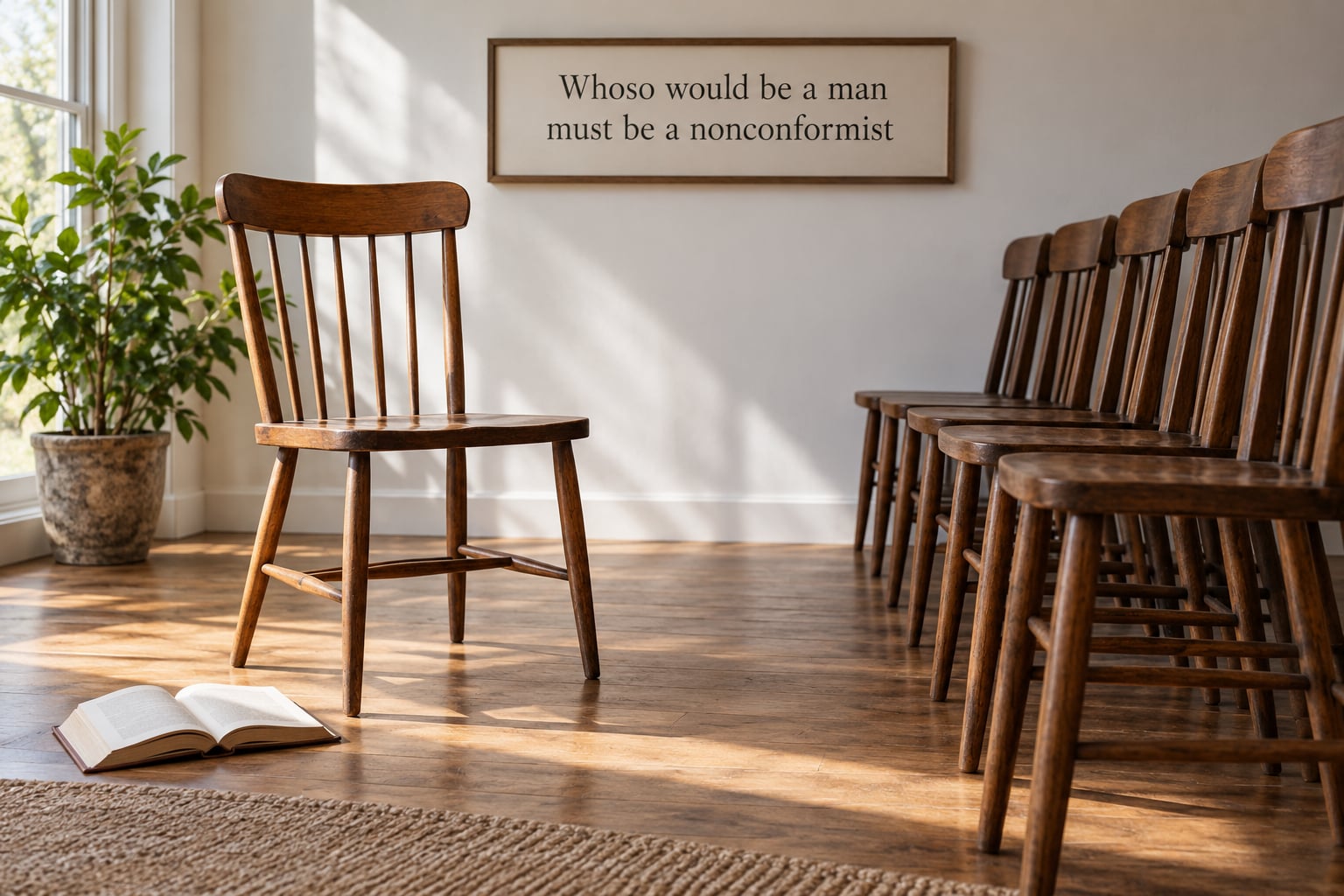
This is Emerson’s demand, from the closing stretch of the essay, that manhood is defined by refusal. He means that a person who has never disagreed with anything has never actually chosen anything.
It is easy to misread this as careless rejection of other people. In the essay, nonconformity sits next to accountability: the person who trusts themselves owes the world honesty, discipline, and real work, which is a heavier obligation than going along. Emerson is describing a responsible career path chosen against family expectation, not a person who answers to nobody.
A concrete version: a twenty-two-year-old turns down the family business role because the work bores them, and instead trains in a field nobody in the family understands. The decision is not about distance from relatives. It is about taking responsibility for a life that nobody else has approved.
2. “A foolish consistency is the hobgoblin of little minds”
Emerson wrote that “a foolish consistency is the hobgoblin of little minds, and is greatly admired by little statesmen and philosophers and divines.” He is attacking the habit of holding a position after the evidence has moved on, purely so past you and present you appear to match.
The distinction he is drawing is between stubbornness and thoughtful revision. Changing your mind because new evidence arrived is exactly what he respects elsewhere in the essay, where he praises a person who is “always original and always new.” The hobgoblin is consistency maintained for its own sake.
Readers often use this line after updating a belief that credible evidence has contradicted. Someone who spent years insisting a certain career would suit them, then goes back to school at forty and rewrites the plan, is doing what Emerson describes. The person who refuses, purely to prove the original claim was right, is the little mind with the hobgoblin.
3. “The only way to have a friend is to be one”
This line comes from Emerson’s essay “Friendship,” which appeared in the same 1841 volume, not from “Self-Reliance.” He argues there that friendship is not a favour granted by a generous other person. It is a capacity you exercise, and it only works if you actually bring it.
Why does that require self-reliance? Because a friendship built on usefulness or on keeping the other person comfortable collapses the moment you get busy, ill, or hard to be around. Emerson’s argument is that consistent character and the willingness to be genuinely available are what make intimacy possible.
The practical demonstration is unglamorous: you answer the message on the day you are tired, you show up when you said you would, you tell the truth when it would be easier to soften it. That is being a friend, and it is the same self-command the essay is describing elsewhere.
4. “Every wall is a door”
Emerson uses the image when he argues that what looks like an external obstacle is often a limit you have drawn yourself, and that a self-trusting person treats those limits as surfaces to move through. The line is short, quotable, and usually quoted badly.
It does not mean every obstacle is secretly a gift. Emerson is not promising that a rejection is a promotion in disguise. He is making a narrower claim: the boundary you treat as immovable is often a decision, and a decision can be revisited.
The example that fits is a rejected application. Instead of filing the rejection as evidence about your worth, you treat it as information about a specific gap, add the missing skill, and apply again with more to show. Nothing about the original rejection was secretly wonderful. What changed was the reader’s view of what the wall was made of.
5. “It is never too late to give up our prejudices”
Emerson offers this after describing how people harden into their habits and assumptions. He pairs it with the observation that we are all “somehow cracked and broken,” which is his way of saying nobody arrives fully finished. Changing direction is available at any age.
Openness here is not the same as abandoning conviction. Emerson is not arguing for permanent neutrality or for treating every position as equally reasonable. The prejudice he names is the one held without examination, the assumption you inherited and never looked at.
A reader who assumed a quiet coworker was difficult to work with, then spent an actual month learning what she was dealing with, has done exactly what the sentence describes. The example that stays with people is the slow one: it takes a new relationship before the old judgement dissolves entirely.
6. “It is not length of life, but depth of life”
This is one of the lines most often printed as Emerson’s, and it is widely attributed to him from his later essays rather than from “Self-Reliance.” Read it as a claim about the quality of experience rather than a measurement of anything.
Emerson’s larger theme here is that most people never live fully in the years they are given, because attention goes to plans, comparisons, and small arrangements. Depth is what happens when a year is actually inhabited instead of scheduled.
Contrast two days that look identical on paper. One is a run of errands, notifications, and obligations cleared. The other is a day where you learned something that changed how you think and helped someone who needed it. Same hours, different depth, and the difference has nothing to do with productivity.
7. “Man is a tool-using animal”
Emerson calls human beings tool-using animals and then adds that the highest use of a tool is to let you express your nature. He is not talking about hardware. The tools are habits, instruments, and skills, and the argument is that raw ability plus the right tool produces a different person.
This is the practical corner of the essay. Emerson elsewhere warns against being “a tool in a man’s hands,” which is about surrendering your own judgement to someone else’s purposes. Claiming a tool yourself is the opposite move.
So a writer who learns to use a word processor well, or a designer who masters a specific program, or an engineer who automates a repetitive process, is doing what the sentence describes. The tool does not supply the judgement. It removes friction from the judgement you already have, which is why competence keeps compounding.
8. “The best way to have a good life is to be involved in a great enterprise”
This sentence circulates widely under Emerson’s name and is regularly printed as one of his, though it does not appear in the 1841 essay. Treat it as an Emerson-attributed line and check a reliable edition before you publish it.
The idea underneath it is well matched to his thought: private comfort is a thin basis for a good life, and motivation that comes from outside yourself runs out. What sustains people is contribution to something larger than their own comfort.
That is why this one pairs well with self-reliance rather than against it. Joining a community garden, volunteering for a project that will outlast the summer, or taking part in research you cannot finish alone gives you a reason to keep working when personal motivation flags. The self-directed part supplies the effort; the enterprise supplies the reason.
9. “Adopt the pace of nature”
The full line is “Adopt the pace of nature: her secret is patience,” and it comes from the essay “Atticus” in Essays: Second Series (1842). Emerson offers nature as the model of organic growth rather than as scenery.
His argument is that nature has no artificial deadlines. A tree does not compare itself to a different tree in a warmer valley, and it does not rush a season. Applying that to people means resisting manufactured urgency, including the urgency you apply to yourself.
A student who decides to master a difficult subject at a steady two hours a day, without comparing progress to a classmate on a different path, is following the sentence’s advice exactly. The patience is not passivity. It is the confidence that lets slow, repeated effort keep going past the point where excitement would have quit.
10. “Write it on your heart that every day is the best day in the year”

The line is attributed to Emerson, and the wording varies noticeably across printings, so check it against a reliable edition before you repeat it. It expresses an idea he returns to throughout his work: the only day you can actually live is the one in front of you.
That is different from pretending every day is wonderful. Emerson is not claiming the circumstances are always good. He is pointing out that attention spent wishing for another day is attention missing the one you have.
Applied as practice, it becomes an exercise rather than a mood. Keep a notebook beside the bed, write one specific thing that made the day worth being in it, and add one action you want to take tomorrow. The point is not gratitude as performance. It is training your attention to land where your life actually is.
Frequently Asked Questions
What did Emerson mean by self-reliance in his essay?
In Self-Reliance (1841), Emerson uses self-reliance to mean trusting your own mind and conscience instead of measuring your life against what your community expects. He is not arguing for isolation. Throughout the essay he pairs independence with accountability, and treats self-trust as the condition for honest work, original action, and genuine friendship.
Which Ralph Waldo Emerson quote is the best expression of independent thinking?
The line most people mean is Whoso would be a man must be a nonconformist, from the closing argument of Self-Reliance. Emerson follows it with the claim that conformity is worse than any crime, because a person who never disagrees has never chosen. It is short enough to remember and blunt enough to be worth arguing with.
Does Emerson’s “Every wall is a door” mean that every obstacle is an opportunity?
Not quite. Emerson uses the image to argue that a boundary you treat as fixed is often a limit you drew yourself, and one you can revisit. He is not claiming every rejection was secretly a gift. The claim is narrower: what you call immovable is usually a decision, and decisions can be reconsidered with new information.
How can I use Emerson’s self-reliance quotes without presenting them as empty motivation?
Attach each line to a specific decision instead of using it as decoration. If you lead with Whoso would be a man, say what you are choosing and what it costs you. If you use a foolish consistency, name the opinion you changed your mind about. A quotation with a named situation attached reads as honest reasoning rather than a slogan.
Where should I check the original wording of an Emerson quotation before sharing it?
Check a scholarly edition rather than a social media post or a quote-collection page. For the 1841 essay, use the text printed in Essays: First Series from James Munroe and Company, or a reputable critical edition. University library digital collections and standard public-domain texts are safer starting points than pin and card images.
What is the difference between Emerson’s self-reliance and simply ignoring other people?
Emerson’s version requires you to answer to your own conscience, and that is a heavier standard than doing whatever you like. He expects discipline, honest work, and respect for others in the essay. Self-reliance is also not financial independence or self-sufficiency, which is the reading most modern readers bring to it and the one Emerson was not making.
Conclusion
Read together, these ten lines make one argument: judge for yourself, pay the social cost of that judgment openly, and then do real work with it. Emerson’s confidence is not arrogance. It comes with a demand to answer to your own conscience, which is harder to live with than approval from a crowd.
One first step, and it is small: pick the single quotation that names the decision you are sitting on right now, check its wording against a proper edition of the source, and apply its idea to that decision today rather than to your life in general. That is the whole essay in miniature.