If you are collecting quotes about Langston Harlem dreams, the lines you want come from two different poems, not one. Langston Hughes wrote “Dreams” in 1926, which opens “Hold fast to dreams,” and he wrote “Harlem” in 1951, which opens “What happens to a dream deferred?” Both poems get quoted constantly, and both get muddled together.
Below are ten lines with their source poems, plain-language meanings, and the correct wording, so you can use them in a classroom discussion, a card, a post, or a paper without repeating a misquote that has been floating around for years.
Table of Contents
- 1Quotes About Langston Harlem Dreams at a Glance
- 21. “Hold fast to dreams”
- 32. “For if dreams die”
- 43. “Life is a barren field” without dreams
- 54. Dreams as a source of courage
- 65. “I am the dream” — and why that attribution is wrong
- 76. “What happens to a dream deferred?”
- 87. Turning a deferred dream into action
- 98. The courage to keep hoping
- 109. Using Harlem dream quotes in the classroom
- 11What These Quotes About Langston Harlem Dreams Teach Readers
- 1210. “Let America be America again” and the national dream
- 13Harlem Versus Dreams: Which Poem Do These Quotes Come From?
- 14The Imagery in “Harlem,” Line by Line
- 15How to Credit These Quotes When You Share Them
- 16Frequently Asked Questions
- 17Is “Hold fast to dreams” from the poem “Harlem”?
- 18What happens to a dream deferred?
- 19What does “Dreams” by Langston Hughes mean?
- 20Is “I am the dream” a real Langston Hughes quote?
- 21What poetic devices are used in “Harlem”?
- 22What is the message of the poem “Dreams”?
- 23Where to Start With These Quotes
Quotes About Langston Harlem Dreams at a Glance
| Quote | Source poem | Theme | Best used for |
|---|---|---|---|
| “Hold fast to dreams” | “Dreams” (1926) | Perseverance | Personal reflection |
| “For if dreams die” | “Dreams” (1926) | Warning | Classroom discussion |
| “Life is a barren field” | “Dreams” (1926) | Loss | Essay writing |
| Dreams as a practice, not a mood | “Dreams” (1926) | Courage | Presentation opening |
| “I am the dream” (usually misattributed) | Not a verified Hughes line | Attribution accuracy | Quotation correction |
| “What happens to a dream deferred?” | “Harlem” (1951) | Unfulfilled hope | Social post, analysis |
| Turning a deferred dream into action | “Harlem” (1951) | Action | Goal planning |
| The courage to keep hoping | “Harlem” (1951) | Hope | Black History Month post |
| “I, too, sing America” | “I, Too” (1925) | Belonging | Racial pride, history |
| “Let America be America again” | “Let America Be America Again” (1935) | National dream | Commencement, speech |
1. “Hold fast to dreams”
Hold fast to dreams, this is the opening line of “Dreams,” the short four-line poem Hughes published in his first collection, The Weary Blues, in 1926. Hold fast means grip tightly, like catching a rope or holding onto something that is being pulled away.
The poem is built on two if-then statements, and this line sets up the first one: hold fast to dreams, because of what follows. It is short enough to remember after a single reading, which is part of why it turns up at graduations, on motivational cards, and in the occasional wedding speech.
In ordinary life the advice is less poetic than it sounds. A friend who enrolled in nursing classes twice and dropped out both times stopped saying she wanted to be a nurse and started scheduling one class a term. Holding on was not inspiration. It was a calendar entry she could not delete without explaining herself to somebody.
2. “For if dreams die”
For if dreams die is the second line, and it is the hinge of the whole poem. Everything after it is a consequence, not an opinion. If dreams die, then life becomes specific, limited things: a bird that cannot fly, a field that cannot grow.
Read the four lines out loud and you hear the structure clearly. Hold fast to dreams, for if dreams die, life is a broken-winged bird that cannot fly. Hughes is not being sentimental. He is laying out cause and effect in the plainest terms he can find, then letting the imagery do the emotional work.
A useful reflection prompt for this line: name something you gave up quietly, without a decision, just because it stopped being convenient. Most people can name three in a minute. That recognition is usually the first real argument for keeping the dream alive.
3. “Life is a barren field” without dreams
Life is a barren field frozen with snow closes the second stanza of “Dreams.” The full pairing is hold fast to dreams, for when dreams go, life is a barren field frozen with snow. Note the wording: when dreams go, not when dreams die. The change matters slightly. Death is abrupt. Going can be slow and quiet.
A barren field frozen with snow is an image that leaves nowhere to grow. Snow is not violent here; it is a cover, a blank white layer over ground that used to produce something. That is closer to how postponed ambitions actually feel than anything that explodes would be.
The contrast with the bird image is worth pointing out to students. A broken-winged bird is stuck in one place in the air. A frozen field is stuck in one place on the ground. Same conclusion, two different failures: one leaves you hanging, the other leaves you motionless.
4. Dreams as a source of courage
This one is not a single line but an idea Hughes builds across both dream poems: hope is something you practice until it can carry weight. Keeping a dream alive is not motivation that arrives. It is a habit that accumulates, and it makes ordinary action feel possible on days when nothing feels possible.
The strongest version of that idea is structural. In “Dreams,” holding on comes before everything bad. The poem puts the effort first and the consequence second, which is the opposite of how discouragement usually talks to you, leading with what has already been lost.
Here is the practical shape of it. Courage in the Hughes sense is not the absence of doubt; it is having something specific you are still working on when doubt shows up. People with a live goal and people without one both get tired. Only one of them has somewhere to go afterward.
5. “I am the dream” — and why that attribution is wrong
I am the dream circulates widely as a Langston Hughes line, often on inspirational quote graphics. It is worth flagging because you will run into it, and because a quote page that repeats it teaches people to trust the next quote blindly.
The wording does not appear in “Harlem,” “Dreams,” “I, Too,” or “Let America Be America Again.” If you want a real line that carries the same feeling, use I, too, sing America from “I, Too” (1925), or the closing question of “Harlem” itself, which is a question rather than a declaration and therefore means something different.
That difference is real. A question keeps the outcome open. A declaration, in the form of a caption claiming Hughes wrote it, resolves the tension and borrows authority he did not lend. A short research note here saves you an awkward correction later.
6. “What happens to a dream deferred?”
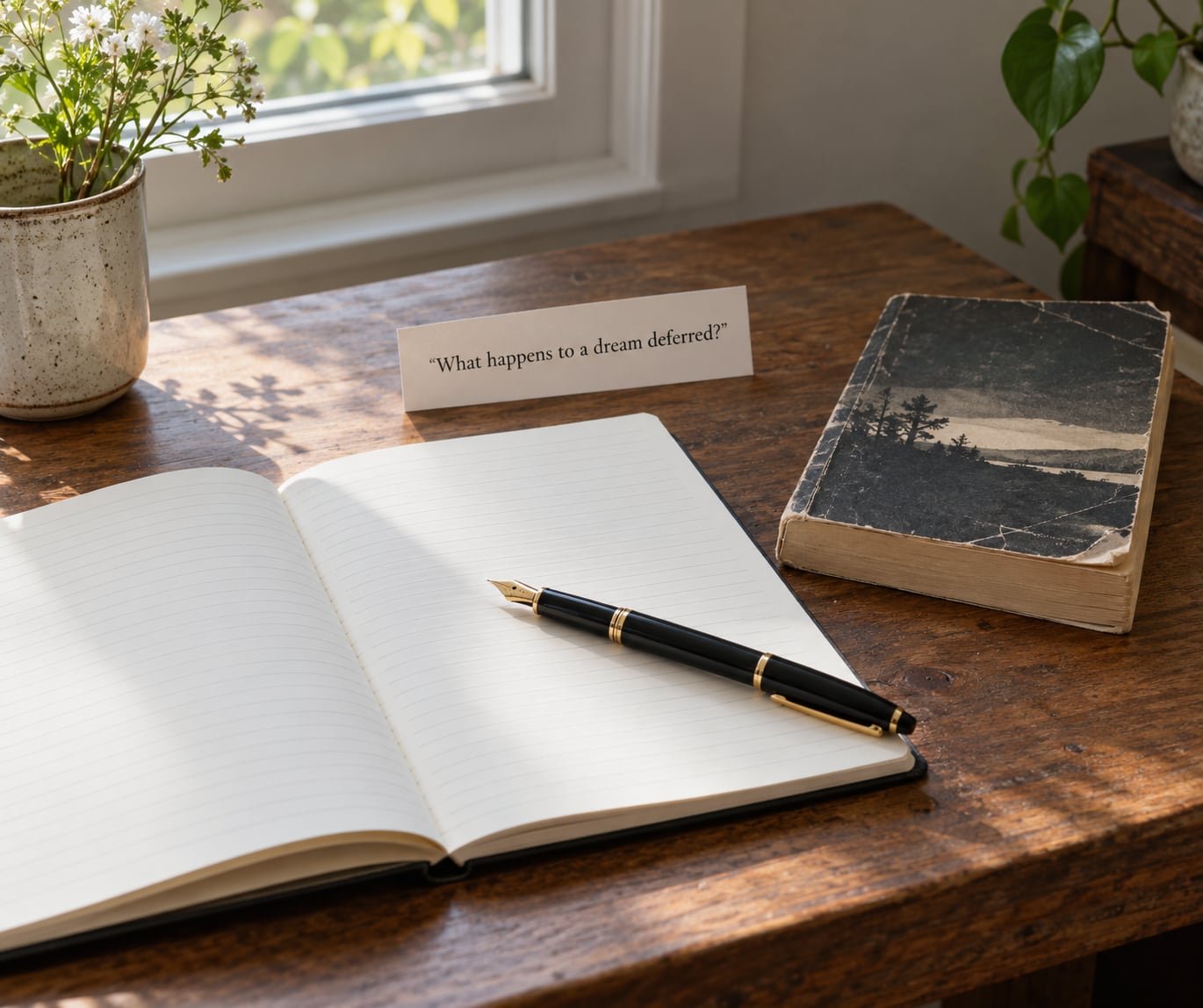
What happens to a dream deferred is the opening question of “Harlem,” published in The New Yorker in 1951. A deferred dream is one that has been postponed, put off, or set aside. The question itself is the poem: it asks and then answers with images rather than with an argument.
The poem is often titled “A Dream Deferred,” and that alternate title is where most confusion with “Dreams” starts. Same poet, same subject, different poems, two decades apart, and very different feelings. “Dreams” warns you in a calm voice. “Harlem” asks a question and lets the answer get stranger.
Readers have argued for decades about whether the poem predicts an explosion. Hughes never confirms it. The honest read is that he lists outcomes of increasing consequence and stops, and that the reader decides how serious the last one is. Treat the ending as an open question rather than a prophecy.
7. Turning a deferred dream into action
The most practical thing to take from “Harlem” is not a reading of the poem but a way to use it. Almost every deferred dream fails the same way: it stays a large, undefined thing that is impossible to schedule, so it never gets scheduled.
Four steps work better than motivation. First, name the deferred dream in one sentence with a verb in it. Second, cut it down until it fits in a week. Third, put it on a calendar with a day and a time. Fourth, attach it to something you already do, so it rides along with an existing routine instead of needing its own willpower.
A concrete case: someone who postponed a novel for six years wrote a one-sentence goal, cut it to a single scene, and attached the writing to the first coffee of the morning. The scene was 900 words. Four months later there was a draft, which is a very different problem from having none.
8. The courage to keep hoping
Hope and wishfulness feel similar from the outside and behave nothing alike. Wishful thinking asks the world to change. Hope is a decision about what you do on Monday, and it survives contact with a bad Tuesday. The difference shows up in the calendar, not in the mood.
That is where these dream quotes earn their keep. “Hold fast to dreams” is a small verb, not a grand claim. It describes an action you can take today. “What happens to a dream deferred?” asks you to take your own situation seriously enough to examine it.
Keeping hope alive also means accepting an honest question. If dreams die, life narrows, and the narrowing is gradual, which means you can usually notice it early enough to do something. Most people who say they lost their dream simply stopped attending to it.
9. Using Harlem dream quotes in the classroom
These lines get assigned more than almost any other American poem, usually at least twice: once in elementary school and again in high school English. That repetition makes them a good vehicle for teaching citation, because most students can quote them and almost none can source them.
For close reading, put “Dreams” and “Harlem” side by side and ask what changes when both poems are on the page. One uses four lines and a single voice; the other uses short stanzas and five images. The student who can explain why one is quiet and the other escalating has understood structure, not just vocabulary.
For discussion, “Does it explode?” works as an open-ended prompt because reasonable students disagree. For journaling, the barren field image gives students something concrete to write about. For presentations, the citation history alone — 1926 in The Weary Blues, 1951 in The New Yorker — makes a short slide that shows research was done properly.
What These Quotes About Langston Harlem Dreams Teach Readers
Four ideas run through all ten lines, and they are simple enough to hand to a student directly. Perseverance: the dream is kept by an action, not by a feeling. Hope: a live goal changes what you tolerate. Responsibility: a deferred dream is usually the result of neglect rather than bad luck. And the distinction that matters most between the two poems is between keeping a dream alive and leaving it unattended. One is a decision you repeat. The other is a decision you never made.
10. “Let America be America again” and the national dream
The tenth quote widens the frame. Hughes published “Let America Be America Again” in 1935, and its second line is the one people remember: Let it be the dream it used to be. Same word, dream, used as a noun for a country rather than for a person.
Read it beside “Harlem,” written sixteen years later, and the pattern is clear. One poem asks for a national dream to be restored. The other asks what happens when ordinary people stop believing their own dreams are possible at all. Different scale, same underlying worry about deferred hope.
This quote about Langston Harlem dreams works well in a commencement address or a speech about national ideals, and it needs the year attached when you cite it. Context is what separates a quote from a slogan, and it is exactly what makes the usage guidance below worth reading.
Harlem Versus Dreams: Which Poem Do These Quotes Come From?
| “Dreams” | “Harlem” | |
|---|---|---|
| Year published | 1926 | 1951 |
| First published in | The Weary Blues | The New Yorker |
| Alternate title | “Hold Fast to Dreams” | “A Dream Deferred” |
| Opening line | “Hold fast to dreams” | “What happens to a dream deferred?” |
| Form | Two quatrains, four lines | One stanza plus a closing question |
| Central images | Broken-winged bird, barren field | Raisin, sore, rotten meat, syrupy sweet, heavy load, explosion |
| Tone | Warning, steady | Curious, then ominous |
| Voice | Direct address, you and your | Third person, the dream as a thing |
If a quote starts with hold fast, it is from “Dreams.” If it asks what happens to something deferred, it is from “Harlem.” That one rule resolves nearly every mix-up people run into when searching quotes about Langston Harlem dreams.
The Imagery in “Harlem,” Line by Line
| Line | What it suggests |
|---|---|
| “Does it dry up / Like a raisin in the sun?” | Shrinking, going stale, losing volume quietly |
| “Or fester like a sore” | An irritation that worsens because it is ignored |
| “And run down, / And crust” | Decay that becomes part of the surface |
| “Or does it explode?” | The consequence he refuses to specify |
| “Maybe it sags like a heavy load” | Weight carried so long it presses down on everything |
| “Or crusts away like a syrupy sweet” | Something pleasant on the outside, spoiled underneath |
The technical vocabulary for these is an extended metaphor running through the poem, built out of repeated similes introduced by like. Enjambment does a lot of the work too: each line breaks before the image finishes, which pulls the reader forward into the next possibility instead of letting them settle.
How to Credit These Quotes When You Share Them
Three fixes cover nearly every problem people run into with these lines. Credit the poem, not just the poet: Langston Hughes, “Dreams,” 1926 is better than a name with no source. Check the wording before posting, because the most-circulated variant of the bird line inserts a like that does not exist in the poem; Hughes wrote life is a broken-winged bird that cannot fly. And do not trim the ending of “Harlem,” where the one-line final question or does it explode? is routinely dropped from copies online, changing the poem into something more definite than it is.
For a caption or a card, name the poem and the year in one line and leave it there. For Black History Month posts, the “Harlem” opening question works as a standalone prompt because it needs no explanation to land. For a school assignment, give both poem titles and both years; teachers notice the difference immediately, and it costs you ten extra words.
Frequently Asked Questions
Is “Hold fast to dreams” from the poem “Harlem”?
No. “Hold fast to dreams” is the opening line of “Dreams,” published in 1926 in Langston Hughes’ first collection, The Weary Blues. “Harlem,” published in The New Yorker in 1951, is a different poem that opens “What happens to a dream deferred?” The two are often credited interchangeably online, and the confusion is the single most common source of misattribution in these dream quotes.
What happens to a dream deferred?
Hughes never answers directly. The poem offers five possible outcomes for a postponed dream: drying up like a raisin in the sun, festering like a sore, running down and crusting over, sagging like a heavy load, or crusting away like a syrupy sweet. It closes with the question of whether it explodes, and leaves that unresolved for the reader to weigh.
What does “Dreams” by Langston Hughes mean?
The poem argues for keeping hold of your goals because the alternative is a life without movement or growth. Two images carry that argument: a broken-winged bird that cannot fly, and a barren field frozen with snow. Both describe loss of potential rather than loss of everything, which is why the poem reads as encouragement rather than despair.
Is “I am the dream” a real Langston Hughes quote?
It circulates online but is not a verified line from Hughes’ poems, including “Harlem,” “Dreams,” “I, Too,” and “Let America Be America Again.” A real line with similar weight is “I, too, sing America” from “I, Too” (1925), or the opening question of “Harlem” itself. Citing the actual wording avoids repeating a common error.
What poetic devices are used in “Harlem”?
The poem runs on an extended metaphor that develops across its five images, built from repeated similes using the word like. Enjambment is the other main device: each line stops before the image is finished, pulling the reader forward into the next possibility. The repeated question-and-response pattern adds pressure to the final, unresolved line.
What is the message of the poem “Dreams”?
The message is causal rather than inspirational. Hold on to your dreams, because if they die life becomes a broken-winged bird that cannot fly, and if they go life becomes a barren field frozen with snow. Hughes puts the effort first and the consequence second, which reverses the order that discouragement usually uses.
Where to Start With These Quotes
Start with “Hold fast to dreams” and put Hughes’ name and the year next to it. Then, if you are writing about Harlem, move to the deferred-dream question and keep its ending intact. Anything that carries the dream idea further, from “I, Too” to the 1935 call for America to be the dream it used to be, gets stronger when it arrives with a date attached. That is the whole craft here: the lines travel well, and the sourcing is what makes them worth repeating.
When you collect or share quotes about Langston Harlem dreams, check the poem title and the year every time. That one habit separates a useful quote card from another misquote in the feed.