
A reluctant reader can read. They just refuse to, especially when reading arrives attached to homework and a due date. The quotes about homework for reluctant readers below are here for adults: one line for the moment your child puts the book down, and a reason to keep it small.
Most homework battles are not laziness. Parents in r/Mommit describe being stunned by third-grade volume, and r/Parenting threads fill up with early-elementary kids breaking down at the dinner table over a reading sheet. The pattern is consistent enough that the best advice out there skips the lecture and goes straight to the smallest possible next step.
One quick note on honesty. Some of these lines are firmly sourced. Several circulate widely with no traceable origin, and we say so rather than pass them off. A quote that sounds good but gets attributed to the wrong person loses the one thing that made it worth reading.
Table of Contents
- 1Quotes About Homework for Reluctant Readers at a Glance
- 21. “Success is the sum of small efforts, repeated day in and day out.”
- 32. “The secret of getting ahead is getting started.”
- 43. “You don’t have to be great to start, but you have to start to be great.”
- 54. “Education is the most powerful weapon which you can use to change the world.”
- 65. “The more that you read, the more things you will know.”
- 76. “It always seems impossible until it’s done.”
- 87. “What you get by achieving your goals is not as important as what you become by achieving your goals.”
- 98. “A little progress each day adds up to big results.”
- 109. “The beautiful thing about learning is that no one can take it away from you.”
- 1110. “Education is not the learning of facts, but the training of the mind to think.”
- 1211. “Motivation is what gets you started. Habit is what keeps you going.”
- 1312. “The expert in anything was once a beginner.”
- 14How to Use Quotes About Homework for Reluctant Readers
- 15When to use a quote, and when to skip it
- 16Say it once, then drop it
- 17Pair every quote with a tiny action
- 18Match the line to the age
- 19What not to say
- 20Reluctant reader or struggling reader?
- 21Frequently Asked Questions
- 22What is the best quote for a child who refuses to read?
- 23What are good motivational quotes for reluctant readers aged 6 to 8?
- 24Are these homework quotes actually verified?
- 25How do I motivate a child who says reading is pointless?
- 26What should I not say when my child refuses to do homework?
- 27Conclusion
Quotes About Homework for Reluctant Readers at a Glance
This table lists each quote, the author it is commonly credited to, and the moment it actually works. Read the third column first — a great quote delivered at the wrong time is just noise.
| Quote | Commonly credited to | Best moment to use it |
|---|---|---|
| Success is the sum of small efforts, repeated day in and day out | Robert Collier (sourced) | When a 20-page assignment is described as one big job |
| The secret of getting ahead is getting started | Mark Twain (unconfirmed) | When the child is scrolling instead of opening the book |
| You do not have to be great to start, but you have to start to be great | Mark Twain (unconfirmed) | When they are convinced they will be bad at it |
| Education is the most powerful weapon which you can use to change the world | Nelson Mandela (sourced) | Older readers who ask what any of this is for |
| The more that you read, the more things you will know | Barack Obama (reported) | When reading feels pointless and assigned |
| It always seems impossible until it is done | Nelson Mandela (sourced) | Midway through a task that suddenly looks huge |
| What you get by achieving your goals is not as important as what you become by achieving your goals | John C. Maxwell (sourced) | When a grade is the only thing on the child’s mind |
| A little progress each day adds up to big results | Anonymous | When improvement is happening but invisible |
| The beautiful thing about learning is that no one can take it away from you | Variously credited (unconfirmed) | When the work feels compulsory and pointless |
| Education is not the learning of facts, but the training of the mind to think | Commonly Aristotle (unconfirmed) | When a child is copying answers without engaging |
| Motivation is what gets you started. Habit is what keeps you going | Unattributed | After one good week, when you need a routine |
| The expert in anything was once a beginner | Commonly Helen Hayes (unconfirmed) | When a child compares themselves to a sibling or peer |
1. “Success is the sum of small efforts, repeated day in and day out.”
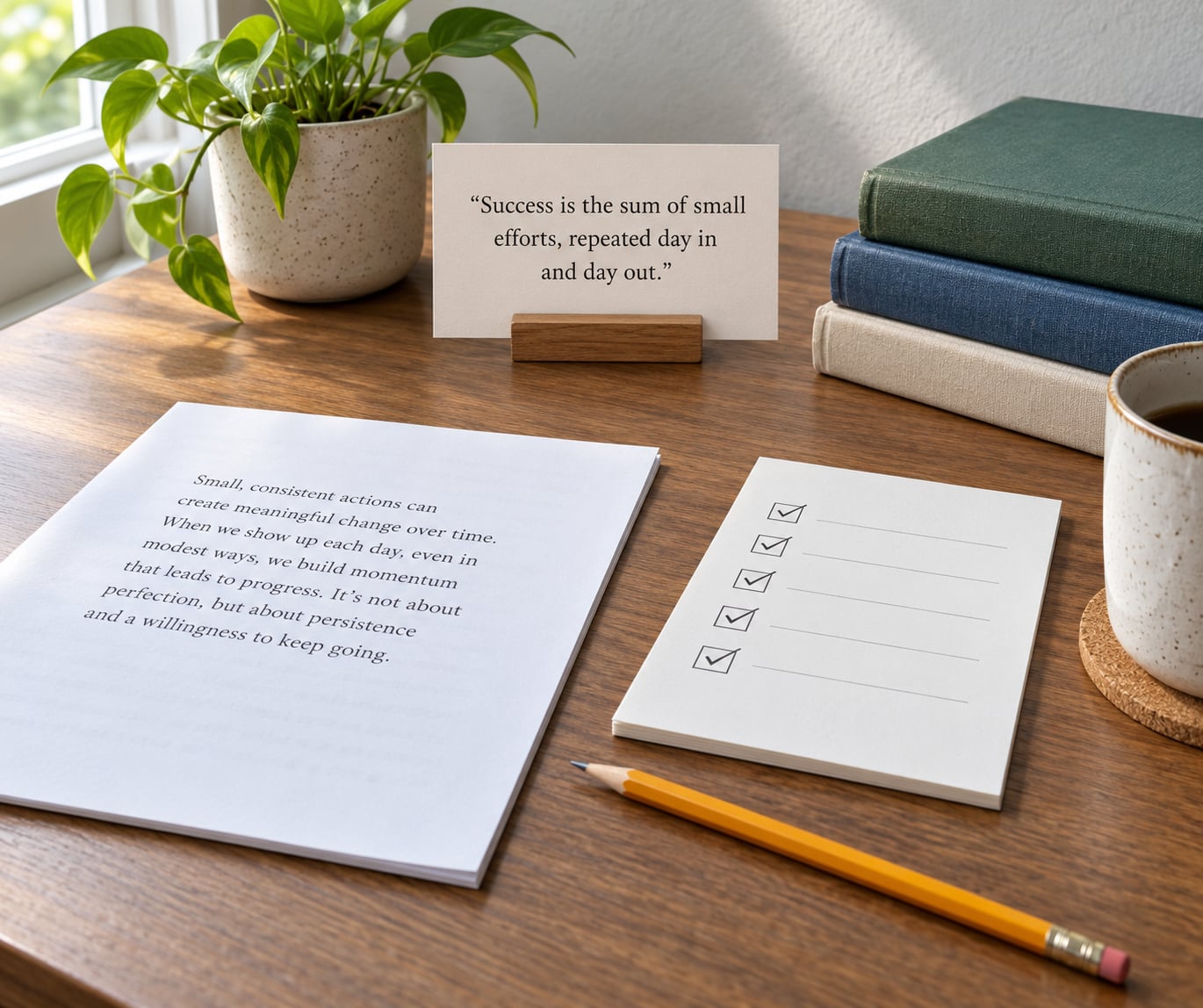
Robert Collier wrote this in The Success Primer in 1922, and it is one of the few lines here with a traceable source. The idea is not about grit as a personality trait. It is arithmetic: small repetitions stack.
It answers overwhelm, which is the barrier most often mistaken for defiance. A 20-page chapter is not a reading problem, it is a starting problem.
Try splitting it into four five-page chunks across four evenings, with the last chunk on a night when nothing else is due. When your child finishes chunk three, the remaining work is real and finite. You can point at the actual pages.
2. “The secret of getting ahead is getting started.”
Commonly credited to Mark Twain, with no verified appearance in his published work. Treat it as a good line, not a documented one — and the advice survives that caveat.
This one is for the stall: the child who is at the table, book closed, phone face-up, insisting they will do it in a minute. Starting paralysis is common in readers who have spent a year being told they are slow.
The practical version is a start so small it feels like cheating. Open the book. Read one question out loud. That is the whole assignment for the first two minutes. Most of the time the child keeps going, and you never have to say anything again.
3. “You don’t have to be great to start, but you have to start to be great.”
Also widely attributed to Mark Twain, also unverified. It is the anti-perfection line, and perfectionism is the quiet reason a capable reader sits frozen.
A child who reads at 40 words a minute with an accent they dislike is not avoiding the work. They are avoiding the evidence. This quote gives you a way to lower the standard out loud: the goal tonight is one paragraph done badly, not the whole sheet done well.
Say it once, then stop talking. Repetition turns a quote into a nag, and nagging confirms the fear that the work is something to be ashamed of.
4. “Education is the most powerful weapon which you can use to change the world.”
Nelson Mandela said this in public remarks, and it is documented. I would hold it back until a child is at least nine or ten. Under that age it reads as a lecture about grown-up problems.
Older reluctant readers reach a stage where they ask the real question: why am I doing this? Dismissing it makes you sound defensive. This line gives you a bridge from the worksheet to something they already care about.
Concrete example: a kid who loves soccer, gaming, or cars will absorb facts faster than you expect if the reading is attached to that interest. Ask them to find three facts about a roster, a game mechanic, or an engine. The assignment is the same; the reason is theirs.
5. “The more that you read, the more things you will know.”
Barack Obama said this at a 2009 book event, and it is one of the most useful lines here for a reader who has decided reading is a waste of a night. It is simple enough that an eight-year-old understands it and true enough that a teenager can stand behind it.
It reframes reading as a private supply of answers rather than a task assigned from outside. The parents I know get the best results when they stop assigning books and start asking questions the child genuinely wants answered.
Try this: write three questions on slips of paper — why cats knead, what happens inside a hurricane, who invented the escalator. The child picks the one they care about, reads to find out, and reports back. Nobody said homework.
6. “It always seems impossible until it’s done.”
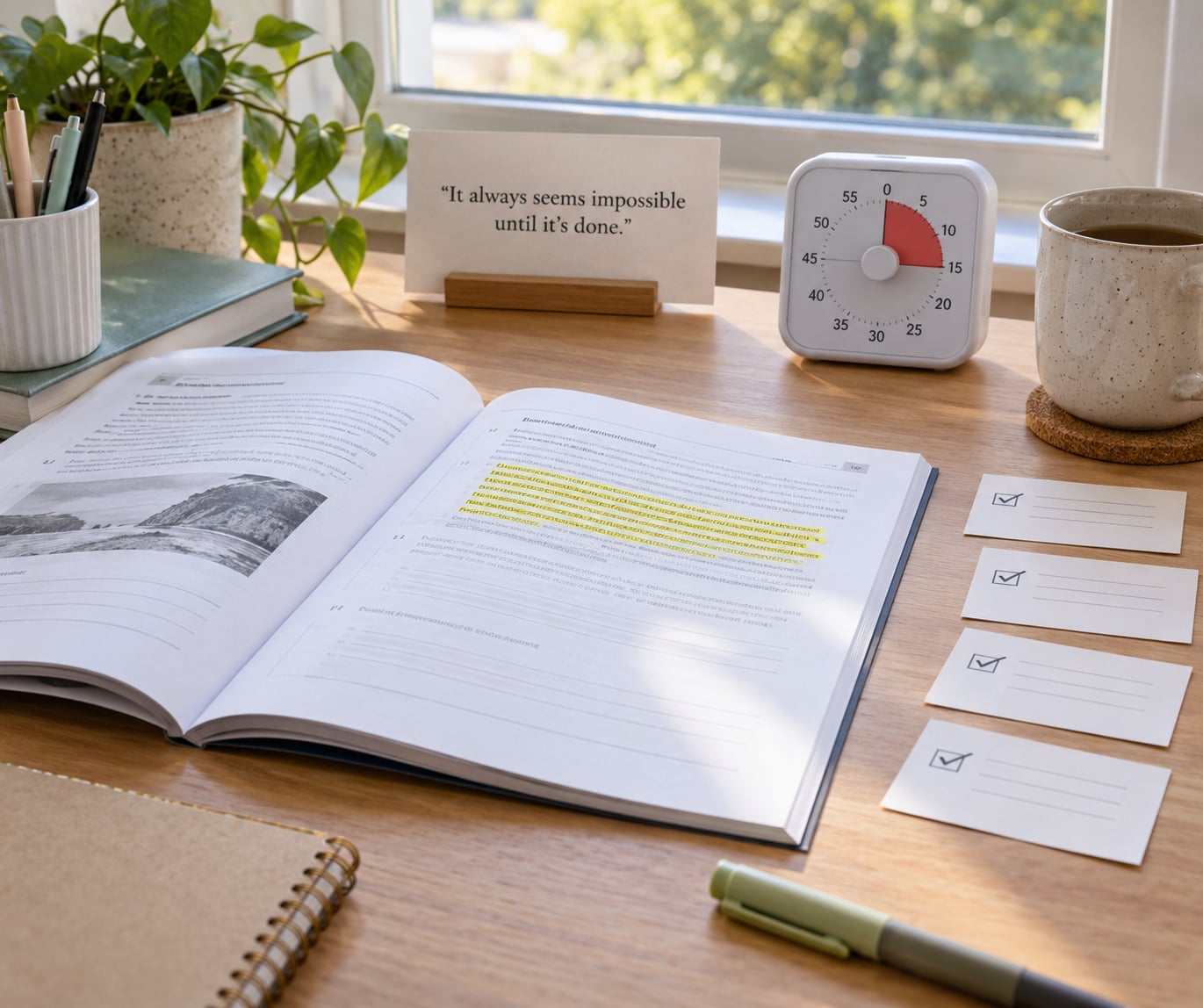
Nelson Mandela said this, and unlike most of the lines here it is well documented. Use it at the moment of being stuck, not at the beginning. Spoken too early it is abstract; spoken at minute twenty-five of a struggling worksheet it lands hard.
Children who are stuck on an assignment often believe the difficulty is permanent. They cannot see that everyone hits a wall on a long task, so a wall feels like proof they are the problem.
Pair the quote with a timer. Ten minutes on one section, then a break, then the next. Break the work into the smallest pieces that still count as progress. When they finish the last piece, this line explains the feeling they just had — and that feeling is the lesson.
7. “What you get by achieving your goals is not as important as what you become by achieving your goals.”
John C. Maxwell, from The Success Mentor. This is the quote for the child whose entire motivation is a grade, because grade-chasing is exhausting and fragile.
A student who only works for the number on the paper has no reason to keep going when the number is bad. Maxwell’s distinction moves the reward inward, toward habits that survive a bad week: showing up, finishing, trying again after a wrong answer.
Ask what they got better at this month, not what they scored. Keep a visible note of things they now do that they could not do a month ago. That record does more for a reluctant reader’s confidence than any single grade.
8. “A little progress each day adds up to big results.”
No verified author, and it is one of the most copied lines on the internet. It earns its place anyway, because it addresses the specific loneliness of slow progress.
Progress in reading is real and almost invisible. A child can be decoding better, comprehension can be improving, and the test score can sit exactly where it was for six weeks. Without evidence, that looks like failure.
Give the improvement somewhere to land. Time a weekly reading, count how many pages they get through, note how many questions they can now answer without help. Put the numbers where the child can see them. This quote is a caption for evidence you have already gathered.
9. “The beautiful thing about learning is that no one can take it away from you.”
Variously credited, with no confirmed source — a fair number of people have said something very close to this. The idea holds up regardless of who said it first.
This is the one for a child who treats the worksheet as something done to them rather than for them. When an assignment feels like a verdict from an authority, ownership is impossible and effort feels pointless.
Translate it into a concrete fact. Ask what the child can do now that they could not do in September — riding a bike, reading a chapter, getting themselves up on time. Then connect it: that is the same category of thing. Nobody can un-teach it, and no bad grade takes it back.
10. “Education is not the learning of facts, but the training of the mind to think.”
Commonly credited to Aristotle, though no source has been confirmed. It is the most teacherly line in the collection, so save it for the classroom or for a kid old enough to find it interesting.
It addresses compliance without engagement: a child who fills in every blank correctly and understands nothing is technically done with homework. Motivation quotes will not fix that, but this one at least reframes the goal.
Change the instruction. Instead of telling them to find the answer, ask them to find the answer and then say what made it tricky. Ask why the wrong option is wrong. That extra step is where thinking happens, and it takes about ninety seconds.
11. “Motivation is what gets you started. Habit is what keeps you going.”
Unattributed, though it is often linked to James Clear and appeared in similar form long before that. Worth using as a statement about how learning actually runs, not as a quotation.
The problem with most homework advice is that it assumes a good mood. Motivation is the one resource that is missing at 7pm on a Tuesday, and no quote can manufacture it.
So build the routine instead. Same chair, same time, same snack, phone in another room. Pick a start time that is slightly too easy to bail out of. A child who reads for five minutes every night for a month has done more than one who read for an hour on a Saturday and then stopped.
12. “The expert in anything was once a beginner.”
Commonly credited to Helen Hayes, with no verified source. It is the closing quote here because it addresses the comparison problem, which is the one reluctant readers rarely say out loud.
Siblings, classmates, the kid down the hall who finishes in four minutes — reluctant readers are constantly measuring themselves against people who enjoy the thing. That comparison is the reason reading feels like an accusation.
The fix is to make the beginner visible. Point out that everyone in the reading corner once misread words, and that you did too. Then name something the child is now good at that they could not do a year ago. This quote closes the loop and hands them back the beginning.
How to Use Quotes About Homework for Reluctant Readers
These lines are tools, and like any tool they work better with instructions. Here is the approach I would use at the kitchen table.
When to use a quote, and when to skip it
Use a quote when the barrier is emotional: fear of being bad, exhaustion, feeling pointless, comparison to a sibling. Skip it when the barrier is physical or structural — a child with dyslexia decoding a chapter, or one with ADHD staring at a wall because the page looks like noise. A quote does not fix decoding, and a child who struggles to read a line of the poster feels more excluded, not less.
If a letter-by-letter struggle is the issue, that is a conversation about a screening and a plan with the teacher. Inspiration is the wrong tool and everyone at the table can feel it.
Say it once, then drop it
The fastest way to make a quote worthless is to repeat it. Say the line, put your phone down, and return to what you were doing. If the child laughs, that is enough. If they ignore it, it still worked — they heard you treat the work as normal rather than as a crisis.
Pair every quote with a tiny action
A quote with no task attached is decoration. A quote with a two-minute task attached is a launch. Here are lines that work, roughly as you would say them:
- “One paragraph. If you hate it after that, come tell me and we will stop.” Then genuinely mean the second part.
- “Read me just the first question out loud. I will do the rest of the talking.”
- “Ten minutes on the timer, then a break. That is the whole deal.”
- “You are not in trouble for being slow. You are in a room with a hard book. Those are different.”
- “I will sit here and do my own thing while you work. No hovering.”
- “If you get stuck, put a star on it and move on. Starring is allowed.”
- “What do you want to read about? Tell me and I will find something on that.”
Match the line to the age
A six-year-old responds to a concrete promise: three books tonight, then done. A ten-year-old responds to progress evidence and private choice. A thirteen-year-old responds almost not at all to quotes, and the better move is to negotiate the workload out loud — which parts actually matter, which can be ten minutes of effort and a confession.
What not to say
Skip anything built on shame: “If you do not read this, you will not amount to anything,” or “I was reading your age.” Both tell a reluctant reader that reading is a moral obligation, which is precisely the belief they are already defending themselves against.
Also skip the lecture stack. Ten minutes of explaining the benefits of literacy at a child who has heard it a hundred times produces exactly the shutdown you were trying to prevent. One line, then work alongside them.
Reluctant reader or struggling reader?
These look identical at the table and need opposite responses. A reluctant reader reads comfortably when the material is interesting, dislikes the assignment, and will do it with company or a better deal. A struggling reader cannot get through the words easily regardless of interest, and often avoids the work because it is genuinely painful.
The tell is whether the child reads fluently when it is something they chose — a graphic novel, a recipe, an instruction manual. If yes, you are dealing with attitude and autonomy. If no, you are dealing with skills, and that is a conversation with the school rather than a poster on the wall.
Frequently Asked Questions
What is the best quote for a child who refuses to read?
The one that works most often is the smallest one: start with one paragraph and promise you will stop there if they still hate it. Big motivational lines tend to raise the stakes, and a reluctant reader is already carrying too many. Say one line, mean the promise, and let the small success do the persuading.
What are good motivational quotes for reluctant readers aged 6 to 8?
Young readers respond to concrete and short. A small daily goal paired with a line about small efforts adding up works better than anything about persistence or character. Keep the visible goal chart where the child can see it, and stop while the child still wants more rather than pushing to the page limit.
Are these homework quotes actually verified?
Some are. The Robert Collier, Mandela, Maxwell and Obama lines are traceable to publications or recorded remarks. The two Mark Twain lines, the beginner quote, the Aristotle line and the learning quote have no confirmed source and are marked accordingly. We flag them because unsourced quotes get passed around as fact.
How do I motivate a child who says reading is pointless?
Argue the point only in a very short window. Ask them to find one thing in a topic they already care about and check whether it is true. A single surprised answer does more than a paragraph about the benefits of literacy. If the resistance is constant across every subject, talk to the teacher about whether something beyond motivation is going on.
What should I not say when my child refuses to do homework?
Avoid shame, comparisons to siblings, and reminders about how much you read at their age. All three confirm that homework is a moral test, which is the belief driving the refusal. Offer a specific small start, sit nearby without hovering, and address the hard parts separately with the teacher rather than at the dinner table.
Conclusion
Pick one quote tonight. Write it on an index card and put it where the child will see it without having to be told, and pair it with a five-minute reading task you both agree on in advance. One line, one small action, no speech about character. If the quote does nothing on the first night, that is normal — it takes a few weeks before a line stops sounding like nagging and starts sounding like something you both believe.