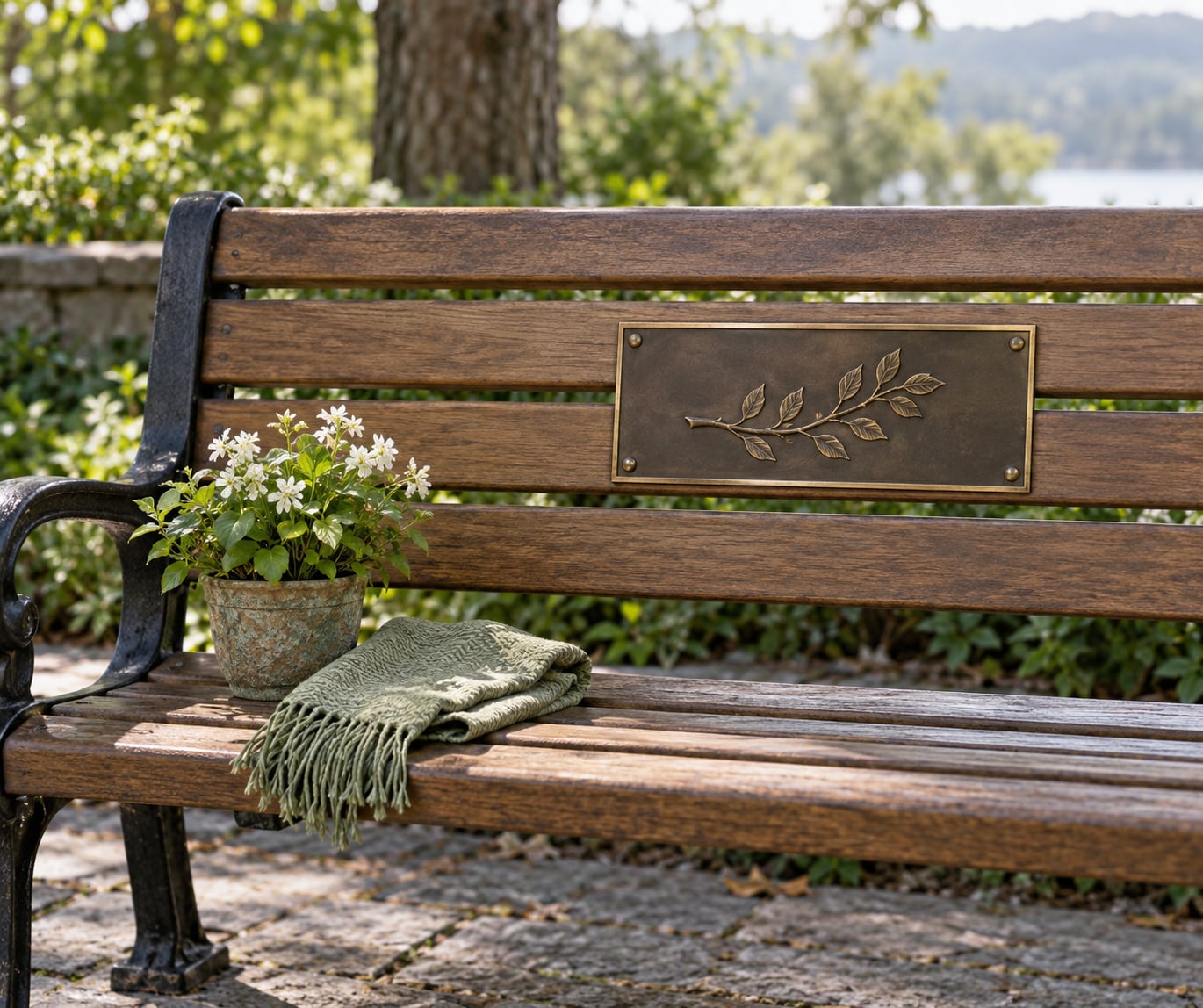
If you are searching for what to write on a memorial bench plaque, the answer is simpler than it feels: three to five short lines that name the person, say what they meant to you, and stop. A bench is read at a glance by people walking past, so every word has to earn its place. Updated for 2026, the fifteen ideas below are written to be copied and edited rather than admired from a distance.
Most drafts go wrong in one of two directions. They are too generic, like beloved father of four, which could sit on any bench in the country. Or they are too long, a paragraph that gets shrunk down to unreadable lettering during engraving. Both are easy to fix once you know the shape of the plaque and the space you have.
Table of Contents
- 1What to Write on a Memorial Bench Plaque at a Glance
- 21. A Short Tribute from the Family
- 3Choosing What to Write on a Memorial Bench Plaque
- 42. The Beloved Parent Tribute
- 53. A Heartfelt Spouse or Partner Tribute
- 64. A Friendship Tribute
- 75. A Grandparent Remembrance
- 86. A Sibling Tribute
- 97. A Teacher or Mentor Tribute
- 108. A Faith-Inspired Memorial
- 119. A Nature and Garden Tribute
- 1210. A Simple Name-and-Date Memorial
- 1311. A Poetry-Inspired Tribute
- 1412. A Classic Quote About Love or Life
- 1513. A Tribute to Service and Community
- 1614. A Humorous and Personal Tribute
- 1715. A Minimalist Tribute That Says It Best
- 18Frequently Asked Questions
- 19How long should the wording on a memorial bench plaque be?
- 20Should I include birth and death dates on a memorial plaque?
- 21Is it appropriate to use a famous quote on a memorial bench?
- 22How do I personalize a memorial plaque without making it too long?
- 23What should I check before ordering an engraved memorial plaque?
- 24How do I choose respectful wording for a public memorial?
- 25Conclusion
What to Write on a Memorial Bench Plaque at a Glance
The table below matches each wording style to the person being honoured, with a real example and a sensible length. Use it to pick a starting point, then swap the example for your own truth.
| Wording style | Example | Ideal length | Best for |
|---|---|---|---|
| Family tribute | Her kitchen fed everyone | 20-30 words | Parents and grandparents seen daily by family |
| Parent tribute | She taught us to keep going | 25-35 words | A mother or father whose influence was practical |
| Spouse tribute | Forty years, and I would do them again | 20-30 words | A husband, wife or long-term partner |
| Friendship tribute | Best friend. Worst driver. | 15-25 words | A close friend or companion animal |
| Grandparent remembrance | The stories started here | 15-25 words | A grandparent who held family history |
| Sibling tribute | Same house, same team | 15-25 words | A brother or sister |
| Teacher or mentor | He taught me to think for myself | 20-30 words | A teacher, coach or mentor at work |
| Faith inspired | At rest, and held in hope | 15-25 words | A person whose life was shaped by faith |
| Nature and garden | She grew things and so did we | 15-25 words | Someone happiest outdoors |
| Name and dates | Eleanor Price 1938-2021 | Under 10 words | Formal or private settings |
| Poetry inspired | Season and season, the road runs on | Under 20 words | A reader who loves poetry |
| Classic quote | A quotation plus a name and dates | Under 25 words | When the words already exist |
| Service and community | She made this town kinder | 20-30 words | A life of volunteering or public work |
| Humorous and personal | He was never late. Except that day. | 15-25 words | Someone known for a joke or habit |
| Minimalist | Loved. Missed. Remembered. | Under 10 words | Readers who prefer restraint |
1. A Short Tribute from the Family
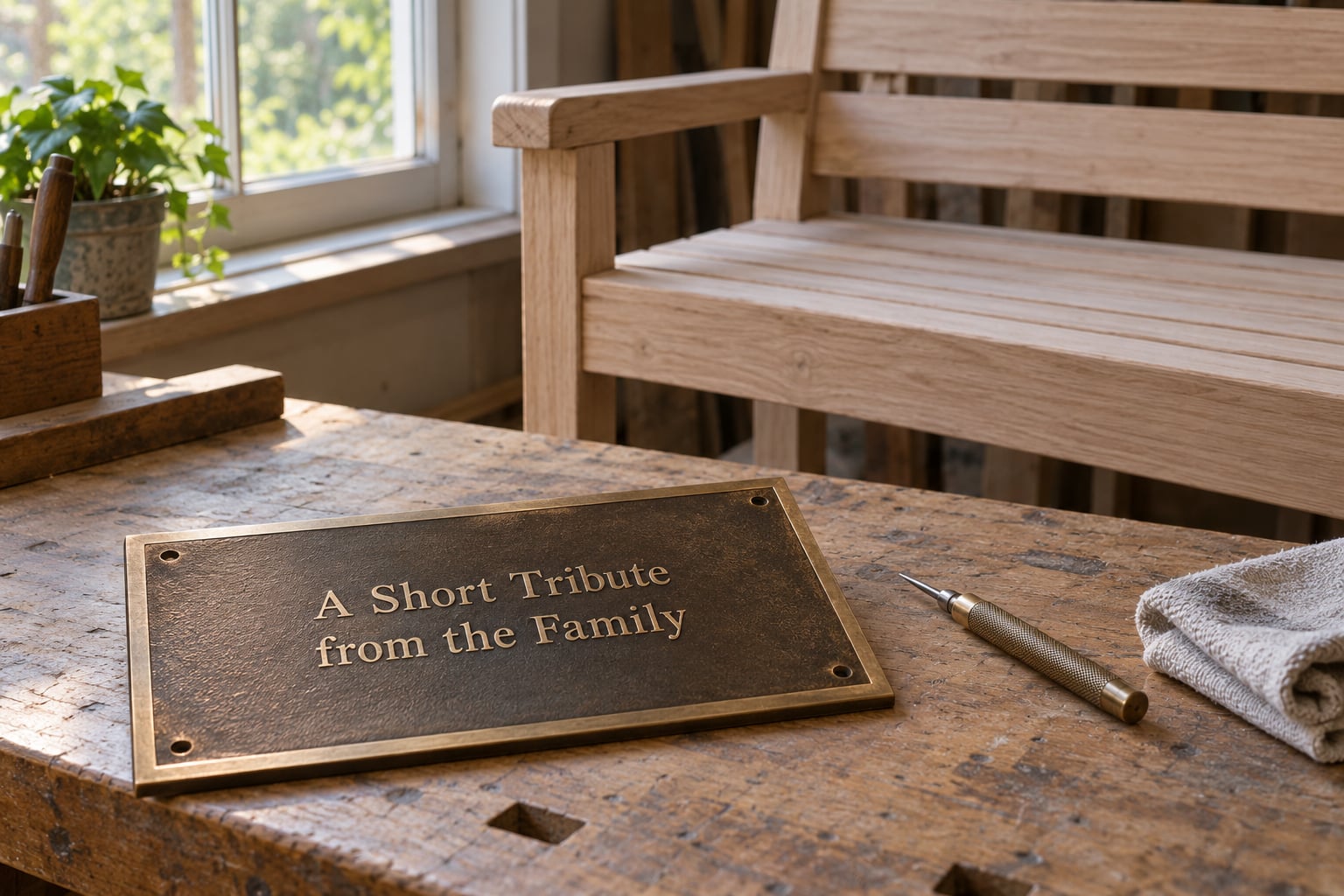
This is the most common wording request, and it works because gratitude is specific where praise is not. A family tribute names what the person actually did for the people around them, in plain language a stranger can understand.
In loving memory of
Margaret Anne Doyle
1950-2024
Beloved mother, grandmother and friend
Her kitchen fed everyone who came through the door
Five lines, under twenty words, and nobody walking past needs a biography to understand what she was to the people who signed off on it. Specificity is the whole trick. Swap in your own line, and keep the structure: name, dates, who they were, one true detail.
Choosing What to Write on a Memorial Bench Plaque
Start with the person, not the format. Write three sentences about them that are not about grief, then see which of the three would still mean something to a stranger in ten years. That sentence is usually your tribute line.
Next, check the space. Benches carry far less text than gravestones or wall plaques, and many councils cap wording at five lines. Ask the park or council for their character limit in writing, then ask the fabricator for the same number. Whoever is smaller wins.
Finally, choose the tone deliberately. Warm and plain beats polished and grand every time, and a plaque that reads like an obituary leaves the reader cold. If the words feel too heavy, cut a clause. If they feel too thin, add one detail and stop there.
2. The Beloved Parent Tribute
Parent tributes work best when they describe a habit rather than an adjective. Loved and wonderful are true of nearly everyone; she started every morning on the back step with coffee is true of one person.
In loving memory of
Thomas Bell
1934-2019
He taught us that a job gets done, not talked about
Loved, and never forgotten
The same structure works for a mother who kept everyone fed, a father who fixed what was broken, or a parent whose job was simply being there. Keep the line to about ten words. It reads from a sitting position, which is where most people will actually be.
3. A Heartfelt Spouse or Partner Tribute
Partnership tributes are where the temptation to be romantic wins, and the risk of sounding like a greeting card is highest. Understated is almost always stronger, and a shared length of time is more moving than any adjective.
Evelyn and Alan
Together fifty-two years
Wherever you are, I am still setting two cups out
That last line is an ordinary domestic detail, which is why it works. Anyone who has shared a kitchen recognises it instantly, and anyone who has not can still feel the shape of it. Keep the memory small and true rather than grand and borrowed.
4. A Friendship Tribute
Friendship tributes can carry more warmth than almost any other, because friends are allowed to describe someone as a person rather than a role. A beloved dog or cat fits the same shape, so the wording transfers well.
In honour of
Deborah Cole
1960-2022
Best friend, worst driver, keeper of every secret
Public settings do allow a little lightness, but check who will read it. A park bench in a school playground and a bench outside a church are different audiences, and the same joke lands differently in each.
5. A Grandparent Remembrance
A grandparent’s bench is really about inheritance, so look for what passed down rather than what was owned. Recipes, phrases, a way of doing Sunday, a chair in a specific spot. Small handed-down things carry the most weight.
In loving memory of
Edith Margaret Doyle
1928-2016
Every good story in this family starts with her
Three generations will read that bench, and each of them will fill in a different half of the sentence. That is worth more than any biography you could fit in the space.
6. A Sibling Tribute
Siblings are the hardest to write about, because the shared history is inside jokes and sibling rivalry rather than gratitude. Reach for the shared place or the shared activity instead of an adjective.
Ronald and Susan Doyle
Brothers and sisters, 1952-1979
Same house, same team, same side of the table
If you are the only one ordering the bench, keep the dates to the one person you are commemorating. Naming a second sibling in the text without including their dates can read like an omission, which surprises people.
7. A Teacher or Mentor Tribute
When the honoree shaped your work rather than your family life, describe the effect instead of the feeling. She believed I could do more than I believed it myself is more useful to a passing reader than a great mentor.
In grateful memory of
Alan Whitfield
Master, 1938-2021
He taught me to check my own answer before I asked him
For a coach, a mentor at work or a colleague, the same frame works. A role plus one thing they taught is usually all the space you need, and role titles give a stranger a handle on who this person was.
8. A Faith-Inspired Memorial
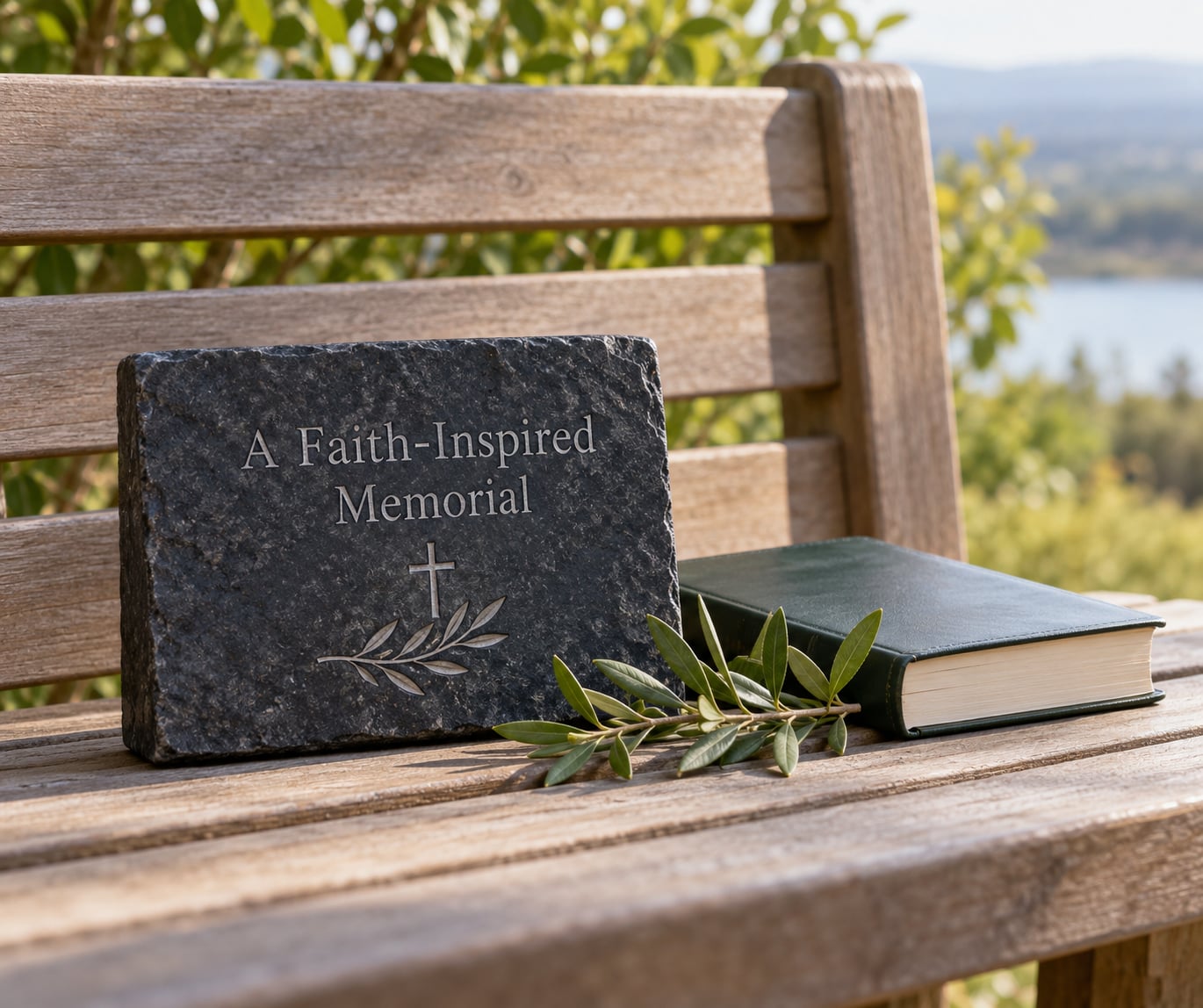
Faith-inspired wording should reflect the person, not the reader. If the person was raised in a faith, use its vocabulary, including the reference that meant something to them. If you are not sure, a reverent line without doctrine is safer than a confident guess.
In the peace of God
Rest with those you love
Clare Henrietta Bowen
1955-2023
For someone with no religion at all, drop the theology and keep the reverence. Rest well. Walk easy. is entirely secular and still feels like a benediction. Never add a scripture to a plaque for a person whose life did not include one.
9. A Nature and Garden Tribute
Gardeners and outdoor people tend to get over-described as peaceful and serene, which is dull. Use a concrete thing they did, like starting seedlings in April or walking the same cliff path every Sunday, and the plaque becomes recognisably theirs.
In loving memory of
John Pallister
1941-2020
He grew things from seed and so did we
Planting a tree or a memorial bed next to the bench extends the wording into the site itself. A short inscription plus something growing beside it does more for the memory than two extra lines of metal.
10. A Simple Name-and-Date Memorial
Sometimes the restrained version is the right one, especially in a formal setting, a private garden or a cemetery bench where stone markers already carry the emotional weight. Under ten words is a legitimate choice, not a failure to write.
Eleanor Price
1938-2021
Beloved wife and mother
Consistency matters here as much as anywhere. If you use life dates, use the same format everywhere, with the birth year first and a dash rather than a full stop. Mixed conventions are the most common reason plaques look unfinished.
11. A Poetry-Inspired Tribute
Poetry can carry more in fewer words, with two conditions: you must have permission, and you must use the poet’s exact words. Do not reconstruct a line from memory, and do not drop the final word to make it fit.
Season and season, the road runs on
In memory of Frank Doyle, who never got lost
Older published work is usually free to quote, but newer poems and popular song lyrics are not, and permission costs time you may not have before an anniversary deadline. When in doubt, write a sentence in the same mood instead and credit nobody.
12. A Classic Quote About Love or Life
A familiar quotation already has its own strength, so the job is pairing: let the quote carry the feeling, then add the name and dates that make it a person rather than a wall calendar. Verify the wording against a reliable source before it is engraved.
Grow old along with me,
the best is yet to be
Walter and Iris James, 1950-2020
Attribution is a small courtesy and most plaque makers expect it. Put the author on the last line, smaller, beneath the name and dates, so the family still owns the centre of the plaque.
13. A Tribute to Service and Community
For someone known for volunteering, organising or looking after others, keep the claim modest and specific. Broad statements about a life changed are not verifiable and rarely mean much to a reader who never met them.
Dedicated to the memory of
Gerald Nkemelu
1951-2019
He ran the food bank for eleven years and never once missed a Saturday
A number or a habit is the strongest thing you can put here. Anyone who was in the community will know exactly what it means, and anyone who was not will still grasp the scale of it.
14. A Humorous and Personal Tribute
A line of humour is a good fit when the person genuinely was that way, and it keeps a public plaque from sounding like a headstone. The test is whether the joke would embarrass the person if they were standing there to read it.
Colm Brady
1962-2021
He was never late. Except for that one day.
Anchor it to a real habit rather than a generic one, and keep it to one line. If the bench sits outside a school, a church or a care home, read it out loud to a stranger first; some audiences will not want it.
15. A Minimalist Tribute That Says It Best
Restraint is a style, not a compromise. Short tributes can be more moving because they trust the reader to fill in the rest, and they age better than anything that tries to tell the whole story.
Loved.
Missed.
Remembered.
Alternatives worth stealing: Always here. Quietly loved, deeply missed. Good company, better friend. Still talking about you. Present in every room. Choose one, keep it under ten words, and let the name below it do the identifying.
Frequently Asked Questions
How long should the wording on a memorial bench plaque be?
Most bench plaques carry three to five lines and roughly twenty to forty words. Many councils cap wording at five lines and some fabricators set their own character limit per line. Ask the council and the maker for both numbers before you draft, then write to the smaller limit. Readability matters more than length, since most people will read it while sitting down or walking past.
Should I include birth and death dates on a memorial plaque?
Yes, for most plaques, and always in a consistent format such as 1938-2021. Dates help a stranger understand a life at a glance and they become important later as records are lost. Include them on a name-and-date memorial by default, and on a fuller tribute if the dates fit within your character limit without shrinking the lettering.
Is it appropriate to use a famous quote on a memorial bench?
It is fine as long as the quote is verified word for word and attributed on the last line, in smaller lettering beneath the name and dates. Check the exact wording against a reliable published source rather than from memory. Some modern quotations and song lyrics are still under copyright, so confirm permission or write your own line in the same spirit instead.
How do I personalize a memorial plaque without making it too long?
Replace one abstract word with one specific detail. Instead of beloved mother, write that her kitchen fed everyone, or that she taught you to check your own work before asking her. That single swap does more personalising work than two extra lines, and it keeps the plaque readable from a sitting position. Write three candidate details and cut down to the strongest one.
What should I check before ordering an engraved memorial plaque?
Check the spelling of the name, every middle initial and the life dates against the certificate or record, since engraving is permanent and cannot be corrected later. Confirm the exact number of lines and characters permitted, the font size, and whether a paper proof or digital proof is sent before anything is cut. Ask who signs off on the proof and how long approval takes.
How do I choose respectful wording for a public memorial?
Start from a fact rather than a feeling, keep the tone dignified, and read the finished wording aloud to someone who never met the person. If the relationship was complicated or estranged, describe the connection honestly and briefly, such as a much-loved father, and leave the rest unsaid. A stranger will read this plaque every day, so it should be true, brief and something you would want a stranger to see.
Conclusion
Begin with the person’s defining relationship or quality, write three facts that are not about grief, and keep the one that would still mean something to a stranger. Choose a single tribute in the style that fits them, trim it to the line limit your council or plaque maker allows, and verify the name spellings and life dates on a written proof before anything is cut.
If the wording feels too much or not quite honest enough, ask someone who never met them to read it aloud. That is the fastest test, and it settles almost every doubt about what to write on a memorial bench plaque.