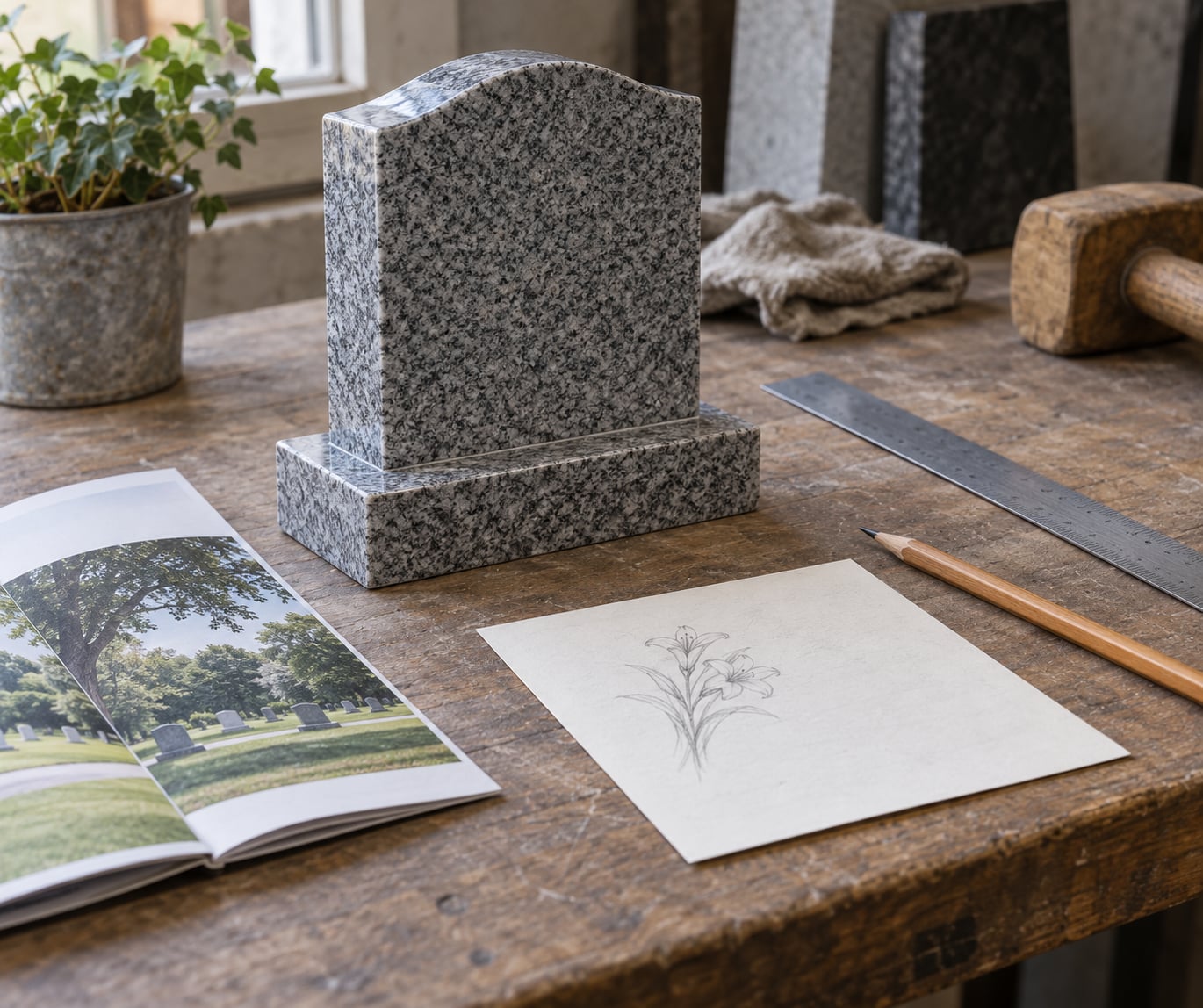
An epitaph is the short line engraved beneath someone’s name and life dates on a headstone, and most run between two and eight words. To learn how to choose an epitaph for a headstone, you narrow the message to one idea, test candidate wording out loud, measure it against the actual stone, and get written approval before engraving begins, because sandblasted granite cannot be corrected later.
This guide takes about an hour of actual decision-making, spread over however many days you need. The hard part is not finding words. It is deciding which single thing you want a stranger to read in a hundred years, and then living with that choice.
Table of Contents
- What You Need
- How to Choose an Epitaph for a Headstone, Step by Step
- 1. Gather the life story and the people involved
- 2. Decide the message’s central meaning
- 3. How to choose an epitaph for a headstone: test the wording
- 4. Check the stone, font, and character limit
- 5. Confirm cemetery and monument-provider rules
- 6. Compare the strongest finalists with a decision-maker
- 7. Get written approval before engraving
- 8. Request a final installed-headstone check
- Common Mistakes
- Frequently Asked Questions
- Conclusion: Start With the Meaning
What You Need
Gather this before you start writing candidates. Without it you will draft something beautiful that has to be cut in half.
- Three or four concrete details about the person’s life. What they did for work, what they loved, how they talked, what they were like on a good day.
- Any written wish. A will, a letter, an old birthday card, or a sentence they once said out loud. A stated wish outranks anything you invent.
- The stone’s dimensions and face area. The size of the granite surface you have, in inches, from your monument provider.
- Cemetery rules. Many cemeteries restrict wording, symbols, and color. Rules vary by location, so confirm yours directly.
- The character or letter limit. Providers publish a maximum character count for the inscription area, which is often stricter than the space looks.
- The names of the people who decide. Usually the person with legal authority over the monument, plus the immediate family who will live with the stone.
Write those six items on one page. Most families who skip this step end up negotiating the wording twice, once before they know the limits and again after.
How to Choose an Epitaph for a Headstone, Step by Step
The process runs eight steps. A finished inscription should be emotionally right for the people who chose it, legible from standing distance in poor light, and formally approved before the stone is cut. Miss any one of those three and you have a problem that cannot be fixed.
1. Gather the life story and the people involved
Start with the person, not with the stone. Ask the people who knew them best for the story: what they were proudest of, what they complained about, the joke they repeated, the thing they did every single Saturday without fail.
Then decide who has a say, and set a date. One grief-stricken group of relatives with unlimited time is how a monument sits unfinished for a year. Name one decision-maker, gather input from everyone within a stated window, and make clear that the decision-maker makes the decision.
Timing matters too. Choosing during the first weeks of acute grief is the single biggest reason families regret the wording later. There is usually no rule that the inscription must be settled this week. If the cemetery or the family is pressing, ask for the deadline in writing and work backwards from it.
2. Decide the message’s central meaning
Pick one emotion or idea before you pick a single word. Love, faith, service, steadiness, belonging, peace, gratitude, resilience, humor, a place, a trade, a family role. One central meaning is what keeps a shortlist from fighting itself.
Without a center, you collect a line about faith, a line about the ocean, a famous quotation about time, and a joke, and none of them belong to the same person. That is the moment most families stall. Pick the idea and let the rest go.
3. How to choose an epitaph for a headstone: test the wording
Draft four or five candidates in plain language. Not in an arch, not in a font you admire, just words on paper. Then read each one aloud at normal speaking volume, standing up.
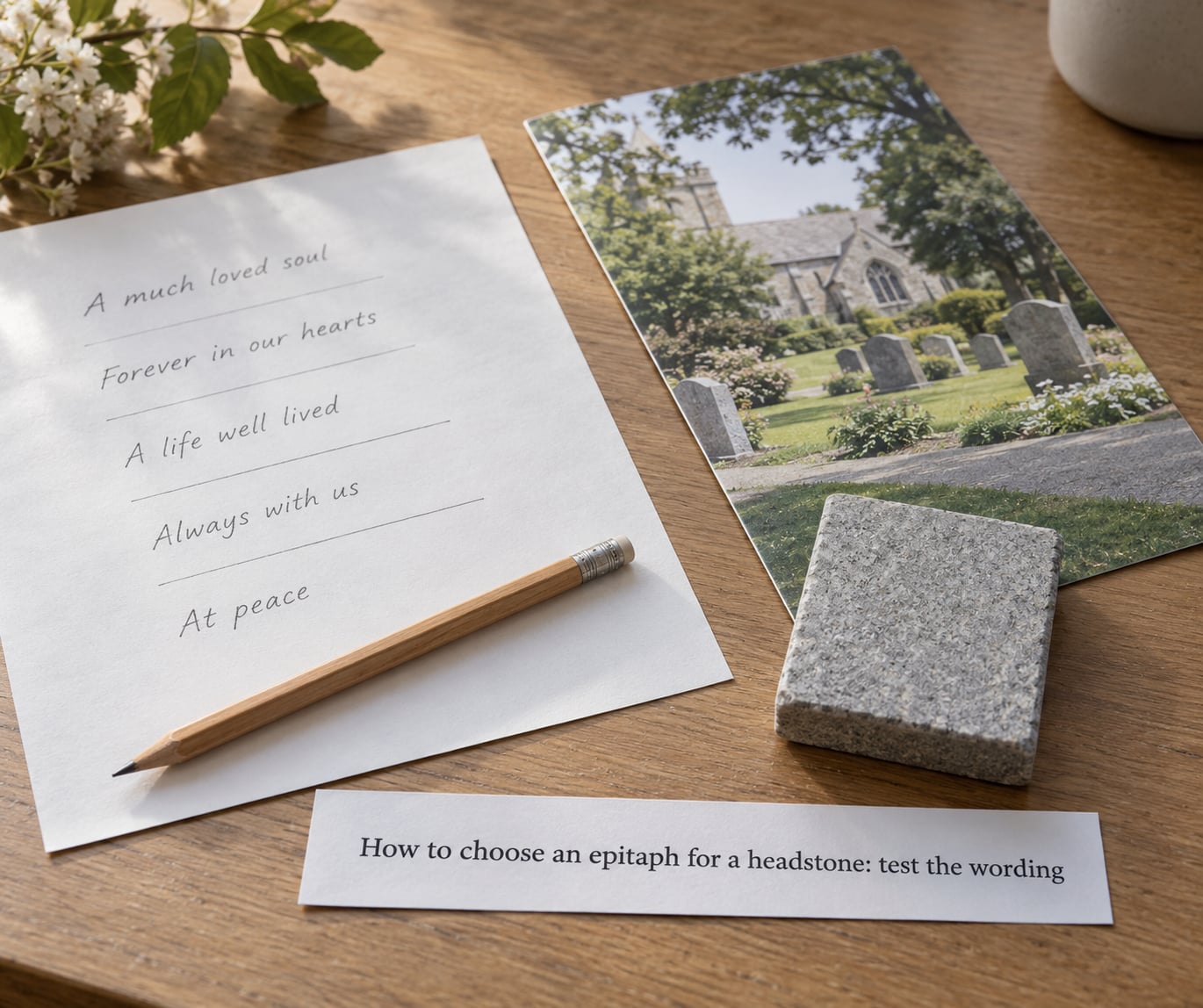
The read-aloud test catches more bad lines than any other check. If you run out of breath, if you stumble, if the last word is unclear, it is wrong. Rewrite until the meaning lands in the first sentence you say, with no explanation needed.
Then look at it from arm’s length, which is roughly how far away a visitor stands. Anything under about half an inch of letter height fails at that distance. Short lines in larger lettering stay readable for decades; three cramped lines in small type do not.
Revise the phrases that feel borrowed. A line should sound like it belongs to this person’s household. If you would not say it out loud at their kitchen table, it will not sit right on the stone either.
4. Check the stone, font, and character limit
This is where good lines die. Ask your provider for the usable inscription area, the maximum character count, and the letter height at the smallest size. Then count.
A typical sizing pattern looks like this. It varies by provider and by granite face, so treat it as a starting point for the conversation, not a promise.
| Headstone style | Typical epitaph length | What fits comfortably |
|---|---|---|
| Flat marker | 2 to 6 words | One short line under the name and dates |
| Bevel or slant marker | 6 to 12 words | Two lines in a wider band |
| Upright monument | 10 to 25 words | Three or four balanced lines |
| Companion monument | 8 to 16 words | Shared space, so shorter |
| Memorial bench or niche plate | 6 to 15 words | A single block of text |
Line breaks matter as much as word count. Four short lines read better than two long ones, and a line break is often the difference between fitting and not. Ask to see the layout scaled before you commit to longer wording.
5. Confirm cemetery and monument-provider rules
Cemeteries set their own rules and they differ from one place to the next. Ask the cemetery office directly, in writing if you can, about restrictions on wording, symbols, emblems, and lettering color. Many limit religious or political symbols; some limit alcohol references or anything colloquial.
Ask the monument provider about their own requirements at the same time: maximum characters, whether a full scripture citation can be engraved, whether an author credit can be added beneath the line, and how quotations are handled.
One more legal check while you are here. Song lyrics and much twentieth-century poetry are still under copyright, and a stone is a permanent commercial reproduction. Public-domain lines from writers who died more than a century ago, and classical scripture in an old translation, are safe. If you love a lyric, write an original line that carries the same feeling instead of asking a monument company for permission it will not have.
6. Compare the strongest finalists with a decision-maker
Cut your list to two or three. More than three and the comparison turns into a vote, and votes on grief produce resentment rather than a decision.
Review the finalists privately with the person who has authority over the monument. Use the same five criteria every time: does the meaning match what we agreed, does the tone sound like them, is it inside the character limit, is it readable at standing distance, and are we both still willing to say it out loud in twenty years.
That last criterion is the useful one. The stone outlives every person in the room.
7. Get written approval before engraving
Before granite is cut, the provider sends a design proof showing the inscription exactly as it will appear, with spacing and line breaks. This is the last moment anything can change, and it is the only moment that counts as final.
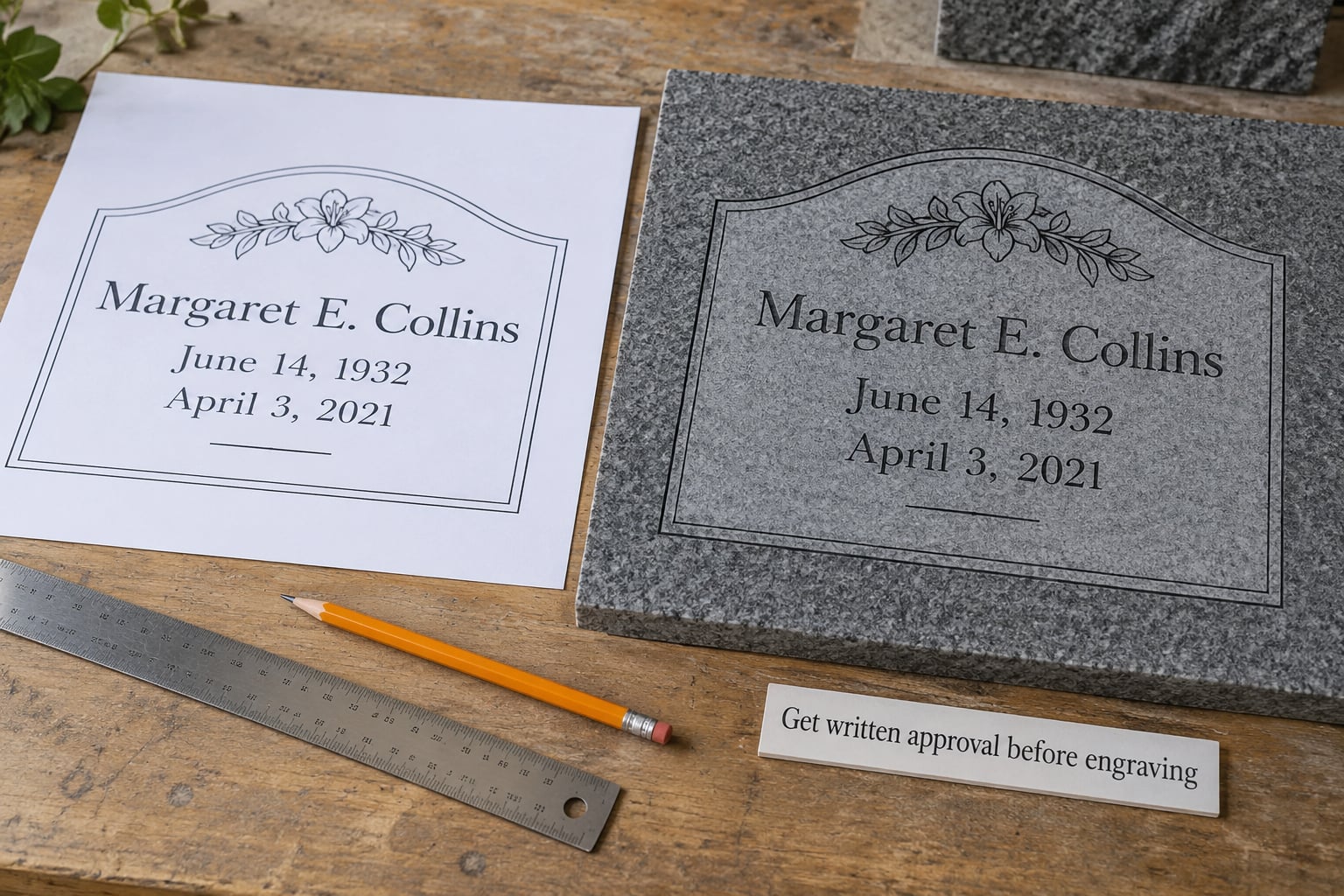
Check it slowly and in writing. Spelling of every name, including a middle name or a maiden name. Capitalization, since engravers follow it exactly. Punctuation, and whether a comma or an ellipsis changes the pause. Life dates, in the format the family wants. Line order, top to bottom. The scripture reference, chapter and verse, if you are using one. The author credit beneath the line.
Then get explicit written approval from the authorized decision-maker. Reply to the proof itself with your name and the date and an unambiguous statement that the wording is final. A text message saying looks good is not the same thing, and neither is a phone call the provider has no record of.
8. Request a final installed-headstone check
When the stone is set, ask to see the installed inscription in person, ideally in daylight and again later in low light. Compare it line by line against the approved proof you signed.
If anything is wrong, report it immediately to the monument company and the cemetery. Some mistakes can be addressed before secondary finishing work or neighboring stones make the correction far harder, and a documented error on the signed proof gives you the standing to make the case. Do not wait a season and hope nobody notices.
Common Mistakes
Choosing a famous quotation because it sounds wise. Half of every crowd recognizes it and nobody in the crowd is thinking about the person. One original line beats a borrowed classic every time.
Letting too many people extend the decision. Every relative added is another opinion to reconcile and another month of delay. One decider, a written deadline, and a short window for input solves most of it.
Using obscure wording. If you have to explain the line to a person who loves them, they will not get it. Plain words carry further than clever ones.
Exceeding the character limit. Drafting first and measuring last guarantees a rewrite. Measure first, then write to the space you actually have.
Relying on punctuation or line breaks to carry meaning. A line that depends on a comma for its whole meaning will not survive the layout your provider chooses. If the meaning needs a comma to work, rewrite the line.
Approving in a casual message. Approve on the proof itself, in writing, with a date. It protects the family and the provider.
Frequently Asked Questions
How long should an epitaph be for a headstone?
Most epitaphs run two to eight words. Flat and bevel markers usually hold one short line, upright monuments can carry three or four. Longer is not better here: fewer words in larger lettering stay readable after decades of weathering. Let the stone’s usable area and your provider’s character limit set the ceiling before you draft.
Should the epitaph be written by a family member or selected from a quotation?
A written wish from the deceased always comes first, including something said out loud years earlier. Otherwise, an original line written by the family usually serves better than a quotation, because it carries specific detail no stranger needs decoded. Use a quotation when it genuinely fits the person and check its copyright status first.
Is it appropriate to use humor in a headstone epitaph?
It can be, if the person told that joke or if the humor is gentle and unmistakable to everyone who visits. Humor lands badly when it references alcohol, driving, or an illness, and it reads wrong to visitors who never knew them. Check the cemetery’s wording rules too. When in doubt, choose warmth over a laugh.
How do I know whether a quote will fit on the stone?
Ask your monument provider for the usable inscription area in inches, the maximum character count, and the letter height at the smallest size they will use. Count the characters including spaces, then check how the line breaks. Seeing a scaled layout before approval is the only reliable test, since fit depends on the granite face and the font, not on guesswork.
Who gives final approval before an epitaph is engraved?
Final approval comes from whoever has legal authority over the monument, which is often a spouse, a named executor, or the person who signed the monument contract. Family should agree beforehand, because that authority rarely transfers later. That person approves the written design proof directly, in writing, with the date recorded, before any stone is cut.
Conclusion: Start With the Meaning
Write down the three or four qualities you want the inscription to communicate, then draft a line around each one and see which survives being read aloud. Take that finalist to your provider, fit it to the actual stone layout, and only then ask anyone to choose.
If you are planning ahead rather than arranging a stone after a death, do this while it is still calm. Write your wishes down, tell one person where the note is, and hand your family a decision that is already half made.