The best quotes about kindergarten for a first day sign run about three to seven words, read as a statement rather than a question, and leave room for your child’s name underneath. Pick a line that matches your kid on the morning itself, print it on a sheet you already have at home, and hold it up in the first-day photo. The sign becomes the marker your family looks at every year after.
Most parents overthink this one. They hunt through printable shops, compare fonts, and end up with a design that says something generic about a school year. What actually matters is the wording and the name, not the paper.
Below are ten lines that print cleanly at home, each with the length, the tone, and the situation where it works best. The table gives you the short version so you can narrow it down before you read further.
Table of Contents
- 1Quotes About Kindergarten for a First Day Sign at a Glance
- 21. Today Is My First Day of Kindergarten
- 32. Big Adventure Begins Today
- 43. Watch Me Grow
- 54. Hello, Kindergarten!
- 65. Ready to Learn, Laugh, and Explore
- 76. New Friends, New Books, New Beginnings
- 87. Small Hands, Big Dreams
- 98. I Am a Kindergarten Star
- 109. Learning Is an Adventure
- 1110. Off to a New School Year
- 12How to Choose the Right Kindergarten First-Day Sign
- 13Pick a quote that fits the sign you actually have
- 14Match the wording to your child’s temperament
- 15Decide who the sign is for
- 16Use the length-to-size guide below
- 17Frequently Asked Questions
- 18What is a good kindergarten quote for a first-day sign?
- 19How do I fit a kindergarten quote on a small sign?
- 20Should a first-day sign include the child’s name?
- 21Can teachers use these kindergarten quotes in the classroom?
- 22Conclusion
Quotes About Kindergarten for a First Day Sign at a Glance
| Quote | Words | Tone | Best used on |
|---|---|---|---|
| Today Is My First Day of Kindergarten | 8 | Milestone | First-day photo held by the child |
| Big Adventure Begins Today | 4 | Playful | Balloon, poster, classroom door |
| Watch Me Grow | 3 | Warm | Photo backdrop, memory book page |
| Hello, Kindergarten! | 2 | Cheerful | Small card, lunchbox note, shirt |
| Ready to Learn, Laugh, and Explore | 6 | Positive | Classroom wall, teacher-made sign |
| New Friends, New Books, New Beginnings | 5 | Warm and social | Door display, family photo prop |
| Small Hands, Big Dreams | 4 | Encouraging | Hand-held sign in the drop-off photo |
| I Am a Kindergarten Star | 5 | Celebratory | School-photo prop, memory book |
| Learning Is an Adventure | 4 | Light and upbeat | Bulletin board, teacher handout |
| Off to a New School Year | 6 | Versatile | New school, new campus, transfer year |
Every line here was written for this article. None of them are attributed to a famous author, because inventing an attribution is the fastest way to make a parent question the rest of the page. If you want a named-author version, check the source before you print it.
1. Today Is My First Day of Kindergarten
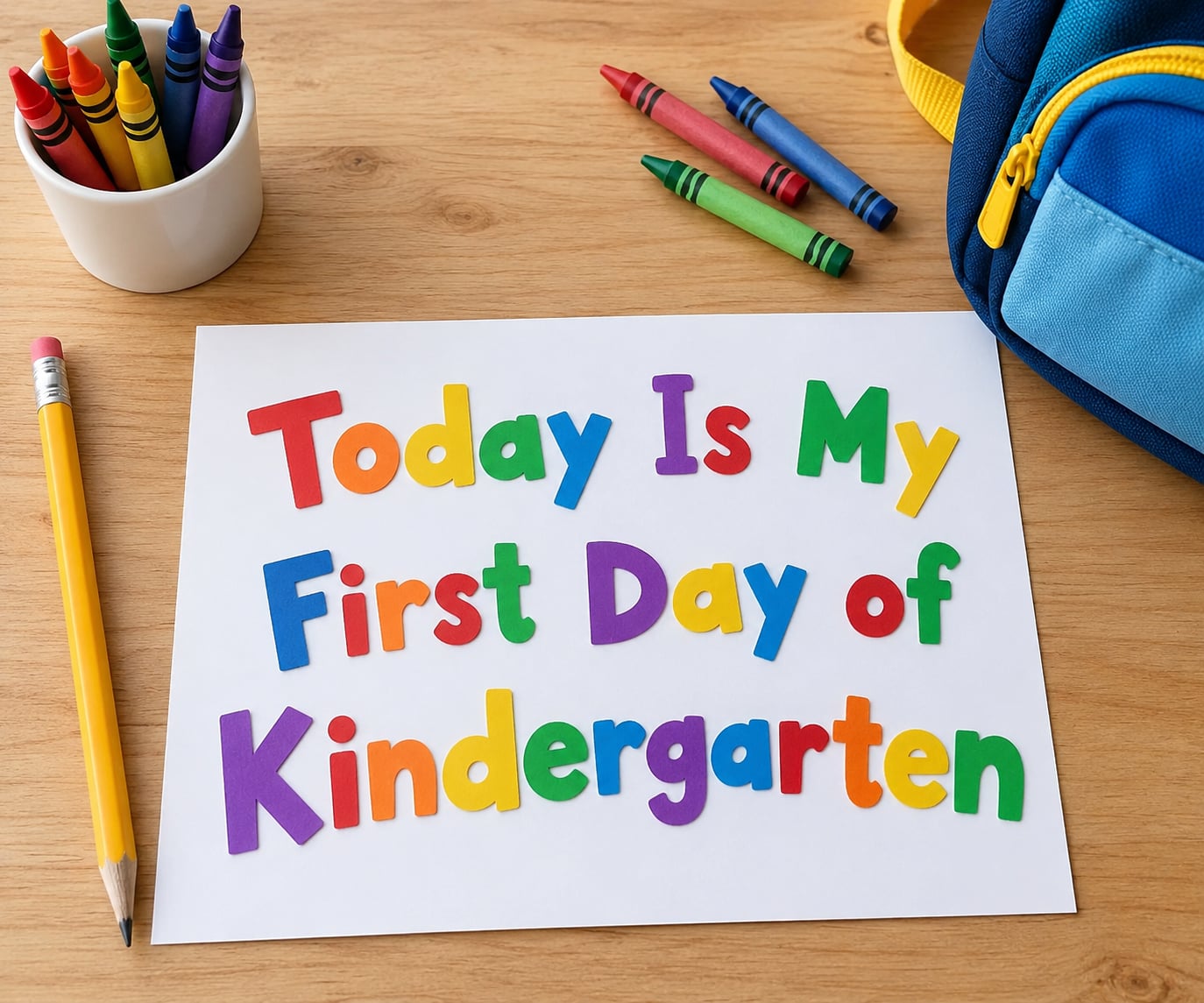
This is the most literal option on the list, and that is exactly why it works. It documents the moment without explaining it, which leaves the photograph to do the emotional work.
Print the quote in the largest type you have room for, then set the child’s first name in a second line at about half the size. A version I like puts the date underneath in small type, because you will forget the exact week otherwise.
It also ages well. A joke about the first day will feel dated in two years; a fact about it will not.
2. Big Adventure Begins Today
Four words, and not one of them about schoolwork. That is deliberate. Some children find that kind of pressure first-day-of-school wording makes them anxious rather than excited.
Use it when your child is the type who runs toward things. It also prints large enough to fill an 8×10 sheet, which matters if you have no template and are working from a blank page.
For an extra line, add a small hand-drawn arrow or a paper airplane in the corner. Do not add more text.
3. Watch Me Grow
The shortest option here at three words, and the one that ages the best of the bunch. It describes the whole year ahead rather than the first morning.
Pair it with a growth chart or a first height mark if you want the photo to document something physical as well as something sentimental. That combination works well in a family album because it gives you a number to compare against later.
It also works as a caption under a photo of your child at the school door, where a longer quote would crowd the frame.
4. Hello, Kindergarten!
Two words, and roughly half of kindergarteners can sound it out or recognize it from the cover of a book. That makes it the safest pick for a child who is still building reading confidence.
Teachers see this one on hand-made signs constantly, and parents report it survives the whole first term better than anything wordier. It also scales down to a lunchbox-size note without losing meaning.
Add the child’s name in a different color and you have a complete sign in about two minutes.
5. Ready to Learn, Laugh, and Explore
This is the most flexible line on the list because it has no first-day framing in it at all. You can hang it on a classroom door in September and it will still be accurate in February.
Teachers tend to pick this one for a wall display rather than a hand-held prop. Parents use it for the front door on the morning of the first day, where it reads as a welcome to anyone walking in.
If you are printing it large, set it on two lines so the phrase breathes. One long line of type on a wide sheet looks thin and hard to read from across a room.
6. New Friends, New Books, New Beginnings
Kindergarten is a social change as much as an academic one, and this line names that without making it sound heavy. The three-part rhythm is easy for a child to chant on the walk to the door.
It works well as the text on a sign propped beside the child in the photo rather than held in their hands, since it is a little too long to grip comfortably.
Parents of kids who are nervous about meeting new people tend to pick this one, because it puts friendships first and puts nothing on the child to perform.
7. Small Hands, Big Dreams
A warm line that puts imagination ahead of achievement. It reads as encouragement rather than expectation, which is usually what a parent wants on a sign their child will see again later.
The phrase is short enough for a 5×7 card, so you can print several and use one in the photo and one in a memory book. It is also a good fit if the sign is for a child who is clearly not the loudest person in the room.
Set the words in a rounded font if you have one. Nothing else on the sign needs to change.
8. I Am a Kindergarten Star
First person works better than almost every other voice on a first-day sign, because the child is holding the thing. You are handing them a sentence to say about themselves.
Use it when your child is excited rather than worried. For a nervous kid, swap the wording for a third-person line like the child’s name followed by a short phrase, so the sign describes them instead of asking them to claim anything.
This is also the version that gets photographed most, since it reads clearly at thumbnail size on a phone.
9. Learning Is an Adventure
A light, upbeat line that works equally well on a bulletin board, a teacher handout, and a family photo prop. It is the most quotable of the ten, so it tends to get reposted with the photo.
If you are posting the picture, put this quote in the caption and use something more personal on the sign itself. That way the two pieces of text do not repeat each other.
It also holds up if your child has a hard first week, because nothing about it promises a specific result.
10. Off to a New School Year
The most versatile wording in the list, because it does not assume anything about the building. That matters if your child is starting at a new campus, moving districts, or switching between a classroom and a multi-age room.
Parents in transfer situations tend to avoid words like first, since the day is not really a first. Off to a new school year sidesteps that and still marks the day clearly.
It is long enough to fill an 8×10 without a second line of text, which makes it a good default when you have a large sheet and not much to say.
How to Choose the Right Kindergarten First-Day Sign
Once you have narrowed the wording down, the sign itself is a simple layout problem. Four things decide it: how much room you have, how your child reads, what mood you want in the photo, and who is holding the sign.
Pick a quote that fits the sign you actually have
Measure before you commit. Most signs at home are 4×6, 5×7, or 8×10, and a standard sheet of paper is 8.5 by 11. The difference between a 5×7 card and a letter sheet is the difference between a three-word line and a full sentence at a readable size.
If the sign is small, cut the quote down before you cut the font. A 24-point line is legible in a photograph; a 14-point line looks like a caption.
Match the wording to your child’s temperament
A nervous child does better with a descriptive line than a commanding one. Something like Small Hands, Big Dreams puts the sentence in front of them rather than asking them to perform it.
An energetic child responds to Big Adventure Begins Today, and a shy child often likes Hello, Kindergarten because it is short, familiar, and easy to point at rather than read aloud.
Forum threads about first-day nerves, particularly the ones in parent-teacher groups, keep landing on the same observation: teachers feel the jitters too. That makes the celebratory lines a safer bet than the ones that sound like a pep talk.
Decide who the sign is for
A sign held by the child should be first person or plain. A sign on the classroom door can be welcoming and general. A card handed to the teacher should thank them, not celebrate the child.
Once you fix the audience, put the child’s name last. It is the detail parents consistently say makes a sign feel personal, and it is also the one that gets cropped out of a badly framed photo.
Use the length-to-size guide below
| Quote length | 4×6 card | 5×7 card | 8×10 print | Letter sheet |
|---|---|---|---|---|
| 3 to 4 words | Good | Good | Good | Good |
| 5 to 6 words | Tight | Good | Good | Good |
| 7 to 8 words | Too long | Tight | Good | Good |
| Full sentence | Split into two lines | Split into two lines | One or two lines | One or two lines |
Add the name, grade, date, and teacher in a second block at roughly half the quote size. That is the whole layout. Resist adding a border, a subtitle, and a quote mark all at once, because each extra element competes with the words in the photograph.
Frequently Asked Questions
What is a good kindergarten quote for a first-day sign?
A good kindergarten quote for a first-day sign is three to seven words long, states a feeling rather than a promise, and leaves space for your child’s name underneath. Short milestone lines such as Today Is My First Day of Kindergarten or Big Adventure Begins Today work best because they stay legible in a photograph and keep working for other uses later in the year.
How do I fit a kindergarten quote on a small sign?
Measure the sign first, then cut the wording rather than the type size. On a 4×6 card, stay at three or four words and set the quote in type large enough to read in a photo. If the line still will not fit, split it across two lines instead of shrinking the font further.
Should a first-day sign include the child’s name?
Yes, and the name should sit in a second block at about half the size of the quote. Parents consistently point to the name as the detail that makes a sign feel personal, and it keeps the wording generic enough that the sign can be reused for a sibling or a cousin in a later year.
Can teachers use these kindergarten quotes in the classroom?
They can. Lines such as Ready to Learn, Laugh, and Explore or Learning Is an Adventure carry no first-day framing, so they stay accurate through the whole year and work on a door display, a bulletin board, or a name card. Teachers who want a welcoming message rather than a celebratory one usually prefer that tone.
Conclusion
Pick the line your child would happily hold in a photograph, check that the words fit the sheet you have, and stop there. The simplest layout that carries the name and the date is the one you will still like looking at in 2026 and every year after.