If you are searching for how to open a speech with a quote that lands, it comes down to four things being true at once: the line is relevant to what you are about to argue, the person who said it has earned the room’s attention, you hand the audience a reason to care, and the whole thing takes about twenty seconds.
Miss one of those and the quote turns into decoration. Most speakers get the first twenty seconds wrong not because they picked a bad quote, but because they never wrote the two sentences that follow it. The fix is a repeatable order of operations, and it is short enough to rehearse on a car ride.
Table of Contents
- What You Need
- Step-by-Step: How to Open a Speech With a Quote That Lands
- 1. Define the Job Your Opening Must Do
- 2. Choose a Quote That Fits the Message
- 3. Find a Personal or Immediate Connection
- 4. Bridge from the Quote to Your Point
- 5. How to Open a Speech With a Quote That Lands in 20 Seconds
- 6. Attribute the Words and Handle Uncertain Sources
- 7. Deliver the Opening So It Sounds Natural
- Common Mistakes
- Frequently Asked Questions
- Conclusion
What You Need
Before you draft anything, get these seven things settled. They take about fifteen minutes and they decide whether the quote works.
- The quote itself — the exact wording, no more than 25 spoken words.
- The speech’s job — what the audience should feel in ninety seconds: challenged, inspired, curious, reassured, or ready to act.
- What the audience already knows about the person you are quoting, and about your topic.
- A personal connection — one small story, observation or example that links the quote to your own life.
- The emotion you want to leave in the room at the moment you finish the quote.
- Delivery notes — where you pause, where your voice drops, where you look.
- Optional visual support — the quote and attribution on one clean slide, visible from the back row.
If the personal connection is missing, that is the gap to close first. Every other item is bookkeeping.
Step-by-Step: How to Open a Speech With a Quote That Lands
1. Define the Job Your Opening Must Do
Write one sentence: “By the end of my first minute, I want this audience to feel ____.” Fill the blank with a single emotion. Challenged, encouraged, curious, reassured, activated.
That sentence is the filter for everything after it. A quote that leaves a fundraising audience feeling inspired is the wrong quote, even if it is famous. Toastmasters evaluators talk about this constantly in terms of your speech’s purpose, and speakers who write the purpose line first tend to get a far cleaner opening than speakers who shop for a good line first.
2. Choose a Quote That Fits the Message
Run four quick questions on any candidate line. Does its idea state my thesis, or fight it? Does the speaker earn credibility in this room? Is it under 25 words? Will this specific audience care?
That third question — does the speaker earn credibility here — is where most openings go wrong. In Toastmasters forums the advice is consistent: name the person’s role, not just their name, and a relevant specialist beats a celebrity with no connection to your topic. A line from a trial lawyer lands harder with a company audience than a line from a film star, because the room can tell why the person had the standing to say it.
Length is the other filter. If a quote runs past about 25 words, you will rush the end of it, and rushed quotes are the ones rooms forget. Trim it instead of slowing down.
3. Find a Personal or Immediate Connection
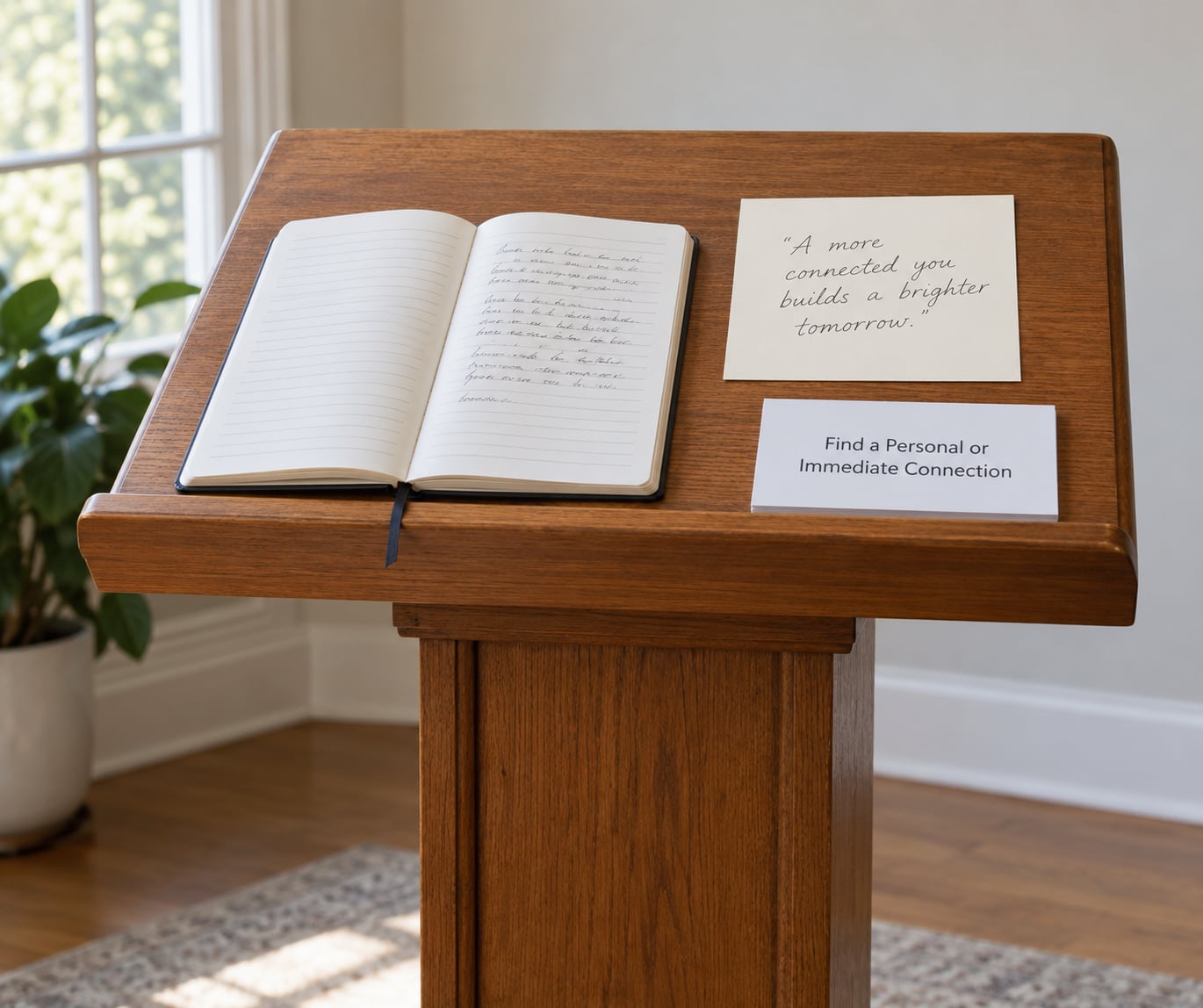
A quotation with no connection to you reads like a school assignment. The connection can be tiny: one sentence about the moment you first heard the line, or the specific situation in which you needed it.
Compare these two:
- Weak: “Winston Churchill once said, ‘Success is not final, failure is not fatal.’ Success is not final, and neither is failure.”
- Stronger: “I read a line from Churchill the week my first proposal was rejected. ‘Success is not final, failure is not fatal.’ I wrote it on the card and taped it to my monitor, and it is still there.”
The second version is two sentences longer and does three times the work, because the audience now knows the quote is about something real in your life rather than about speeches in general.
4. Bridge from the Quote to Your Point
The bridge is the one or two sentences that carry borrowed words into your own argument. Without it, you pivot, and the room feels the seam. Four formulas do most of the work:
- “That line has stayed with me because ____.” — the simplest and the safest.
- “Churchill was talking about war. Here is what it looks like at a 6 a.m. shift change.” — name what the quote is about, then relocate it.
- “He was wrong about ____, and that is exactly the point.” — disagreement gives the quote energy and lets you control the direction.
- “Here is the sentence I keep coming back to. ____” — hands the quote over as a tool rather than an ornament.
Do not summarize the quote after you say it. The audience just heard it, and a paraphrase tells them you were not confident in your own words.
5. How to Open a Speech With a Quote That Lands in 20 Seconds
Searching for how to open a speech with a quote that lands usually turns up pages of beautiful twenty-second opening lines. The lines are not the problem. Time is.
Set yourself a spoken ceiling. Fifteen to twenty seconds for the quote, attribution and bridge together is plenty, and it is about 60 to 80 words. Anything longer and you are delivering a monologue before your speech starts.
Long lines get trimmed, not slowed down. Cut a middle section with an ellipsis:
Full: “We are what we repeatedly do. Excellence, then, is not an act, but a habit. So it is not until we have done so much that we can no longer do something wrong that we have really done something good.”
Spoken: “We are what we repeatedly do. Excellence, then, is not an act, but a habit.”
You can also patch a word into a sentence with square brackets when you change a word to make it grammatical, but do not silently rewrite a line. If you need more than two cuts, paraphrase instead and drop the quotation marks. A paraphrase in your own words with a nod to the original is far better than a mangled quote with a famous name on it.
6. Attribute the Words and Handle Uncertain Sources
The credit formula is: name, role, source, year if you know it. “Abraham Lincoln, in his first inaugural address in 1861, told a divided country that the Union was not half won or half lost.” Four pieces of information, about eight seconds spoken. Long-time Toastmasters speakers land on the same rule.
- Formal. “Simone Weil, the French philosopher, wrote in a 1942 letter, ‘Attention is the rarest and purest form of generosity.'” Use it in formal rooms, at lecterns, panels and funerals.
- Warm. “My grandmother used to say, ‘Feed a cold, starve a fever.’ She was not a medical professional. She was right about most things.” Use it at toasts, club meetings and family occasions.
- Punchy. “Robert Frost put it this way in a 1914 poem: ‘The best way out is always through.'” Use it in short slots, high-energy rooms and class projects.
- Bridging. “In the middle of the French Revolutionary wars, Thomas Paine wrote, ‘The world is my country.’ I want to talk about how seriously I take that.” Use it when you need to hand off to your argument fast.
Never open with “someone once said.” It is the single most common tell that nobody checked, and a room reads it as an apology.
When you cannot verify a line, you have three honest options. Drop it. Paraphrase it and name the source without quotation marks: “Churchill described failure as a temporary setback, not a final one,” said in your own words. Or keep the words and drop the certainty: “A line I have seen attributed to ____, which I cannot confirm, but it captures what I want to say.” That last option works more often than people expect, especially with younger audiences.
Verification takes about two minutes. Search the exact phrase in quotation marks; if nothing returns a book, interview, transcript or reputable archive, treat it as unverified. Go to the original work rather than a quote-collection page, because quote accounts recycle attributions that later turn out to be wrong. “Play it again, Sam” was never spoken in the film it is famous for, and “Elementary, my dear Watson” appears nowhere in Arthur Conan Doyle’s stories, yet both get offered as documented originals at least once a month. If a chatbot generated your quote list, verify every single line before it goes in your mouth.
7. Deliver the Opening So It Sounds Natural
Say the words as if you are telling someone at your kitchen table. The physical mechanics matter more than people expect.
- Pause before the quote. One beat after your attribution, so the room registers that a quotation is coming.
- Shift your voice. Drop the volume and slow down slightly. Speakers in r/PublicSpeaking describe a two to three second hold after a significant line as reading as emphasis, not as a mistake, as long as you do not rush to fill it.
- Never say “quote, unquote.” It is not how anyone speaks. The vocal shift and the pause do the same job.
- Look up before you start. Find one friendly face, hold it for your first line, then move.
- Map, do not memorize, except the opening. The consensus in r/PublicSpeaking is to rehearse out loud and record yourself rather than learning word for word, but to memorize the first 30 to 60 seconds so nerves cannot eat them.
Show the quote on a slide if the room is large enough to read it. Put the words and the attribution both on screen, in a plain font, and leave it up while you talk through the bridge. Then hide it before your first argument point so you are not reading.
One rehearsal drill worth doing: record the opening on your phone, listen once, and count the seconds from your first word to your first argument. Most speakers land somewhere between 45 and 90 seconds, which is twice what they planned.
Common Mistakes
Forced relevance. The quote is famous and your speech is not. Fix: if you cannot complete “the quote is about ____, and my speech is also about ____” in one breath, choose another line.
Overused quotes. If the audience can finish the line before you say the last word, you have lost the first impression you were trying to make. Fix: pick something two steps away from the obvious choice. Lincoln’s Gettysburg triad and Caesar’s three words are still great lines, but they are the first two everyone thinks of, so spend them only when the rest of your opening earns them.
Weak or missing attribution. A name with no role gives the audience no reason to care. Fix: name, role, source, year.
Over-explanation. You said the quote, then explained it, then restated it. Fix: delete the explanation and go straight to the bridge.
A seam instead of a bridge. “Anyway, so today I want to talk about…” throws away the momentum. Fix: use one of the four formulas above and connect on a real word, not on the word “so”.
Recited delivery. The quote sounds recited because you read it off a card. Fix: keep the quote on a card for accuracy, but say it to the room. If you are reciting, your eyes are on the card instead of on the one person who looked friendly at you a second earlier.
Tone mismatch. A line chosen for its cleverness at a funeral, or its shock value at a sales meeting, reads as bad judgment rather than good timing. Forum debate on this question is consistent: audiences judge quote choice morally as well as technically, and tone fit matters more than fame.
Last tip before you speak: read your opening aloud to someone else. If they can repeat the bridge sentence back to you, it works. If they cannot, rewrite the bridge, not the quote.
Frequently Asked Questions
How long should a quote be when opening a speech?
Aim for 25 spoken words or fewer, roughly 15 seconds. Longer lines tempt you into rushing, and rushed quotations are the ones an audience forgets. If the original runs longer, cut the middle with an ellipsis or the end with a full stop after the strongest phrase. If you need more than two cuts, paraphrase it in your own words instead.
Should I explain the quote after saying it?
No. The audience just heard it, and a paraphrase tells them you were not confident in your own phrasing. Move straight to your bridge sentence, where you say why that line matters to you or why it applies to your argument. Context belongs before the quote or in the bridge, not in a follow-up explanation.
Can I open a speech with a quote I wrote myself?
You can, and for a eulogy or a personal tribute it is often stronger than a famous line, because nobody else can say it the way you do. Make clear that it is yours by framing it as something you wrote or something you have always believed. Do not present your own words in quotation marks attached to your name as though they were a documented quotation.
What if no one recognizes the person I am quoting?
That is fine, as long as you supply the reason they should. Name the role rather than the fame: the surgeon who performed the operation, the teacher who ran the classroom, the engineer who designed the thing you are describing. Relevance persuades a room far more often than recognition does, and it is what evaluators and audiences respond to.
Is it okay to open a serious speech with a humorous quote?
Usually yes, if the room already knows you and the joke earns the topic rather than detouring from it. The safest order is a short humorous line followed immediately by a serious line, so you set the tone and then set the stakes. Skip humor entirely at funerals, memorials, disciplinary meetings, and anywhere your audience has not yet relaxed.
How should I handle a quotation I cannot verify?
Search the exact phrase in quotation marks first, and only use the line if you find it in a book, interview, transcript or reputable archive rather than a quote-collection page. If you cannot find the source, paraphrase the idea without quotation marks and name who it came from, or say plainly that you have seen it attributed to them. Dropping the quote is always better than getting it wrong in front of a room.
Conclusion
To open a speech with a quote that lands, do four things in order: write the one sentence describing the feeling you want the room to have, pick a short line whose speaker has standing in your subject, add a sentence that makes it personal, then hand it to your argument with a bridge. Attribute it properly, verify it before you stand up, and deliver it with a pause and a slight drop in volume rather than with the words “quote, unquote”.
Do one thing tonight: write your opening objective in a sentence, choose your quote, and draft the two-sentence bridge. Then say all three out loud and time yourself. If the quote is still landing after twenty seconds of honest rehearsal, it will land on stage.